We use cookies to enhance your browsing experience, serve personalized content, and analyze our traffic. By clicking "Accept All" you accept this and consent that we share this information with third parties and that your data may be processed in the USA. For more information, please read our .
You can adjust your preferences at any time. If you deny, we will use only the essential cookies and unfortunately, you will not receive any personalized content.

Spring break is here, and so is a mess at airport security. The partial government shutdown has created up to three-hour security wait times and a shortage of TSA workers at airports across the country, right at the start of the spring break travel period. If you're flying in the next few weeks, this affects you directly, and the situation is likely to get worse before it gets better.
The partial shutdown began on February 14 after lawmakers failed to reach a funding deal for the Department of Homeland Security. The rest of the federal government is still operating normally. This shutdown only affects agencies under DHS.
That distinction matters for travelers because the Transportation Security Administration (TSA) sits inside DHS. TSA agents and most other DHS employees are classified as essential workers. That means they are required to keep working even though they are not being paid right now. DHS is also facing a leadership transition: President Trump fired Secretary Kristi Noem and tapped Oklahoma Sen. Markwayne Mullin to replace her starting March 31, adding further uncertainty to the agency at an already difficult moment.
In practical terms, airport security is still operating. TSA officers are showing up, screening bags, checking IDs, and keeping lines moving. The difference is that they are doing all of it without a paycheck. Workers did receive a partial paycheck on February 28, but the first full missed paycheck is scheduled for March 14. As that date approaches, financial pressure on employees is growing, and the strain is starting to show at airports.
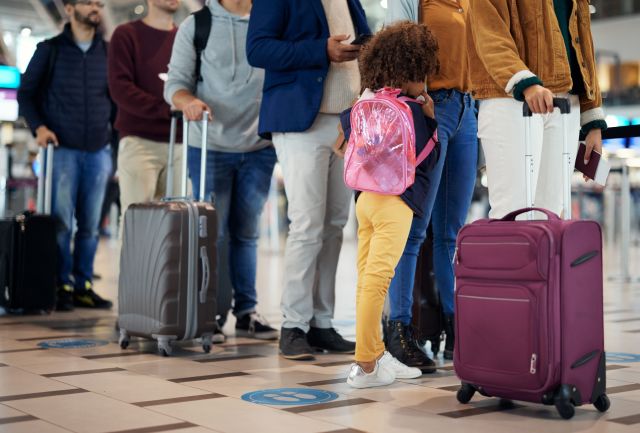
Airport security wait times soared across the country over the weekend, with travelers running into long backups at TSA checkpoints in Houston, Atlanta, New Orleans, and Charlotte, causing missed flights and significant delays.
Here's where things stood as of this weekend:
Houston Hobby Airport (HOU): Three-hour waits have now been reported on both Sunday and Monday morning, making this a sustained pattern rather than a one-day spike. The airport continues to urge passengers to arrive four to five hours ahead of their flight.
Hartsfield-Jackson Atlanta (ATL): Hour-long average backups reported at the world's busiest airport
Louis Armstrong New Orleans (MSY): Hour-long waits reported, with the airport asking travelers to arrive at least three hours early
Houston George Bush Intercontinental (IAH): 51-minute average checkpoint wait times reported
Charlotte Douglas International (CLT): 47-minute average wait times reported
Phoenix Sky Harbor (PHX): Lines remained manageable at around 10 minutes as of Monday morning
The situation also isn’t the same everywhere, which makes it harder for travelers to know what to expect. At a smaller airport, even a handful of TSA call-outs can quickly cause delays. Larger hubs usually have more staff and may be able to absorb the strain more easily.
Industry leaders say the real concern is how problems can spread through the system. If smaller airports start experiencing delays, those disruptions can ripple outward, eventually creating congestion at larger airports as well.
This is where things got genuinely confusing over the past few weeks, so here's the clearest summary possible.
For now, TSA PreCheck is still operating normally, and the program itself hasn’t changed. That said, staffing shortages could affect how smoothly things run at some airports. If problems worsen, DHS officials say certain services could be temporarily suspended at individual locations. In other words, you can still use your PreCheck lane — at least for the moment.
Global Entry is a different story. The program has been paused nationwide, which means U.S. citizens and permanent residents returning from international trips cannot use the automated kiosks for expedited immigration processing. Instead, everyone is being routed through the regular Customs and Border Protection lines. If you are coming back from an international trip, it is wise to allow significantly more time at customs than you normally would.
Other programs are still working. CLEAR and Mobile Passport Control remain fully operational at participating airports. If you have access to either one, this may be a good time to use it.
The timeline matters here. TSA workers are expected to miss their first full paycheck this week, and more employees are already calling out, which is starting to show up as longer lines at some airports. After weeks of partial or delayed pay, many workers are now facing a zero-dollar paycheck, and that is pushing some to stay home.
The travel industry is raising alarms. A coalition of travel groups has launched a “Pay Federal Aviation Workers” campaign urging lawmakers to end the shutdown. The concern is timing. TSA expects to screen about 2.8 million passengers a day in March and April, which would be an all-time high. During a previous shutdown in 2025, roughly 9,000 flights were delayed or canceled, costing the travel industry an estimated $6 billion. This one is unfolding during an even busier travel season.
There is also recent history to consider. During the 2018–2019 government shutdown, TSA call-outs rose significantly as the shutdown dragged on. Some airports had to close security checkpoints, and screening lines grew much longer. That shutdown ultimately ended after staffing shortages among air traffic controllers began disrupting flights on the East Coast. Situations like this often escalate before they resolve.
Airlines say it is impossible to predict where disruptions might appear next. Major hubs, smaller regional airports, and even overseas departure points could all feel the effects. For travelers, the best advice right now is simple: allow extra time and pack a little patience.
You can't fix the shutdown, but you can make smarter choices around it. Here's what actually helps:
Arrive earlier than you think you need to. Houston's Hobby Airport has been advising passengers to arrive four to five hours before their flight. For most airports, three hours is now the minimum for domestic travel during this period.
Check your airport's social media before you leave. Many airports are posting real-time TSA wait time updates on X. Search your airport by name and check their feed the morning of your flight.
Use TSA PreCheck if you have it. It's still operational and still faster than the standard lane, even with reduced staffing.
If you're returning internationally, skip Global Entry. Global Entry is paused nationwide, so plan for the standard customs line and give yourself extra time on the back end of your trip.
CLEAR and Mobile Passport are still running at participating airports and can save meaningful time where available.
Check your flight status the morning of travel. Congestion at security can back up into delayed departures, even if your airline is operating normally.
Contact your embassy or consulate if you're stuck abroad. If you're traveling internationally and facing significant disruption, your embassy can advise on options.
Spring break trips are still happening, and millions of Americans will get where they're going this month. But the airport experience right now requires patience, a buffer, and an honest look at your departure time. Leave earlier than feels necessary. You probably won't regret it.
Partially, yes. The Department of Homeland Security has been operating under a funding lapse since February 14, after Congress failed to reach a deal on DHS funding. The rest of the federal government remains funded. This is a DHS-specific shutdown affecting the TSA, Coast Guard, FEMA, and other agencies under that department.
Yes. TSA agents are deemed essential employees and are required to continue working during the shutdown, but without a paycheck. Lines are longer because some workers are taking unscheduled time off due to financial hardship, but the agency is still screening passengers.
TSA PreCheck is currently operational with no changes, though the TSA has said it will evaluate staffing at airports on a case-by-case basis and may adjust operations if constraints arise. Use it if you have it.
Yes. Global Entry is paused nationwide. U.S. citizens and permanent residents arriving from international trips must go through standard CBP lines instead of the expedited kiosks. Budget significantly more time for customs if you're returning from abroad.
Airports reporting extended wait times include Houston's Hobby Airport and George Bush Intercontinental, Louis Armstrong New Orleans International, Hartsfield-Jackson in Atlanta, and Charlotte Douglas International. Conditions change daily — check your airport's social media the morning of your flight.
Houston's Hobby Airport has advised passengers to arrive four to five hours before their flight. For most major airports, three hours is a safe minimum for domestic travel during this shutdown period. If your airport has been flagged for long lines, go earlier.
There's no resolution in sight as of March 9. The shutdown stems from a standoff between Republicans and Democrats over DHS funding and immigration enforcement policies. No vote is currently scheduled. Monitor news updates for the latest on any deal.
Because the FAA and air traffic control remain funded, flights aren't being canceled due to the shutdown alone. However, long security lines can cause passengers to miss flights, which creates downstream delays and disruptions for other travelers.