We use cookies to enhance your browsing experience, serve personalized content, and analyze our traffic. By clicking "Accept All" you accept this and consent that we share this information with third parties and that your data may be processed in the USA. For more information, please read our .
You can adjust your preferences at any time. If you deny, we will use only the essential cookies and unfortunately, you will not receive any personalized content.

If you've ever landed in the United States after a long international flight only to be greeted by a slow-moving customs line, you know how quickly that final stretch can drain the excitement from a trip. For families trying to make a connection or business travelers racing the clock, the wait can feel longer than the flight itself.
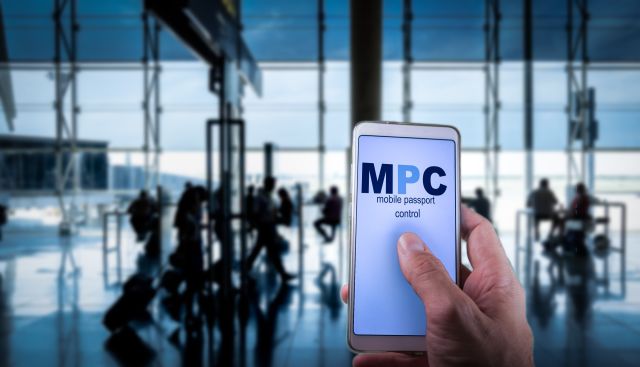
There is, however, a lesser-known option that can significantly reduce that time at many airports. It's called Mobile Passport Control, a free app from U.S. Customs and Border Protection that allows eligible travelers to submit their customs information digitally before speaking with an officer. It does not replace your passport or any required ESTA or visa. But in many airports, it can mean walking into a noticeably shorter line and clearing customs more efficiently.Here is how it works, who can use it, and when it makes sense.
Mobile Passport Control, often shortened to MPC, is a free smartphone app designed to streamline the customs declaration process for eligible travelers entering the United States.
Instead of filling out a paper form or answering standard declaration questions at a kiosk, you:
Download the MPC app from the Apple App Store or Google Play
Scan your passport and create a traveler profile
Submit your trip details and customs declaration electronically
Receive a digital receipt with a QR code
Enter the designated MPC lane at customs
You will still speak with a Customs and Border Protection officer and present your physical passport. The difference is that much of the administrative work is completed ahead of time, which allows officers to process travelers more efficiently.
At many airports, the MPC lane is shorter than the regular line. In some cases, it can move almost as quickly as Global Entry.
There’s also a timely reason Mobile Passport Control is worth knowing right now. During the current DHS government shutdown, TSA PreCheck is still operating, but Global Entry services are paused, which may mean longer customs lines for international arrivals. If you are coming home from abroad and want a faster option without enrollment, Mobile Passport Control is one of the simplest tools you can use.
Mobile Passport Control is available to:
U.S. citizens
U.S. lawful permanent residents
Returning Visa Waiver Program travelers with approved ESTA
Certain Canadian B1 or B2 visitors
You can create up to 12 traveler profiles on one device and submit a single group transaction. For families, this is one of the biggest advantages. Instead of approaching the booth individually, you stay together and speak to the officer as a group.
If you do not qualify for a Trusted Traveler Program or are still waiting for Global Entry approval, MPC offers a practical alternative.
Mobile Passport Control is currently offered at dozens of major U.S. international airports. The list of U.S. international airports includes:
Atlanta Hartsfield-Jackson International Airport (ATL)
Baltimore/Washington International Thurgood Marshall Airport (BWI)
Boston Logan International Airport (BOS)
Charlotte Douglas International Airport (CLT)
Chicago O’Hare International Airport (ORD)
Dallas/Fort Worth International Airport (DFW)
Denver International Airport (DEN)
Detroit Metropolitan Airport (DTW)
Dulles International Airport (IAD)
Fort Lauderdale-Hollywood International Airport (FLL)
Honolulu Daniel K. Inouye International Airport (HNL)
Houston George Bush Intercontinental Airport (IAH)
Houston William P. Hobby International Airport (HOU)
John F. Kennedy International Airport (JFK)
Kansas City International Airport (MCI)
Las Vegas Harry Reid International Airport (LAS)
Los Angeles International Airport (LAX)
Miami International Airport (MIA)
Minneapolis-Saint Paul International Airport (MSP)
Newark Liberty International Airport (EWR)
Oakland International Airport (OAK)
Orlando International Airport (MCO)
Philadelphia International Airport (PHL)
Phoenix Sky Harbor International Airport (PHX)
Pittsburgh International Airport (PIT)
Portland International Airport (PDX)
Sacramento International Airport (SMF)
Salt Lake City International Airport (SLC)
San Diego International Airport (SAN)
San Francisco International Airport (SFO)
San Jose International Airport (SJC)
San Juan Airport (SJU)
Seattle-Tacoma International Airport (SEA)
Tampa International Airport (TPA)
MPC is also available at all international preclearance locations, including Dublin Airport and Montréal–Trudeau International Airport, where travelers complete U.S. customs before boarding their flight. When you land in the United States from these airports, you arrive as a domestic passenger and skip customs entirely.
Availability can vary by airport and operational conditions, so it is wise to confirm before departure.

Both programs speed up entry into the United States, but they function differently.
Free
No application or background check
No fingerprinting
Requires speaking with a CBP officer
Requires submitting trip details each time
$120 for five years
Application, background check, and interview required
Often allows kiosk or facial recognition clearance
Includes TSA PreCheck
If you travel internationally four or more times a year, Global Entry may be worth the cost and effort. If you travel occasionally, or want a free solution without enrollment, MPC is often the easiest win.
Interestingly, some frequent travelers use both. In busy periods, the MPC lane can occasionally move faster than the Global Entry kiosks.
With Global Entry currently paused during the shutdown, MPC can be a helpful backup for eligible travelers who want a shorter customs line without paying or enrolling. In that context, its appeal becomes even clearer. It’s free, it takes minutes to set up, and it can reduce stress at one of the most unpredictable points in international travel.
To use it effectively:
Download and set up the app before your return trip
Submit your declaration within the allowed window before arrival
Make sure your phone is charged
Look for MPC signage in the customs hall
One important detail: if your flight diverts to an airport that does not support MPC, you will need to use the regular customs line.
It is not a guarantee of instant entry, but it often makes the process smoother and more predictable.
International travel always comes with a few unknowns, and airport reentry is often one of them. With Global Entry services currently paused during the DHS shutdown, having a reliable alternative matters more than usual.
Mobile Passport Control will not eliminate every wait, but it offers a free, practical way to move through customs more efficiently without interviews, fees, or long approval timelines. If you have an upcoming international return, setting it up before you travel is a small step that can make a meaningful difference when you land.
Yes. The app is completely free to download and use.
No. You must still present your physical passport to a CBP officer.
Yes. You can create profiles for up to 12 travelers and submit one group declaration.
In many airports it is comparable, but it still requires speaking with an officer. Global Entry can be faster for very frequent travelers.
No. There is no background check or interview required.
Yes. For air arrivals, submissions are typically active for four hours before landing. For land borders, up to eight hours.
You will need to use the standard customs line.
Yes. Information is submitted directly to U.S. Customs and Border Protection through secure encryption protocols.