We use cookies to enhance your browsing experience, serve personalized content, and analyze our traffic. By clicking "Accept All" you accept this and consent that we share this information with third parties and that your data may be processed in the USA. For more information, please read our .
You can adjust your preferences at any time. If you deny, we will use only the essential cookies and unfortunately, you will not receive any personalized content.

If you've spent the past few days binge-watching Young Sherlock on Amazon Prime Video, you're definitely not alone. Guy Ritchie's eight-episode series premiered on March 4, 2026 and quickly drew viewers into a younger, rougher version of the world's most famous detective. Hero Fiennes Tiffin stars as a rebellious 19-year-old Holmes who is still figuring out the brilliant mind that will one day make him legendary. Beyond the story, one thing viewers notice immediately is how good the series looks, moving from the darker corners of London to the famous spires of Oxford and on to sweeping sequences representing Paris and Constantinople. For travel lovers, the most rewarding discovery is that many of those places are real locations you can actually visit.
A large part of Young Sherlock takes place at the fictional Candlin College in Oxford, where the young Holmes ends up working as a dogsbody for the college porters after a stint in prison. The production design gives everything a rich Victorian atmosphere that feels both authentic and a little larger than life, and Oxford's genuine medieval architecture does most of the heavy lifting.
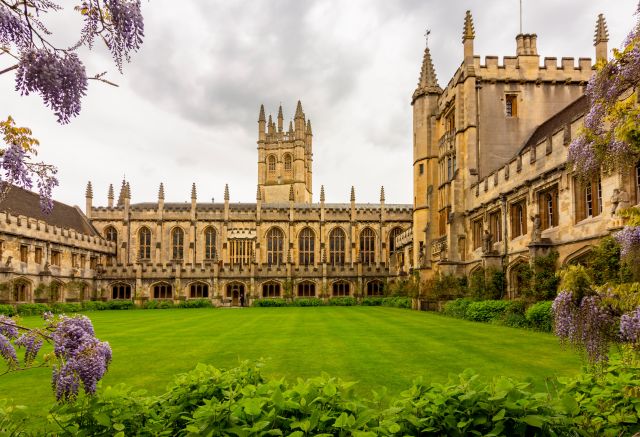
Most of those scenes were filmed at Magdalen College, one of the city's most prestigious and visually stunning institutions. Founded in 1458, Magdalen features late medieval stonework along the River Cherwell that gives the show its distinctive collegiate mood, and it earns every second of screen time it gets.
Several other Oxford landmarks appear throughout the series. The Divinity School, one of Oxford University's oldest surviving buildings and a Gothic gem that also served as the Hogwarts Infirmary in the Harry Potter films, turns up in the show alongside the Convocation House at the Bodleian Library, whose striking fan-vaulted stone ceiling was used for classroom scenes. Duke Humfrey's Library, the oldest reading room in the Bodleian, appears after the party scene, its oak beams, 17th-century bookcases, and intricate fan vaulting creating exactly the kind of atmosphere a Victorian mystery deserves.
If the show has put Oxford on your radar, budget at least a full day to explore properly. The Bodleian Library tours are especially worthwhile, and the city's maze of narrow streets and ancient colleges rewards slow, aimless wandering more than almost anywhere else in England.
Here's where things get interesting for anyone planning a trip. A surprising amount of Young Sherlock was filmed not in London, but in Bristol, a city that has become one of Britain's most reliable stand-ins for 19th-century London on screen, and for very good reason.
Queen Square in Bristol, a beautiful Georgian square whose elegant symmetrical terraces and tree-lined paths make it feel like stepping into another century, was used extensively throughout the production. It doubles convincingly as Baker Street, the future home of Sherlock Holmes, and several other London locations. Walking it today, you can immediately see why directors keep coming back. The wide lawns, symmetrical buildings, and period architecture make it easy to picture the gaslit streets of the Victorian world without any heavy set construction required.
Other Bristol locations used in the series include Small Street, dressed as the Collins and Sons tobacconist's shop, the Georgian House Museum which appears as the interior of Mycroft Holmes's Baker Street residence, the Sailors Refuge in Queen Square, Broad Street standing in for Holborn, and the historic Underfall Yard on Spike Island representing a workshop on Cheapside.
Bristol is genuinely underrated as a travel destination in its own right, and the harborside, Clifton Village, and the Georgian architecture of the city center all reward exploration well beyond their screen credentials.
Wales did a lot of quiet heavy lifting in Young Sherlock that most viewers won't realize while watching. HM Prison Shepton Mallet in Somerset stood in for Newgate Prison in the opening episode.
A large block of interior filming took place at Great Point Studios in St Mellons, Cardiff, a 200,000 square foot facility that served as the production's home base throughout filming. The Glamorgan Building in Cardiff's Cathays Park civic centre also appears in the series as the Foreign Office in London, while Shire Hall in Monmouth, a Grade I listed Baroque building constructed in 1724, was used for the court scenes.
Perhaps most significantly for fans wanting to visit, Llanvihangel Court near Llanvihangel Crucorney in Monmouthshire served as Appleton Manor, the ancestral Holmes family home. This Tudor manor house with medieval origins dating to at least 1471 is now a private home that opens for summer tours and events, and it's worth checking ahead if you'd like to visit.
The Rolls of Monmouth Golf Club on the historic Hendre estate also doubled as the Beechworth Sanatorium, and Monmouth's period-appropriate Victorian buildings and streetscapes were used throughout the production for various background and exterior scenes
Merthyr Mawr Estate in Bridgend County is one of the most visually rewarding stops on any Young Sherlock location tour. Often called Wales's own Cotswold village for its honey-colored stone cottages and thatched roofs, the estate also encompasses vast sand dunes, windswept landscapes, and historic woodland that gave the production a remarkably versatile natural backdrop.
The surrounding dunes at Merthyr Mawr Warren are among the highest in Europe, and roaming them today gives you a genuine sense of the dramatic natural scenery the show was working with. The estate's 19th-century manor house and woodland areas were also used for several scenes throughout the series.
Margam Park in Port Talbot is another standout location and well worth building into your itinerary. The 1,000-acre estate, home to a Gothic-style castle, a tranquil deer park, and the ruins of a 12th-century Cistercian abbey, served as the setting for Abdon Abbey in episode four, with the ancient monastery ruins providing exactly the kind of atmospheric backdrop a Victorian mystery deserves.
The original nave of the abbey survives today as St Mary's parish church, with 19th-century restorations, and the wider parkland rewards a leisurely afternoon of wandering. If you're already making the trip to Merthyr Mawr, Margam is close enough to fold into the same day without much effort.
Ewenny Priory is one of the less expected locations in the series and one of the most atmospheric. Its fortress-like Norman stone walls, soaring arches, and timeworn interiors played the backdrop for scenes tied to Sherlock's childhood, and visiting it today the choice makes complete sense. The priory blends Norman architecture with monastic serenity in a way that feels genuinely ancient, and it's a quietly special place that doesn't attract the same crowds as some of Wales's more well-known historic sites.
St Fagans National Museum of History in Cardiff brought a different kind of authenticity to the production. The open-air museum is home to dozens of historic buildings relocated from across Wales and rebuilt on its grounds, including the Oakdale Workmen's Institute, a model mining village community hub that was dismantled brick by brick in 1989 and rebuilt at St Fagans in 1995. Its immersive heritage streetscapes and period interiors gave the production a ready-made Victorian environment that would have cost significantly more to construct from scratch anywhere else.
Abergavenny, nestled beneath the sweeping ridges of Bannau Brycheiniog, also appears in the series, its historic market town streets and castle ruins contributing to the show's Victorian atmosphere. The town is a pleasant base for exploring the surrounding national park, and combining an Abergavenny visit with a stop at Llanvihangel Court nearby makes for a genuinely rewarding day in this corner of Monmouthshire.
And speaking of Bannau Brycheiniog, the mountainous national park formerly known as the Brecon Beacons was itself used for one of the show's more surprising production decisions. Rather than attempting to build a full Chinese village set, the production constructed a yurt village against the sweeping mountain landscape for the show's flashback sequences, and the sheer scale of the scenery did the rest.
One of the most interesting production choices in Young Sherlock is how extensively Andalusia was used for the show's more exotic and action-heavy sequences. Rather than filming in France or Turkey, the production found that southern Spain could convincingly stand in for both, and the results on screen are genuinely striking.
The sequences set in Paris were filmed between Argüelles and Spain Square in Cádiz, with the Hotel Thérèse actually being the Recreo de las Cadenas in Jerez de la Frontera. The scenes set in Constantinople were filmed at two of Seville's most spectacular historic sites: the Alcázar of Seville, the royal palace originally built as a Muslim fortress in the 10th and 11th centuries, and Casa de Pilatos, a stunning 16th-century palace blending Gothic-Mudéjar, Renaissance, and Romantic styles that also served as a filming location for Lawrence of Arabia back in 1962.
The climactic mining sequence, set in Turkey, was filmed at the Rio Tinto mines about an hour from Seville. This extraordinary landscape has been mined for more than 5,000 years and looks genuinely otherworldly on screen, with rust-red rivers, ancient excavations, and a stark almost science-fiction quality to the terrain that makes it memorable even without a film crew. The area is open to visitors and includes a mining museum and a historic train. If you've been meaning to visit Andalusia, this is a very good reason to finally go.
Whether you're watching Young Sherlock or revisiting the broader world of Holmes adaptations, London rewards dedicated fans in ways that few other cities can match. The Sherlock Holmes Museum at 221B Baker Street is the most obvious starting point, a four-story Georgian townhouse dating from 1815, decorated as it would have been during Holmes's fictional time there.
A short walk away, the exterior used for 221B in the BBC's Sherlock series is at 187 North Gower Street in Bloomsbury, above Speedy's Sandwich Bar, which is worth stopping at for a coffee just for the atmosphere.
St. Bartholomew's Hospital in West Smithfield, one of England's oldest hospitals, is memorialized in BBC Sherlock as the place where Holmes and Watson first meet. The building's architecture is worth seeing in its own right, and it remains an active hospital with public areas open to visitors. Taken together, Baker Street, Bloomsbury, and St. Bart's make for a satisfying half-day walk through the city that Holmes made his own.
Young Sherlock has arrived at exactly the right moment, a smart, stylish, propulsive show that gives you somewhere real to go when you finally close your laptop. Oxford is especially beautiful in spring, Andalusia rewards visitors year-round, and Bristol is one of Britain's most underrated cities regardless of what brought you there. The locations are genuine, the history is extraordinary, and the adventure of visiting them is entirely your own. Holmes would probably deduce you've already started looking up flights, and honestly, he wouldn't be wrong.
The series was filmed across multiple locations including Oxford and Bristol in England, numerous sites across South Wales, and Jerez, Cádiz, and Seville in Andalusia, Spain.
Queen Square is in Bristol, not Oxford. It was used extensively in Young Sherlock as a stand-in for Baker Street and other Victorian London locations. Bristol frequently doubles for 19th-century London on screen due to its well-preserved Georgian architecture.
Magdalen College was the primary Oxford filming location, used for the exterior of Candlin College, the Dining Hall, the New Building exterior, Magdalen College Chapel, and St Swithun's Quad. The Bodleian Library's Convocation House and Duke Humfrey's Library also appear in the series.
Margam Park in Port Talbot served as the setting for Abdon Abbey in episode four, with the ruins of the park's 12th-century Cistercian monastery providing the atmospheric backdrop for those scenes.
Yes. The Rio Tinto mining area near Seville is open to visitors and includes a mining museum, a historic train, and some of the most striking industrial landscapes in southern Europe.
The Sherlock Holmes Museum is located at 221B Baker Street in London and is open to the public. The exterior used in the BBC's Sherlock series is at 187 North Gower Street in Bloomsbury, above Speedy's Sandwich Bar.
Hero Fiennes Tiffin plays the 19-year-old Sherlock Holmes. The series also stars Dónal Finn as Moriarty, Joseph Fiennes as Sherlock's father, Colin Firth as Sir Bucephalus Hodge, and Max Irons as Mycroft Holmes.
All eight episodes are available now on Prime Video.
No second season has been officially confirmed yet, though early reviews and viewer response have been strong.