We use cookies to enhance your browsing experience, serve personalized content, and analyze our traffic. By clicking "Accept All" you accept this and consent that we share this information with third parties and that your data may be processed in the USA. For more information, please read our .
You can adjust your preferences at any time. If you deny, we will use only the essential cookies and unfortunately, you will not receive any personalized content.

Some of the best travel experiences in the world involve watching, or joining, a competition where the activity itself makes no logical sense but everyone is dead serious about winning. These five events share the same spirit: steeped in their own lore, drawing international competitors, carrying real stakes, and with an entry bar low enough that you could theoretically show up and take a crack at it yourself. No professional training required. Protective clothing, however, is sometimes strongly recommended.
The Calaveras County Fair and Jumping Frog Jubilee in Angels Camp, California traces its competitive roots to Gold Rush-era boredom. Miners bet on frog-jumping contests. Mark Twain, then still going by Samuel Clemens, overheard a bartender telling a version of one such story in the 1860s, rewrote it, and published it in 1867 as The Celebrated Jumping Frog of Calaveras County, the story that launched his literary career. In 1928, the town held its first official frog-jumping contest to celebrate the paving of a local road, and the competition has run every year since.
Today, the event draws 30,000 to 50,000 visitors over four days, always the third weekend in May, and professionals travel from across the world to compete. The rules are precise: your frog gets three jumps, the distance is measured in a straight line from the starting lily pad to the final landing spot, and you cannot touch the frog once it's placed. The current world record, 21 feet 5¾ inches set by a frog named Rosie the Ribiter in 1986, has never been beaten. Doing so comes with a $5,000 cash prize and a brass plaque on the Frog Hop of Fame in downtown Angels Camp. The 2026 fair runs May 14–17.
The Wife Carrying World Championship in Sonkajärvi, Finland began, according to legend, with a 19th-century bandit named Herkko “Robber” Ronkainen, who tested recruits for his gang by having them carry heavy sacks of grain across difficult terrain. The competition has run officially since 1992 and now draws more than 200 participants from 18 countries.
The rules are extremely specific: the official track is 253.5 meters and includes two dry obstacles and a water pit roughly a meter deep. The female competitor must weigh at least 49 kg (around 108 lbs), with lighter participants carrying a weighted backpack to make up the difference. Carrying techniques range from a piggyback to a fireman’s carry to the famous “Estonian style,” where the woman hangs upside down with her legs wrapped around the man’s shoulders. The prize? The wife’s weight in beer. In 2025, organizers introduced a separate women’s category for the first time. The 2026 championship takes place July 3–4.
The World Bog Snorkeling Championships in Llanwrtyd Wells, Wales has been running since the 1970s, when it started as a fundraising stunt. The premise is simple and deeply unpleasant: competitors wear a snorkel, mask, and flippers and must complete two lengths of a 60-yard trench cut through a peat bog. Conventional swimming strokes are banned, so participants rely entirely on flipper power while pushing through cold, dark, near-zero-visibility bog water.
The world record currently stands at 1 minute 12.34 seconds, set by Neil Rutter in 2023. Fancy dress is not just permitted but enthusiastically encouraged, with past competitors showing up as lobsters, mermaids, and at least one very committed Ken and Barbie duo. In 2023 alone, the field included participants from Sweden, Serbia, Denmark, Belgium, the Netherlands, Australia, Norway, South Africa, Germany, Italy, and the USA. The 2026 edition is scheduled for August 30.
The Henley-on-Todd Regatta in Alice Springs has been running since 1962 and holds the distinction of being the only boat race in the world held on a dry riverbed. The Todd River, which runs through town, is typically dry, so participants carry bottomless boat frames around their waists and run the course on foot, Flintstones-style.
There are also giant hamster wheel races, sand ski events, sandcastle building competitions, and a “budgy smuggler” race, with the whole spectacle kicking off via a parade of boats down Todd Mall and into the riverbed. One footnote worth knowing: in 1993, heavy rains actually filled the Todd River on race day, forcing the only cancellation in the event’s history, because a dry riverbed boat race cannot function with an actual river in it. The 2026 regatta is set for August 15.
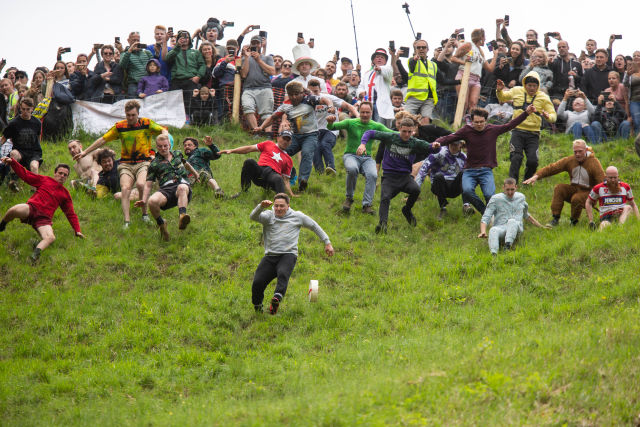
The Cooper’s Hill Cheese-Rolling and Wake in Brockworth, Gloucestershire has been running for at least 200 years and possibly more than 600. The setup is almost offensively simple: a 7–9 pound wheel of Double Gloucester cheese is rolled down a 200-yard hill with a gradient of roughly 1:2, and competitors launch themselves after it. The cheese can hit speeds of up to 80 mph. Nobody catches it. The first person over the finish line at the bottom wins the cheese.
That’s the entire sport.
There’s no official organizing body, no prize money, and no registration process. You simply show up at the top of Cooper’s Hill on the Spring Bank Holiday and decide whether this is the year you’re willing to tumble down a near-vertical hillside in front of thousands of spectators.
Despite the obvious injury risk, the event attracts competitors from around the world every year. Twisted ankles, broken collarbones, and concussions are common enough to be considered part of the experience. In 2025, German YouTuber Tom Kopke defended his title in the men’s race for the second year running, while American Ava Sender Logan won the women’s race on her debut. The 2026 edition is scheduled for Monday, May 25.
What these events share isn’t just absurdity. It’s genuine community and a very real competitive spirit that somehow makes all of this feel completely normal once you arrive. The cheese rolling brings thousands to a Gloucestershire hillside that otherwise wouldn’t appear on most tourist itineraries. The frog jubilee transforms a small Gold Rush town into a massive weekend celebration. The wife carrying championship has produced dynasties of champions and a qualifying culture serious enough to include Finland’s Strongest Man as a competitor.
None of these competitions require elite athleticism, official rankings, or even particularly good judgment. Most simply require showing up and being willing to look a little ridiculous. Which, honestly, is probably part of the appeal.
Monday, May 25, 2026. Races traditionally start around noon.
No. Anyone over 18 can show up at the top of Cooper’s Hill and enter. Protective clothing is strongly recommended.
May 14–17, 2026, at the Calaveras County Fairgrounds in Angels Camp, California.
Yes. You can rent a frog at the event. Professional frog teams travel from around the world, but first-timers are completely welcome.
21 feet 5¾ inches, set in 1986 by Lee Guidici with a frog named Rosie the Ribiter. It has never been beaten. Breaking it earns a $5,000 prize.
July 3–4, 2026, in Sonkajärvi, Finland.
No. The female competitor does not need to be legally married to her partner but must be at least 17 years old and weigh a minimum of 49 kg (around 108 lbs).
August 30, 2026, in Llanwrtyd Wells, Wales.
August 15, 2026, in Alice Springs, Australia.
It gets cancelled. In 1993, the Todd River actually filled with water on race day, forcing the only cancellation in the event’s history. A dry riverbed boat race only works if the riverbed stays dry.