We use cookies to enhance your browsing experience, serve personalized content, and analyze our traffic. By clicking "Accept All" you accept this and consent that we share this information with third parties and that your data may be processed in the USA. For more information, please read our .
You can adjust your preferences at any time. If you deny, we will use only the essential cookies and unfortunately, you will not receive any personalized content.

If you watched Thrash on Netflix and quietly thought that Annieville didn't look much like South Carolina, you're in good company. I was born and raised in the Palmetto State and still take my kids to Pawleys Island every summer. The real Annieville is an actual neighborhood in Georgetown County, about 25 minutes down the road from where I've been planting my beach chair my entire life. The version you see on screen isn’t even close to South Carolina, because Thrash was actually filmed in Australia.
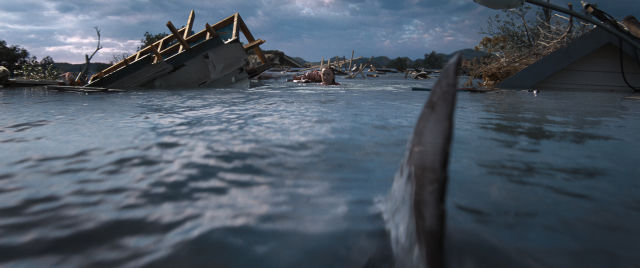
Written and directed by Norwegian filmmaker Tommy Wirkola (Violent Night, Dead Snow), Thrash is a gleefully chaotic survival thriller about a group of residents who fail to evacuate the fictional coastal town of Annieville, South Carolina, before a Category 5 hurricane makes landfall. When the seawall breaks, the town floods fast, and as if raging winds and rising water weren't enough, there are also sharks swimming down Main Street.
Phoebe Dynevor plays Lisa, a very pregnant woman trapped in her car as the waters rise. Whitney Peak plays Dakota, an agoraphobic teenager who comes to her rescue. Djimon Hounsou plays Dale, Dakota's marine biologist uncle racing toward town as the storm hits. And Stacy Clausen, Alyla Browne, and Dante Ubaldi play a trio of foster siblings whose awful guardians really should have evacuated when they had the chance.
It's intense, it's fun, and the sharks are mean. But don't let the "South Carolina" signage fool you.
Image courtesy of Netflix
The vast majority of Thrash was filmed in Victoria, Australia, with Melbourne serving as the primary base of operations. Principal photography began in July 2024, which is the dead of winter in the Southern Hemisphere. So while the finished film looks like a sun-baked coastal disaster zone, the cast was essentially freezing the entire time.
Phoebe Dynevor has spoken about just how brutal the conditions were, noting that the rain and wind machines on top of the cold water meant that some scenes required very little acting at all. She also revealed that she wore two wetsuits under her prosthetic pregnancy belly every single day on set. Method acting meets hypothermia prevention
The flooded streets of Annieville, the visual centerpiece of the entire film, were built in a parking lot outside Docklands Studios, located in the inner-city suburb of Docklands, Melbourne. Producer Kevin Messick has described the transformation as almost unbelievable, explaining that what looks like a flooded South Carolina town square is actually a downtown Melbourne parking lot surrounded by high rises, with an on-site water tank built specifically for the production. Visual effects handled the rest.
Director Tommy Wirkola has been candid about how punishing it was to pull off. The production ran on a 32-day schedule, which is tight under any circumstances, and filming in water with wind and rain machines running made nearly every shot more time-consuming than it would have been on dry land.
The production also shot on location across greater Melbourne and the surrounding region to capture the outdoor scenes that the studio lot couldn't provide. Canterbury, an affluent eastern suburb of Melbourne, doubled as the residential streets of Annieville.
Mount Macedon, about an hour northwest of the city, supplied the sweeping landscape shots used as the storm closes in.
Mount Macedon, about an hour northwest of the city, supplied the sweeping landscape shots used as the storm closes in. And Mornington Pier, at Schnapper Point Drive in the seaside suburb of Mornington, stood in for the film's coastal and waterfront scenes. It's probably the most convincing of the location stand-ins, though anyone who knows the Carolina coast will still clock the difference.
Australia has become a go-to destination for major productions that need reliable studio infrastructure, experienced crews, and government-backed production incentives. Victoria in particular has invested heavily in its screen industry, and Docklands Studios is purpose-built for exactly this kind of large-scale, effects-heavy filmmaking.
The combination of water tanks, versatile studio space, and access to a wide range of Victorian landscapes made it a practical choice for a film that required a flooded American town, a pregnant woman giving birth in a hurricane, and a rotating cast of very aggressive sharks, all on a 32-day schedule.
Image courtesy of Netflix
As for whether it convincingly passes for South Carolina? If you've never spent a summer on the Grand Strand, maybe. If you have, you'll know the second the first wave hits the screen that you're nowhere near South Carolina.
Thrash is streaming now on Netflix. If you love a good shark movie, this is the kind of watch that doesn’t take itself too seriously and still manages to pull you in.
Thrash was filmed primarily in Victoria, Australia, with most production taking place in and around Melbourne. Key locations include Docklands Studios, Canterbury, Mount Macedon, and Mornington Pier.
No. Despite being set in a South Carolina coastal town, Thrash was not filmed in South Carolina at all. The entire production took place in Australia.
Sort of. Annieville is a real neighborhood in Georgetown County, South Carolina, near Pawleys Island. The town depicted in the film is fictional, but the name belongs to a real community on the Grand Strand.
Principal photography began in July 2024 and wrapped by the end of that year. July is winter in Australia, which made for a notoriously cold shoot, especially for scenes filmed in water tanks.
The flooding sequences set in Annieville's town center were filmed in a parking lot at Docklands Studios in Melbourne, with extensive visual effects used to transform the urban Australian location into a South Carolina coastal town.
Thrash was filmed at Docklands Studios in Melbourne, located at Stage 1/476 Docklands Drive in the Docklands suburb. The studio's water tanks were central to the production.
Yes. Filming took place during the Australian winter, and Phoebe Dynevor has confirmed she wore two wetsuits under her prosthetic pregnancy belly every day on set to stay warm during the water-based scenes.