We use cookies to enhance your browsing experience, serve personalized content, and analyze our traffic. By clicking "Accept All" you accept this and consent that we share this information with third parties and that your data may be processed in the USA. For more information, please read our .
You can adjust your preferences at any time. If you deny, we will use only the essential cookies and unfortunately, you will not receive any personalized content.

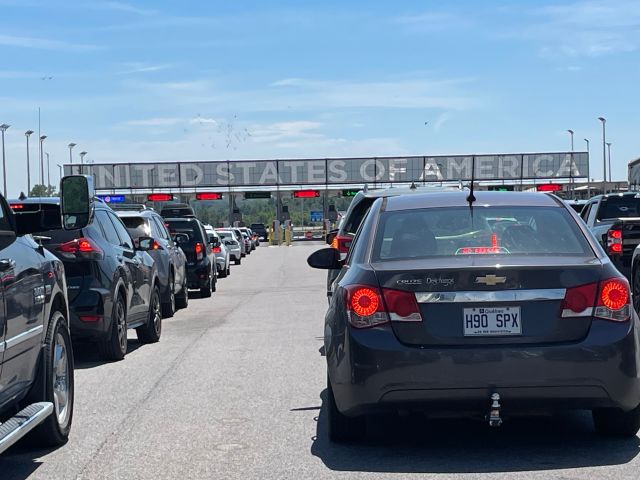
If you're planning a trip across the United States-Canada border this Memorial Day weekend, expect company. A lot of it. AAA is forecasting 45 million Americans on the road between May 21 and May 25, and U.S. Customs and Border Protection is already warning travelers at Michigan's Detroit, Port Huron, and Sault Ste. Marie crossings to prepare for delays and to come equipped.
Here's what you need to know before you go.
U.S. Customs and Border Protection (CBP) is not going to let you wing it at the border. U.S. citizens crossing by land need a valid passport, passport card, Enhanced Driver’s License, or a Trusted Traveler card like NEXUS. Non-U.S. travelers should apply for their I-94 ahead of time online or through the CBP Link app. Doing it before you arrive can significantly speed up processing at the port of entry.
Visa Waiver Program travelers, including most Europeans, Australians, and citizens of several Asian countries, must also have an approved ESTA before attempting to enter the U.S. by air or land. The application fee is currently $40, up from $21 last September, and you should only apply through the official government site at esta.cbp.dhs.gov. Fake ESTA websites are a well-documented scam, so this is not the place to take shortcuts.
This one catches people off guard more than it should. CBP requires you to declare all goods you're bringing into the country, and the list is longer than most people expect:
Purchases and alcohol
Fresh fruit and vegetables
Packaged and prepared food, including homemade meals
Raw meat and eggs
Live plants, animals, and seeds
Agricultural products
Firewood
Certain agricultural items are restricted or prohibited because of pest and disease concerns. Failing to disclose any of the above could cost you up to $1,000 in fines, which is a rough way to end a holiday weekend.
Anyone carrying more than $10,000 in cash or monetary instruments must report it to CBP. That covers physical currency, traveler's checks, money orders, and certain negotiable instruments.
There's an online reporting portal available, and CBP issued a separate reminder about this earlier in May after officers confiscated $44,000 from a traveler who hadn't declared it at Philadelphia International Airport.
Even if you're crossing from a Canadian province or entering a U.S. state where marijuana is legal, it remains illegal under federal law. That applies to all cannabis products. NEXUS card holders, take note: carrying prohibited goods in the wrong lane or at all can get your card revoked.
Transportation analytics company INRIX predicts the worst traffic congestion will hit on Thursday, May 21, and Friday, May 22, between 3 p.m. and 6 p.m. Monday afternoon is also expected to be especially busy. Travelers with flexible schedules may want to aim for Sunday instead, which is currently forecast to be the lightest travel day of the weekend.
Before you even leave the driveway, AAA recommends checking tire pressure, battery health, and fluid levels. Last Memorial Day weekend, the organization responded to more than 350,000 roadside assistance calls related to flat tires, dead batteries, and empty gas tanks. That’s the kind of delay that has nothing to do with border traffic and everything to do with skipping a quick five-minute pre-trip check.
If you're crossing this weekend, plan ahead, declare honestly, and pad your timeline. Real-time border wait times and full travel requirements are available at CBP.gov/travel.
CBP's warning specifically calls out the Detroit, Port Huron, and Sault Ste. Marie land border crossings in Michigan. All three connect to Canadian provinces and are expected to see heavy traffic over the holiday weekend.
Acceptable documents include a valid U.S. passport, passport card, Enhanced Driver's License, or a Trusted Traveler card such as NEXUS.
An I-94 is an arrival and departure record issued by CBP to most non-U.S. international visitors, tracking their legal entry and length of stay. U.S. citizens, lawful permanent residents, and some Canadian and visa-exempt visitors are generally exempt. If you need one, applying online or through the CBP Link app before you reach the border can speed things up at the crossing.
An ESTA is an electronic travel authorization required for travelers from Visa Waiver Program countries, including most of Europe, Australia, and several Asian nations. It must be obtained before traveling to the U.S. by air or land. The current application fee is $40, and you should only apply at the official government site, esta.cbp.dhs.gov.
Failing to declare agricultural goods can result in fines of up to $1,000. CBP takes this seriously because of the risk of pests and diseases entering the country via food, plants, and seeds.
No. Marijuana and all cannabis products remain illegal under U.S. federal law, regardless of whether they're legal in the state you're entering or the Canadian province you're leaving.
Yes, if you're carrying more than $10,000 in cash or monetary instruments, including traveler's checks and money orders, you're required to report it to CBP.
Sunday is forecast to be the lightest travel day. The worst congestion is expected on Thursday and Friday between 3 and 6 p.m., and Monday afternoon is also predicted to be busy. If you have flexibility, plan around those windows.