We use cookies to enhance your browsing experience, serve personalized content, and analyze our traffic. By clicking "Accept All" you accept this and consent that we share this information with third parties and that your data may be processed in the USA. For more information, please read our .
You can adjust your preferences at any time. If you deny, we will use only the essential cookies and unfortunately, you will not receive any personalized content.

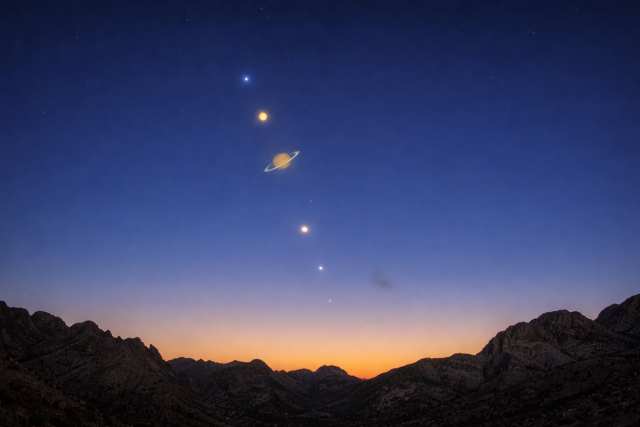
Mercury, Venus, Saturn, Jupiter, Uranus, and Neptune will all appear along the same sweeping arc after sunset, forming what astronomers call a planet parade.
Because the planets orbit the Sun along the same flat plane, they naturally gather along a single curved path in our sky. On this evening, that pattern becomes unusually clear, with multiple worlds spaced across one broad stretch above the western horizon.
As February 28 approaches, the real question is practical. If you step outside after sunset, what will you actually see, how long will you have before the lower planets set, and which ones are realistically visible from the United States? Here is exactly what to know before the sky begins to darken.
From the United States, the best viewing window will be roughly 30 to 60 minutes after your local sunset on February 28, 2026. During that period, the planets will be arranged along the curved path of the ecliptic, which is the same path the Sun appears to follow across the sky during the year.
Here’s how the alignment will be positioned:
Low in the western sky: Mercury, Venus, Saturn, and Neptune
Higher in the western sky: Uranus
High in the southeast: Jupiter
Jupiter will be the easiest to spot, shining steadily and brighter than any nearby star, and it will stay visible long after the planets in the west have slipped below the horizon. The lower planets will take a bit more patience, especially if your view is partially blocked by buildings, trees, or a hazy skyline. An open, unobstructed western horizon makes a noticeable difference, so coastal views, wide plains, or even a nearby hilltop can improve your odds.
February 28 offers one of the best overall windows for trying to see as many of the planets as possible in a single night.
All of the planets travel around the Sun on nearly the same flat track, a remnant of the spinning cloud of gas and dust that formed our Solar System billions of years ago. When we look up at night, we are essentially looking along that shared track, which shows up as a gentle curve across the sky. Because each planet moves at its own pace, they sometimes appear to bunch up along that curve before gradually spreading out again over time.
Alignments like this are not once in a lifetime events, but having six planets visible at the same time is uncommon enough to feel special. What makes this one particularly interesting is the contrast. The inner planets glow low in the fading light, while the larger outer planets shine higher in darker skies. Instead of one dramatic focal point, you get a layered view of the Solar System unfolding from the horizon upward.
Mercury reached what astronomers call greatest eastern elongation earlier this month, meaning it now sits as far from the Sun as it will appear in the evening sky. Even at this point, it stays low near the horizon. On February 28, it will linger a little longer after sunset than it did at the start of the month, giving you a slightly better window to catch it, though it will still look faint and may fade quickly into the haze near the skyline. Spotting Mercury often feels especially satisfying because it requires careful timing, a clear western view, and a bit of patience.
Venus is much brighter than Mercury and will be easier to identify as a steady, luminous point in the western twilight. On February 28, Venus and Mercury appear relatively close together, so locating Venus first can help guide your eye to Mercury nearby. Although Venus will still be low, its brightness allows it to hold its place in the sky a little longer before setting.
Saturn will be part of the cluster low in the western sky, appearing as a steady, soft golden point above the horizon. Earlier in the month it sat a bit higher and was easier to pick out, but by February 28 it will be closer to the skyline and partly washed by the remaining light of sunset. If you have binoculars or a small telescope, you may be able to make out its rings once the sky grows darker. Just be sure the Sun is fully below the horizon before using any optical equipment, as even a brief accidental glance can damage your eyes.
For most people, Jupiter will be the easiest and most impressive planet to spot. High in the southeastern sky, it shines steadily and stays visible long after the lower planets have set. Even in suburban areas with some light pollution, Jupiter stands out clearly. If you have a small telescope, you can often see its cloud bands and its four largest moons lined up beside it, which makes it one of the most satisfying sights of the entire alignment.
Uranus will be positioned higher in the sky than the planets near the western horizon, sitting beneath the Pleiades star cluster in Taurus. That extra height helps, since it rises above some of the haze that lingers closer to the skyline. Under very dark skies it can sometimes be seen without optical aid, but binoculars make it much easier to identify. When you find it, Uranus looks like a small, steady point of light with a faint bluish tint, noticeably calmer than the twinkling stars around it.
Neptune will be the most difficult planet to spot in this alignment. It sits low in the western sky near Saturn and requires a telescope to see at all. Because it is positioned close to where the Sun has just set, timing matters, and you should wait until the Sun is completely below the horizon before even attempting to look for it. If you are unsure or do not have the right equipment, there is no harm in focusing on the brighter planets and saving Neptune for another night.

If you step outside tomorrow evening, here is what you can realistically expect:
Jupiter will be bright and easy to see
Venus should be clearly visible with good timing
Saturn is possible with a clear horizon
Mercury will require patience and a precise viewing window
Uranus benefits from binoculars
Neptune is best left to experienced telescope users
You don’t have to find all six planets for the evening to feel worthwhile. Even spotting three or four in one night gives you a real sense of scale that no diagram or photo quite captures. There is something grounding about seeing those distant worlds sharing the same curved path across the sky, a quiet reminder that Earth is just one part of a much larger system moving together above us.
As March begins, Mercury and Venus will move closer to the Sun’s glare and gradually slip from view, and the tight grouping of planets will begin to loosen. Jupiter and Uranus, however, will remain visible into the spring, giving you more chances to look up in the weeks ahead. The night sky stays busy in early 2026, with a total lunar eclipse in early March and meteor showers later in the season, so February 28 can feel like a natural starting point for paying closer attention to what unfolds overhead this year.
On February 28, 2026, the evening sky offers a rare chance to spot multiple neighboring planets at once. You do not need perfect conditions or expert equipment, just a clear horizon and a few quiet minutes after sunset. Sometimes looking up and finding even a handful of those distant worlds is enough to remind you how connected our Solar System really is.
The alignment peaks on February 28, 2026, though the planets are positioned throughout the final two weeks of February.
Plan for approximately 30 to 60 minutes after your local sunset.
Face west for Mercury, Venus, Saturn, and Neptune, and look southeast for Jupiter.
No. Uranus typically requires binoculars, and Neptune requires a telescope.
They will follow the curved path of the ecliptic rather than forming a perfectly straight line.
Only after the Sun is fully below the horizon. Never scan near the Sun.
Six visible planets at once are uncommon, though smaller alignments occur more frequently.