We use cookies to enhance your browsing experience, serve personalized content, and analyze our traffic. By clicking "Accept All" you accept this and consent that we share this information with third parties and that your data may be processed in the USA. For more information, please read our .
You can adjust your preferences at any time. If you deny, we will use only the essential cookies and unfortunately, you will not receive any personalized content.

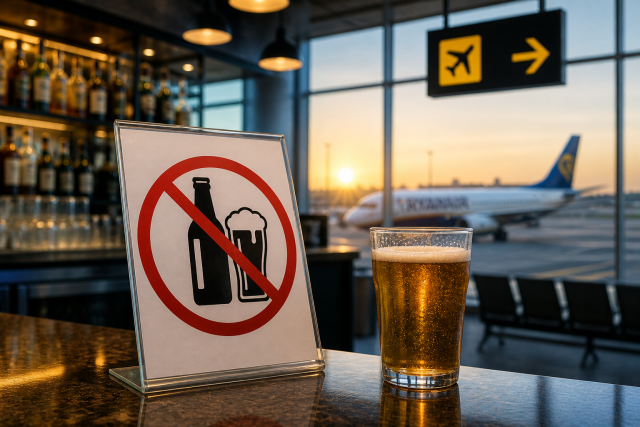
If you've ever walked through an airport at 6 a.m. and seen travelers already ordering beers and mimosas, you're not alone. In many airports, especially in Europe and vacation-heavy destinations, the "vacation starts at the airport" mentality is very real. Now, though, Ryanair CEO Michael O'Leary says that culture has gone too far. He’s calling for restrictions on early-morning alcohol sales at airports after a sharp rise in disruptive passenger incidents and flight diversions across Europe.
According to O’Leary, disruptive passenger behavior has become dramatically worse over the past decade. He says Ryanair now has to divert nearly one flight per day because of onboard incidents involving drunk or aggressive passengers. About ten years ago, he says that number was closer to one diversion per week.
In interviews with British media outlets, O’Leary specifically criticized airport bars serving alcohol before sunrise, saying “I fail to understand why anybody in airport bars is serving people at five or six o’clock in the morning. Who needs to be drinking beer at that time?”
In the UK, airport bars located past security, often called "airside" venues, are exempt from the standard licensing restrictions that apply to regular pubs and restaurants. That means while the bar on your street can't legally serve you a pint at 5 a.m., the one next to your departure gate absolutely can.
O'Leary wants that loophole closed. He argues that airports should be held to the same standards as traditional bars and pubs.
Specifically, he's pushing for:
A ban on alcohol sales at airports outside normal pub licensing hours
A two-drink limit for passengers in airport bars
Boarding-pass-based drink tracking at airports
Stronger enforcement against disruptive passengers
O’Leary also argued that airports profit from overserving travelers during delays, while airlines are left dealing with the consequences once passengers board.
For Americans, the idea of banning pre-flight airport alcohol may sound extreme. But the airport drinking culture in parts of Europe, especially on low-cost leisure routes, can look very different from what many US travelers are used to.
Flights from the UK to destinations like Ibiza, Alicante, and Tenerife have become particularly associated with disruptive passenger incidents, according to British reporting.
The dynamic on these routes is shaped by a few factors that don't really have a direct US equivalent:
Extremely cheap fares can encourage "party trip" travel behavior
Many passengers arrive after overnight clubbing or bachelor/bachelorette parties
Duty-free alcohol purchases before boarding are common
Early-morning departures are extremely frequent on low-cost carriers
That combination can create volatile cabin environments, especially on packed short-haul flights where there's nowhere to go and little room to de-escalate.
Probably not in the same way, at least not anytime soon.
US airports already have stricter alcohol oversight in many states, and airlines can deny boarding to visibly intoxicated passengers. Federal law also makes interfering with a flight crew a serious offense.
Still, disruptive passenger behavior has become a growing issue in the US too. The Federal Aviation Administration has issued repeated warnings in recent years about unruly passenger incidents, including cases involving alcohol. Airlines across the US have also expanded internal no-fly lists and increased penalties for onboard misconduct.
O'Leary's fight is definitely a European one. But the underlying dynamic, airports profiting from alcohol sales while airlines absorb the operational fallout, isn't unique to Ryanair's routes.
Ryanair isn’t the only airline sounding alarms. UK carrier Jet2 recently called for the creation of a shared national database of disruptive passengers so airlines could ban problem travelers across multiple carriers.
Meanwhile, Ryanair has started pursuing legal action against passengers who force flight diversions. In one case, the airline sought €15,000 (about $17,000) in damages from a passenger connected to a diverted flight between Dublin and Lanzarote.
Under UK law, being drunk on an aircraft can result in:
Fines of up to £5,000 (about $6,600)
Up to two years in prison
Airline bans
Liability for diversion costs that can reach tens of thousands of dollars
Not surprisingly, the proposal has sparked strong reactions online.
Some travelers argue that most passengers drink responsibly and shouldn’t be punished for the actions of a small minority. Others say airports have become increasingly chaotic post-pandemic and that airlines are right to crack down before things escalate further.
For now, this is still just an idea from one airline CEO, not an actual law or airport rule. But it does tap into a growing frustration across the airline industry: flights are getting harder to manage when the partying starts before passengers even board the plane.
Whether a ban ever happens or not, airlines are clearly putting more pressure on airports to take some responsibility for what happens after travelers leave the bar and head to the gate. If you're flying through Europe this summer, don't be surprised if airports start taking a closer look at early-morning drinking culture.
Yes. Airside venues, meaning bars and restaurants located past airport security, are currently exempt from standard UK alcohol licensing hours, meaning they can serve at almost any time of day.
CEO Michael O'Leary has called for airside bars to follow the same licensing hours as regular venues, a hard cap of two drinks per passenger enforced by boarding pass, and stronger consequences for disruptive passengers.
In the UK, being intoxicated on an aircraft is a criminal offense. Penalties include fines of up to £5,000 (around $6,300) and up to two years in prison.
O'Leary stated that Ryanair is currently diverting close to one flight per day due to disruptive passengers, up from roughly one diversion per week a decade ago.
Yes. Ryanair has started pursuing legal action against passengers who cause diversions. In one case, the airline sought €15,000 (around $16,500) in damages from a single incident.
Flights from the UK to Ibiza, Alicante, and Tenerife have been flagged as particularly problematic. Routes from Ireland and Poland have also reportedly experienced frequent disruptions.
No. US airport alcohol policies vary by state and local law, but airside bars are generally permitted to serve at any hour. The FAA has logged thousands of unruly passenger reports in recent years, many involving alcohol, but no coordinated push to restrict airport-level alcohol sales has emerged.
Budget carrier Jet2 has lobbied for a national database allowing UK airlines to share information on disruptive passengers and collectively ban them across carriers.