We use cookies to enhance your browsing experience, serve personalized content, and analyze our traffic. By clicking "Accept All" you accept this and consent that we share this information with third parties and that your data may be processed in the USA. For more information, please read our .
You can adjust your preferences at any time. If you deny, we will use only the essential cookies and unfortunately, you will not receive any personalized content.

Project Hail Mary just landed in theaters and it's already being called one of the best science fiction films in years. Directed by Phil Lord and Christopher Miller and starring Ryan Gosling as Ryland Grace, a science teacher turned astronaut who wakes up alone on an interstellar spacecraft with no memory of how he got there, the film adapts Andy Weir's bestselling 2021 novel. It was released by Amazon MGM Studios on March 20, 2026, and shot for IMAX to capture the full scale of space. If you've seen it and found yourself wondering where exactly it was filmed, here's the full breakdown.
Project Hail Mary was filmed entirely in England, specifically in Surrey, Portsmouth, and Cambridgeshire. Principal photography got underway in early June 2024 and wrapped in late October of the same year. The production mixed massive studio builds with a small number of real locations chosen specifically because they fit the film's scientific grounding
A significant portion of the film was shot at Shepperton Studios in Surrey, just outside the village of Shepperton. The studio is one of the UK’s largest, with 31 sound stages, backlots, and full post-production facilities.
What makes this production stand out is how much of it was built for real. The filmmakers chose to avoid green screens almost entirely, constructing the full interior of the Hail Mary ship inside the studio. Co-director Christopher Miller explained that space scenes were created using black backgrounds, while planetary auroras were filmed against shifting colored backdrops. The wider space exteriors were handled digitally by ILM, and Rocky was brought to life through a mix of puppetry and animation by Framestore.
Becuase the film was also shot for IMAX, the sets had to accommodate large-format cameras and compositions designed for the biggest possible screen.
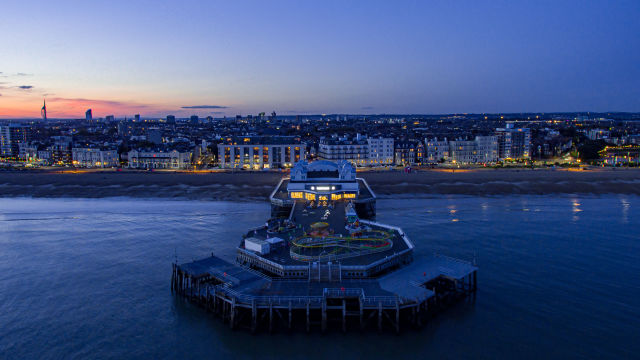
The production also spent time in Portsmouth, where Ryan Gosling and the crew filmed at South Parade Pier in Southsea in October 2024. The Victorian pleasure pier was completely closed off during filming, with its boardwalk, arcade areas, and seaside views standing in for everyday moments from Ryland Grace’s life before the mission.
Drone shots captured the pier mid-transformation, and the cast worked through classic rainy autumn weather to get the scenes done. Today, it’s still a fully functioning pier on England’s south coast and open to the public, which makes it one of the easier filming locations to visit.
The production also headed to Cambridgeshire, filming around the Mullard Radio Astronomy Observatory at Lords Bridge near Cambridge. The site, part of the University of Cambridge’s astrophysics program and the Cavendish Laboratory, is home to a network of radio telescopes used for real research.
Using an actual working observatory instead of a built set gives these scenes a level of authenticity that’s hard to fake. It also fits perfectly with a story centered on scientists trying to decode a mysterious threat to the sun.
South Parade Pier and the Southsea waterfront in Portsmouth are open to the public year-round and easy to reach from London by train. The Mullard Radio Astronomy Observatory is a working scientific facility and not generally open to casual visitors, though the surrounding Cambridgeshire countryside is accessible. Shepperton Studios is a private working film lot with no public access.
Project Hail Mary currently holds a 95% score on Rotten Tomatoes, with critics calling it a visually dazzling space odyssey anchored by one of Ryan Gosling’s most charming performances. Time described it as one of the most purely enjoyable and uplifting films in years, even calling Gosling’s role a career milestone. And according to many reviews, if you liked The Martian, this one is very much in the same spirit.
Almost entirely in England, specifically in Surrey, Portsmouth, and Cambridgeshire. The primary studio base was Shepperton Studios in Surrey, with real-world locations at South Parade Pier in Portsmouth and the Mullard Radio Astronomy Observatory near Cambridge.
No. The entire ship interior was physically built at Shepperton Studios, and the alien character Rocky was present on set throughout filming rather than added in post-production. Wide space exterior shots were handled digitally by ILM.
Yes. The film was shot for IMAX to capture the full scale of space sequences, and it was released in IMAX theaters on March 20, 2026.
South Parade Pier is located in Southsea, Portsmouth, on England's south coast. It's a Victorian-era pier open to the public and was used in the film for Earth flashback scenes depicting Ryland Grace's pre-mission life. Filming took place in October 2024 with the pier closed entirely for production.
South Parade Pier in Portsmouth is fully open to the public. The Mullard Radio Astronomy Observatory near Cambridge is a working research facility with limited public access. Shepperton Studios is a private working film lot and not open to visitors.
Principal photography began in early June 2024 and wrapped in late October 2024, entirely in England.
Phil Lord and Christopher Miller directed the film, working from a screenplay by Drew Goddard.
Ryan Gosling plays Ryland Grace. Sandra Hüller plays Eva Stratt, the tough project leader who recruits him. The supporting cast includes Ken Leung, Milana Vayntrub, Lionel Boyce, Liz Kingsman, James Ortiz, and James Wright.
Yes. It adapts Andy Weir's 2021 novel of the same name. The screenplay was written by Drew Goddard, who also adapted Weir's earlier novel The Martian.