We use cookies to enhance your browsing experience, serve personalized content, and analyze our traffic. By clicking "Accept All" you accept this and consent that we share this information with third parties and that your data may be processed in the USA. For more information, please read our .
You can adjust your preferences at any time. If you deny, we will use only the essential cookies and unfortunately, you will not receive any personalized content.

A solar storm is arriving today, and if you've been waiting for a chance to see the northern lights without booking a flight to Iceland, this might be your moment. A recent solar eruption is now heading toward Earth, expected to arrive on March 19, with the potential to trigger stronger geomagnetic storm conditions and a much more vivid and widespread light show in the nights ahead. According to NOAA's Space Weather Prediction Center, the strongest conditions are expected tonight into the early hours of Friday morning, with a potential G3 storm arriving Saturday that could push the aurora even further south. If you're anywhere in the northern US and the sky is clear tonight, go outside after 10pm and look north. This is the one.
This isn’t just a one-night event. In fact, it’s already started. Faint aurora activity was visible across high-latitude regions earlier this week as the first wave of solar wind moved past Earth, and things have been building since. What we’re seeing now is just the beginning of a multi-day sequence, and it’s only going to get stronger from here.
What’s happening behind the scenes is a series of solar eruptions, known as coronal mass ejections, arriving one after another. Each one sends a wave of charged particles toward Earth, and together they’re building into something much more powerful than a typical aurora setup. NOAA confirmed that eruptions from March 16 and 17 are reaching Earth today, which means tonight’s display should already be noticeably stronger than what we saw last night. Another eruption from March 18 is expected to arrive on Saturday, along with a fast-moving stream of solar wind that could push conditions into G3, or “strong” storm levels.
In simpler terms, last night was the warm-up. Tonight is when things really start to come together, and Saturday could be the peak. The latest NOAA forecast shows the visibility zone stretching much farther south than usual, deep into the northern United States. If you’re anywhere along that northern tier and the skies are clear, this is one of those rare moments where it’s genuinely worth stepping outside, finding a dark spot, and looking north.
The early part of the evening, before around 10pm, will probably be fairly quiet. The aurora should stay mostly confined to higher latitudes like Alaska and northern Canada while everything is still building. The energy is arriving, but it takes a little time for the atmosphere to respond.
As the night goes on, though, things should shift. Conditions are expected to strengthen into the late evening and overnight hours, which is when the aurora has a real chance of pushing farther south.
The best window to watch is between about 10pm tonight and 2am Friday morning. That’s when NOAA is forecasting stronger activity, enough to bring the lights well below the Canadian border. If you’re in one of these areas, you’ve got a legitimate shot:
Montana, North Dakota, Minnesota, Wisconsin, and Michigan
Washington, Idaho, and Oregon
New York, Vermont, Maine, and much of northern New England
Even parts of Iowa, Indiana, and Pennsylvania, especially if you can get somewhere dark
And if things strengthen even further into G3 storm levels on Saturday, which NOAA says is possible, the aurora could dip farther south again. That would give parts of the central U.S. a chance too, which is not something you get very often.
Knowing the forecast is only part of it. Here is the practical checklist:
Check conditions within an hour of going out. Space weather can shift significantly in a short window. Use NOAA's 30-minute aurora forecast at swpc.noaa.gov or apps like My Aurora Forecast, SpaceWeatherLive, or Aurora Now for live data.
Get away from light pollution. Use a light pollution map like lightpollutionmap.info to find dark sky locations near you. Even a short drive makes a real difference.
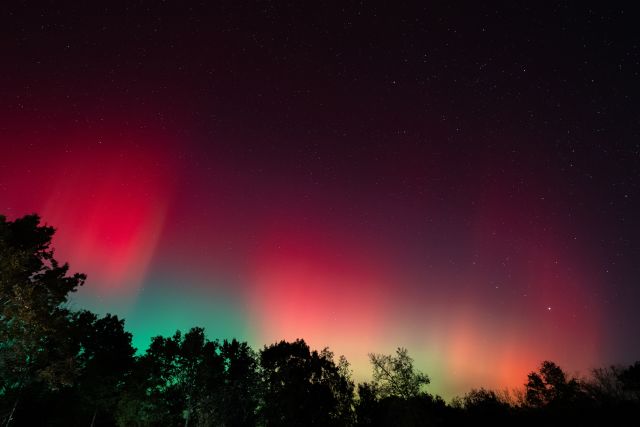
Face north and be patient. The aurora often starts as a faint greenish glow low on the horizon before building. Give your eyes at least 20 minutes to adjust to the dark.
Go out between 10pm and 2am local time. NOAA suggests traveling to a north-facing, high vantage point during these hours for the best visibility.
Source: Screenshot from NOAA website, March 19
You don’t need a fancy camera to capture the northern lights. Most modern smartphones handle low-light surprisingly well if you give them the right conditions. If your phone has Night Mode or Pro Mode, turn it on and use the main camera lens rather than the ultra-wide for sharper photos. The biggest trick is keeping the phone completely still. A small tripod works great, but even resting your phone on a rock, fence, or car roof can work.
Expect the camera to take longer exposures of about five to ten seconds. If your phone allows it, shooting in RAW format can give you more flexibility if you edit the photo later. One thing that surprises people: your camera often sees more color than your eyes do. What looks like a faint grayish glow in the sky might show up as green, purple, or even red in a photo. So it’s always worth taking a few shots, even if the display looks subtle at first.
And this weekend, the conditions aren’t just theoretical. The solar wind is already elevated and the geomagnetic storm is already underway. At this point, the biggest question is simple: will the sky above you cooperate?
We’re currently near the peak of Solar Cycle 25, which is the sun’s roughly 11-year activity cycle. In simple terms, this is when the sun is at its most active, and it’s why we’ve been seeing more frequent and stronger aurora displays over the past year. On a few nights, the lights have even pushed as far south as the southern U.S. and parts of Europe, which doesn’t happen very often.
What makes this week a little different is the timing. Instead of a single solar eruption, we’re getting several arriving one after another. When that happens, the effects tend to stack, leading to longer-lasting and more intense activity.
That’s why Saturday is especially worth keeping an eye on. If conditions reach G3 levels, which NOAA says is possible, the aurora could stretch much farther south than usual. Under dark skies, that can mean visibility into places like the mid-Atlantic, which is rare enough that it’s always worth paying attention when it lines up like this.
If this week's display gives you the bug and you want to plan a proper aurora trip, these US destinations consistently offer the best conditions:
Fairbanks, Alaska: The gold standard for US aurora viewing, with a dedicated aurora season and specialist tour operators
Upper Peninsula of Michigan: Dark skies, manageable logistics, and surprisingly frequent displays during active solar periods
Northern Minnesota, Boundary Waters area: Exceptional darkness and lake reflections that double the visual impact
Grand Teton and Yellowstone, Wyoming: High elevation, dark skies, and jaw-dropping scenery as a backdrop
Cherry Springs State Park, Pennsylvania: One of the darkest skies on the East Coast and a realistic option during strong storm events
The solar storm is already on its way and there's nothing to do now except check the forecast, find a dark field, and look north. Friday night is shaping up to be the best window. Set a reminder, charge your phone, and don't forget a jacket.
Possibly, but tonight's display is expected to be relatively mild, with a forecasted Kp of 3 and activity limited to higher latitude regions including Alaska and northern Canada. The stronger viewing opportunity is Friday night, March 20, when NOAA is forecasting Kp 6 and G2 storm conditions.
During Friday night's forecasted G2 conditions, states with the best chance include Montana, North Dakota, Minnesota, Wisconsin, Michigan, Washington, Oregon, Idaho, Maine, Vermont, and northern New York. If conditions reach G3 on Saturday, the viewline could extend further south.
NOAA recommends heading out between 10pm and 2am local time, from a north-facing location with as little light pollution as possible.
G2 is a moderate geomagnetic storm on NOAA's five-level scale, where G1 is minor and G5 is extreme. A G2 storm typically produces aurora visible as far south as the northern tier of the continental US under dark skies.
NOAA's Space Weather Prediction Center at swpc.noaa.gov is the most reliable source. The Aurora Viewline page updates continuously and shows both tonight and tomorrow night's forecast.
No. The naked eye is sufficient for a strong display. For photography, a smartphone in night mode works well. A DSLR or mirrorless camera on a tripod with a wide-angle lens will produce the best results.
During G2 conditions, parts of New England and upstate New York have a reasonable chance under dark, clear skies. A potential G3 event on Saturday night could push visibility further south toward the mid-Atlantic.
Not as rare as it used to be. We're near the peak of Solar Cycle 25, which means aurora activity has been elevated for the past year. However, a multi-CME sequence producing G2 to G3 conditions over three consecutive nights is still a significant event worth paying attention to.