We use cookies to enhance your browsing experience, serve personalized content, and analyze our traffic. By clicking "Accept All" you accept this and consent that we share this information with third parties and that your data may be processed in the USA. For more information, please read our .
You can adjust your preferences at any time. If you deny, we will use only the essential cookies and unfortunately, you will not receive any personalized content.

Some trips begin with a dream destination, a long-awaited escape, or the simple wish to see somewhere beautiful. This one began with a name our family has said out loud every Memorial Day for as long as I’ve been part of it.
While we usually write about travel deals and dream destinations, some journeys deserve a different kind of story. Our trip to Lorraine, France, was not about going somewhere glamorous or famous. It was about going to the place where someone our family had loved through letters, stories, and memory was waiting, long before we ever stood at his grave.
When my in-laws began planning their first trip to Europe with my husband, our four kids, and me, we told them the continent was wide open. Paris, Rome, the Alps, the Amalfi Coast. Anywhere they had always wanted to go.
My father-in-law did not hesitate.
“Lorraine,” he said.
Not Paris. Not Rome. Not one of the places people usually picture when they imagine their first trip to Europe. Lorraine, a quiet region in northeastern France that many Americans could not place on a map. But my father-in-law knew exactly where it was. In a way, the answer had been decided long before we asked the question.
Since I married into this family, we have marked every Memorial Day the same way. My father-in-law or my husband finds the letters in our family documents, and we read them out loud. They were written by a young man named Charles Ralph Campbell, known to everyone who loved him as Bud.
Bud was my father-in-law’s uncle, the beloved little brother of my husband’s grandmother, less than two years her junior. She spoke of him often before she died, and the way she spoke made one thing clear: some losses do not soften. They simply become part of who you are.
My kids have grown up knowing his name. They know he was steady and capable, and the kind of pilot his crew trusted so completely that they refused to fly with anyone else. They know his plane was shot down over Vienna on December 11, 1944. And they know he is buried at the Lorraine American Cemetery in Saint-Avold, France, among more than ten thousand Americans who never came home.
As we drove to Lorraine during this family trip, we did what we always do on Memorial Day. We read the letters out loud.
Bud’s final letter was published in the local newspaper back home. He wrote it to his father, and it reads like a man who had figured out, with complete clarity, what mattered. He opens by describing the little white piece of paper in the operations room, the one with his name on it and 36 squares, one colored red for each mission completed.
“I’m sort of living right there on that piece of paper,” he wrote. “Every time I come back from a mission, no matter how rough it was or how much we got shot up, I feel good when my whole crew is OK and we walk in and see another one of those white squares colored red. Just a few more and we’ll be seeing the ones we love at home.”
Then he tells his father what occupies his mind. Not the war. The plain, ordinary things.
“I want to get up in the morning, do a good hard day’s work, eat a good meal at a good family table, say ‘hello’ to neighbors, shoot pheasants, walk out through a pretty field of spuds, drive to town through the snow, go to church on Sunday with my Dad, wrestle with the boys and tease Mom and the girls, sing in the choir, have a family dinner together on Thanksgiving, go fishing, haul more beans with my truck than the next guy can with his, hug my Mom, marry the sweetest girl in the world, do as fine a job raising a family as my Dad did, build a house and help to make it a home.”
He closes with this: “A million things like that are what I want to live for, Dad. When I hear a beautiful piece of music, that’s what it says.”
His plane went down three weeks later. He was twenty-three years old.

On that drive to Lorraine, we noticed another letter I had never read before. A new document had been uploaded to our family records online. This letter was from Jack Ward, Bud’s co-pilot.
Jack had been seated behind Bud when flak hit the plane over Vienna. The aircraft was badly damaged, losing control, and Bud was unconscious in the pilot’s seat. With only moments left, Jack tried one last time to pull him free before he had no choice but to jump.
He couldn't do it.
Jack wrote to Bud’s parents afterward, not because he had to, but because he felt they deserved to hear it from someone who had been there. He told them Bud had been leading the squadron that day because the commanding officer considered him the most reliable. He told them exactly what happened.
And then he wrote: “His crew felt so safe with him that they wouldn’t fly with any other pilot. He isn’t the sort of person one thinks of as being dead. He’s merely ahead of the rest of us, living a richer life.”
We finished the letter just as we pulled into the cemetery.
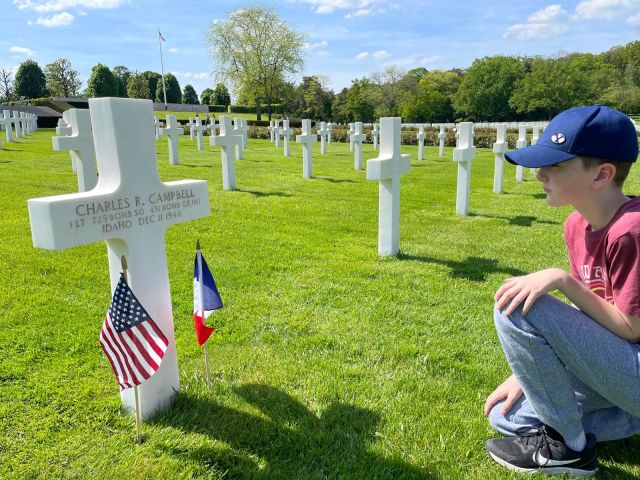
With all of that fresh in our minds, we arrived at Lorraine American Cemetery. At the visitor center, my father-in-law told the employee that we were next of kin and had traveled there to visit Charles Campbell’s grave. She asked for his middle initial and where he was from. Once my father-in-law clarified that we meant Charles Ralph Campbell from Idaho, her expression changed.
Her eyes lit up.
“I know him,” she said. “He’s quite famous around here. I know exactly where he is.”
We were taken aback. There are six men named Charles Campbell buried at Lorraine American Cemetery. Ours is in Row B. But once she narrowed it down to our Charles Campbell, she knew him immediately.
She gathered a bucket of sand and two flags, one American and one French, and led us out into the cemetery. As we walked, she told us that Bud’s final letter is one they read aloud on tours. He is one of the men they tell visitors about. She told us one of her colleagues even has the letter memorized.
“Charles Campbell is important to us,” she said.
We were all thinking the same thing: what? The words our family had gathered around every Memorial Day for decades, the letter we had treated as something almost privately ours, had been read aloud to strangers from around the world. Uncle Bud’s words, the ones we had cherished so deeply as a family, had traveled farther than we ever realized. And somehow, those visitors had felt what we felt. The ache in them. The beauty. The impossible ordinariness of what he wanted.
She told us about a girl on a school trip who heard the letter read aloud and said quietly, “I miss my family now. I want to see them.” That is what Bud’s words do. Eighty years later, to people who never even knew him.
My father-in-law brushed sand into the engraved letters of the cross so the name stood out clearly.
CHARLES R. CAMPBELL
We stood together in a field in France, grandparents, parents, kids, three generations gathered at his grave. Many of us cried, including the guide who had led us there. In that moment, we all felt love and connection for a man we had never met, but somehow felt we knew.
I keep coming back to Bud’s list. He wanted a hard day’s work and a good meal. He wanted to drive to town through the snow, spend time with his dad, haul more beans than the next guy, hug his mom, get married, raise a family, build a house, and help make it a home.
He wasn’t dreaming of anything grand. He was dreaming of the ordinary life waiting for him on the other side of the war. And standing in Lorraine, that was what stayed with me most.
Travel is often about seeing beautiful places, trying new food, or experiencing something different from daily life. But this trip reminded us that travel can also make a family story feel real in a new way. For years, Bud had been a name in letters, photographs, and Memorial Day memories. In Lorraine, he became someone with a specific place, a grave, and a community that still speaks his name. History felt less distant there because we were standing in the place where part of our family’s story had come to rest.
There was also something especially moving about making this journey together. My father-in-law, the generation closest to the loss. My mother-in-law, who had spent fifty years hearing stories of Bud from the sister who never forgot him. My husband, who grew up hearing Bud’s name. Our children, who have heard his letters read every Memorial Day. And all of us standing in a cemetery in France, watching a woman who never knew him speak his name with the same tenderness our family has always felt.
That is what I will remember most. Not just that we found him, but that Lorraine had kept him too.
So this Memorial Day, I am thinking less about one trip to France and more about what it means to remember someone well. To say their name. To tell their story. To go, if you can, to the place where they rest. Some trips are not really about sightseeing. Some are about finally showing up for someone who never made it home.
Uncle Bud, we are so glad we finally made it to Lorraine.
We will continue to read your letters every Memorial Day. And now, alongside the words you left behind, we will add this story too: the story of standing at your grave in France, of learning how far your words had traveled, and of discovering how much that visit meant to all of us.