We use cookies to enhance your browsing experience, serve personalized content, and analyze our traffic. By clicking "Accept All" you accept this and consent that we share this information with third parties and that your data may be processed in the USA. For more information, please read our .
You can adjust your preferences at any time. If you deny, we will use only the essential cookies and unfortunately, you will not receive any personalized content.

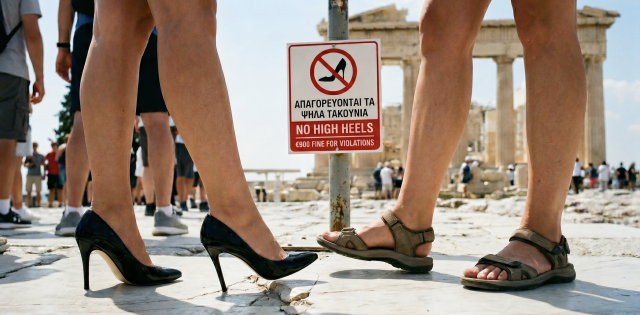
If you're planning a trip to Greece and packing your favorite heeled sandals, here's something worth knowing before you go: high heels have been banned at ancient archaeological sites since 2009, and the rule is actively enforced. It sounds quirky, and it definitely makes for a great conversation starter, but the reasoning behind it is genuinely sound. Ignoring the rule could cost you entry to some of the most iconic ruins on earth, along with a hefty fine that’ll sting long after you’ve landed back home.
The ban came into effect in January 2009 after Greek archaeologists raised concerns about the long-term damage caused by stilettos and narrow heels on ancient marble surfaces. The issue is simple physics: a stiletto heel concentrates a person’s body weight onto a tiny point. Multiply that by thousands of visitors a year, and it can slowly create micro-cracks and surface erosion on marble that has survived wars, earthquakes, and centuries of weather.
Eleni Korka, then director of Greek Prehistoric and Classical Antiquities, put it plainly: female visitors must wear shoes that don't "wound the monuments." She described the marble as having a kind of protective “skin” that can suffer slow but irreversible damage.
The rule applies at major archaeological landmarks across Greece, including the Acropolis of Athens, the Theatre of Dionysus, and the Odeon of Herodes Atticus. It also extends to performances held at historic venues, meaning summer concerts at ancient theaters still come with one very modern dress code recommendation: leave the stilettos at the hotel and wear comfortable flats instead.
Violating the rule can lead to fines of up to €900 (roughly $990), and Greek authorities do enforce it. Visitors can be denied entry or removed from archaeological sites if they refuse to comply. This is not one of those obscure travel rules buried in fine print. It’s an active preservation policy designed to protect some of the world’s most fragile historical landmarks.
And the footwear ban is only part of it. Food, sugary drinks, and chewing gum are also prohibited inside many archaeological sites under the same preservation logic. At the Odeon of Herodes Atticus alone, maintenance crews reportedly once removed nearly 60 pounds of chewing gum stuck beneath the ancient marble seating. After thousands of years of surviving wars, earthquakes, and exposure to the elements, Greek officials are trying to make sure modern tourism doesn’t become the thing that finally damages them.
The preservation argument is compelling enough on its own, but there’s also a very practical reason Greece recommends flat shoes at archaeological sites: ancient marble is slippery. The Acropolis of Athens in particular is known for its smooth, heavily worn stone surfaces, which can become surprisingly slick under the Mediterranean sun. After baking in direct heat all day, the marble can feel almost polished underfoot. Stilettos offer virtually no grip, but honestly, flip flops are not much better. If you’re visiting the ruins, rubber-soled shoes with decent traction are easily the safest option.
This is not Greece being overly cautious. Anyone who has walked across the Acropolis knows the terrain is uneven, steep in places, and genuinely slippery. Comfortable, supportive shoes are not just the recommended choice here. They’re the obvious one.
Flat shoes with rubber soles are your best option when visiting Greece’s archaeological sites. Sneakers, walking sandals, or low-profile trainers all work well. The good news is that you do not have to sacrifice style entirely. Plenty of fashionable flats are perfectly suited to a long day of sightseeing. Save the heels for dinner at a waterfront taverna in Plaka or cocktails at a rooftop bar in Monastiraki. Greece has no shortage of places where they will feel far more appropriate anyway.
Beyond the footwear rules, the dress code at Greek monuments is fairly relaxed. Unlike some religious sites in Europe or the Middle East, there is generally no requirement to cover your shoulders or legs. Still, lightweight and comfortable clothing is the smartest choice. Most visitors spend hours walking across uneven ground under intense summer heat, often with very little shade.
Greece’s policy fits into a much broader global trend of countries using laws and visitor restrictions to protect historic landmarks from the pressures of mass tourism. Italy, for example, has banned tourists from sitting on the Spanish Steps or wading into historic fountains in Rome. Japan regularly asks visitors to follow strict etiquette around temples and shrines, while Cambodia enforces modest dress rules at Angkor Wat. In every case, the reasoning is similar: when millions of people interact with fragile cultural sites every year, seemingly small individual actions can create very real long-term damage.
Greece arguably has more reason than most countries to be protective. The Acropolis of Athens alone attracts roughly three million visitors annually. Even if only a small percentage of those visitors wore high heels, the cumulative pressure on marble surfaces that have already survived roughly 2,500 years of history becomes significant over time.
There's something fitting about a country that gave the world democracy, philosophy, and the foundations of Western architecture asking visitors to tread carefully. The Acropolis has already lasted 25 centuries. A little footwear consideration seems like a fair ask to help it last a few more.
High heels concentrate body weight onto a sharp point, which causes micro-cracks and surface damage to ancient marble floors at archaeological sites. The ban was introduced in 2009 to protect monuments that cannot be easily restored once damaged.
The ban applies at all major archaeological sites and ancient monuments, including the Acropolis, the Theatre of Dionysus, and the Odeon of Herodes Atticus. It also covers outdoor performances held at historic venues.
Flat, rubber-soled shoes are ideal. Sneakers or walking sandals with grip are your best bet. The marble surfaces can be slippery, so traction matters as much as heel height.
Yes. The rule applies only at ancient archaeological sites. You're free to wear whatever footwear you like in restaurants, hotels, shops, beaches, and everywhere else in the city.
Food, sugary drinks, and chewing gum are also banned inside historical sites. Only bottled water is typically permitted.
You'll likely be stopped at the entrance. Guards may ask you to remove your heels or turn you away entirely. Fines for violations can reach up to €900 (around $990).
Yes, site guards actively enforce it. It's not a symbolic rule, so don't assume you'll slip through unnoticed.
Greece announced the ban in 2009, with enforcement beginning in January of that year.