We use cookies to enhance your browsing experience, serve personalized content, and analyze our traffic. By clicking "Accept All" you accept this and consent that we share this information with third parties and that your data may be processed in the USA. For more information, please read our .
You can adjust your preferences at any time. If you deny, we will use only the essential cookies and unfortunately, you will not receive any personalized content.

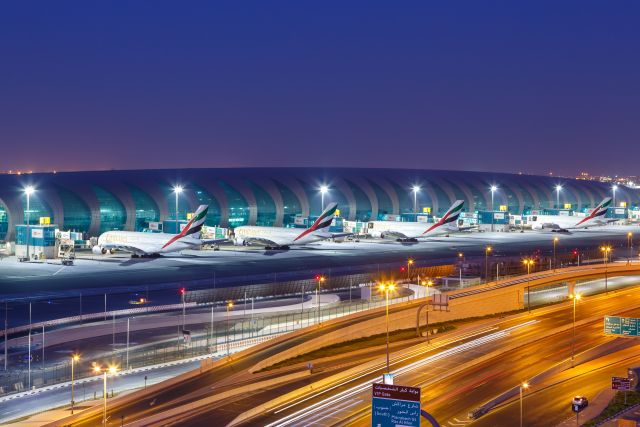
This morning, two drones fell in the vicinity of Dubai International Airport in an incident directly connected to the ongoing regional conflict, and the situation at one of the world's busiest travel hubs has escalated in a way that changes the calculus for anyone with UAE travel plans. Four people were injured. Passengers were evacuated from parts of the airport. Air defense systems were actively engaged overhead while commercial aircraft were held in holding patterns above the city. If you have a trip touching the UAE in the coming days, this update deserves your full attention before you make any decisions.
Dubai authorities confirmed that two drones fell near Dubai International Airport early Wednesday morning. Four people were injured in the incident: two Ghanaian nationals and one Bangladeshi national suffered minor injuries, while an Indian national was reported to have moderate injuries.
For a short time, several Dubai International Airport arrivals were placed in holding patterns while authorities responded to the situation, according to flight tracking data from Flightradar24.
People working in offices around the airport’s free zone said they could feel the impact from inside nearby buildings, and at least one witness reported seeing a drone strike directly.
The Dubai Media Office later said that air traffic returned to normal operations after the incident. Still, that description has left many travelers, airport workers, and nearby residents uneasy. For those on the ground, the morning’s events have raised a simple question: whether continuing operations as usual makes sense under the circumstances.
(Source: Dubai Media Office via X, March 11, 2026)
As of Tuesday, UAE air defenses say they had detected 1,475 drones launched by Iran since hostilities began on February 28. Most were intercepted, but not all. Officials report that 1,385 were stopped while 90 struck land. This morning’s incident adds two more to that total, and it happened in the airspace surrounding the world’s busiest international airport.
That’s the reality travelers are navigating right now. So when you hear that “air traffic is operating as normal,” it’s worth pausing for a moment to understand what normal actually looks like in this situation.
This morning’s drone incident didn’t happen in isolation. It’s part of a much larger situation unfolding across the Gulf, and that context matters for anyone trying to decide whether to travel right now.
Iranian counterattacks have continued across the region, with Kuwait, Saudi Arabia, and the UAE all reporting missile and drone interceptions in recent hours. Since the strikes began on February 28, UAE defense officials say six people have been killed and 122 injured across the country as of March 10.
The impact hasn’t been limited to airports or flight schedules. In Abu Dhabi, a drone strike sparked a fire at the Ruwais Industrial Complex, forcing the Abu Dhabi National Oil Company to shut down a refinery capable of producing about 922,000 barrels of oil per day. Debris from intercepted drones and missiles has also been reported in several parts of Dubai and Abu Dhabi, including areas near Palm Jumeirah, Burj Al Arab, and Jebel Ali Port.
For years, the UAE has built a reputation as one of the world’s safest and most stable travel destinations. That reputation is now being tested in ways that few people could have imagined just a couple of weeks ago.
Current conditions at Dubai International Airport (DXB) and Al Maktoum International Airport (DWC) as of March 11, 2026:
Against this backdrop, here is where every major airline stands as of this morning. It's worth noting that this list has shifted daily since the crisis began, and today's update may not reflect where things stand by this evening.
Airport status: Open and operating at DXB and DWC
Emirates: Operating to 84+ destinations, though planes were placed in holding patterns during this morning's incident. Check emirat.es/flightstatus before leaving for the airport, and check it close to departure.
flydubai: Continuing a reduced schedule from Terminals 2 and 3, with some flight times longer than usual due to rerouting through alternative corridors. Check flydubai.com for current status.
Etihad: Operating limited flights from Abu Dhabi through March 19 across a broad range of global destinations. Check the company website before heading to the airport: etihad.com.
Air Arabia: Running limited flights from Sharjah, Abu Dhabi, and Ras Al Khaimah to select destinations across India, Pakistan, Egypt, Europe, and the Middle East. Check airarabia.com for current routes.
Virgin Atlantic: Seasonal Dubai service suspended for the remainder of the winter season, with Riyadh also paused and under ongoing review.
British Airways: All flights to Dubai, Abu Dhabi, Amman, Bahrain, Doha, and Tel Aviv cancelled. Dubai and regional routes are suspended through the end of March, and Abu Dhabi flights are cancelled until later this year. Final repatriation flights from Muscat to London Heathrow run today and tomorrow at 2:30am local time, with very limited seats remaining. Contact BA directly at +44 203 467 3854.
Oman Air: Flights to and from Amman, Dubai, Bahrain, Doha, Dammam, Kuwait, Copenhagen, Baghdad, and Khasab cancelled through March 15.
Air France: Suspension of flights to Dubai.
Qatar Airways: Qatar Airways is not flying to or from Dubai. It's operating limited repatriation flights out of Doha only, and at a fraction of its normal schedule.
Lufthansa Group: Suspension officially expired March 10. Contact your specific Lufthansa Group carrier directly to confirm whether Dubai service has resumed before assuming it has.
KLM: Suspension officially expired March 10. Check klm.com for confirmed status before booking or traveling.
Finnair: All Dubai flights cancelled through March 29, with special repatriation flights from Muscat to Helsinki operating for passengers currently stranded in the region.
Norwegian: All Dubai flights cancelled through March 12
Cathay Pacific: All Hong Kong to Dubai flights cancelled through March 31.
Singapore Airlines: Dubai flights cancelled through March 15.
UAE airspace: Partially open, with flights operating through restricted corridors and active air defense engagement ongoing.
Passenger access: Confirmed bookings only. Do not travel to the airport without direct, current confirmation from your airline.
Source: Screenshot from Dubai Airports Website March 11, 2026
If you’re currently in Dubai or anywhere in the UAE, the most helpful thing you can do right now is stay in close contact with your airline and your country’s embassy or consulate. This morning’s incident is a reminder that the airport and the surrounding areas aren’t completely separate from what’s happening across the wider region. Conditions can change quickly, sometimes within hours, and those shifts can affect everything from flight schedules to access to the terminal itself.
One practical tip: don’t head to the airport unless you have a confirmed, active booking, and try to double-check that reservation as close to departure as possible. Many major airlines are still offering fee-free rebooking or full refunds for flights in and out of the region, so travelers do have some flexibility if plans need to change.
If you’re trying to figure out your next steps, here are a few places to start:
Do not go to the airport without a confirmed booking from your airline. Even then, check again right before you leave. Conditions changed quickly this morning and schedules are still shifting.
Check your flight status right before you leave. Not just the night before. Use the airline's app or website within an hour of departure.
Check Emirates flight status at emirat.es/flightstatus.
Check Etihad flight status at etihad.com.
Keep an eye on your email and airline notifications. Airlines are contacting confirmed passengers directly with updates, rebookings, and boarding instructions.
Confirm your terminal before leaving, as some operations have shifted between DXB terminals.
If you need an Etihad refund, use the online form at etihad.com/en/help/refund-form
If you are still stranded and cannot secure a commercial seat, contact your country's embassy about charter or repatriation options.
If your flight was cancelled, contact your airline directly or your travel agent. Online rebooking portals are the fastest option for most carriers.
For the most up-to-date information, travelers are encouraged to monitor the following official accounts on X: Dubai Media Office, Dubai Airports, Emirates, and Etihad
If you haven't yet traveled to the UAE and were planning to in the coming days, consult your government's official travel advisory before making any decisions. The US State Department, UK Foreign Office, and Australian DFAT all maintain live advisories for the region that are updated regularly and reflect the current situation on the ground.
For travelers in the UAE who haven’t been able to secure a commercial flight home, Muscat is still one of the most reliable ways out of the region right now. Options there remain relatively strong compared to other nearby airports. Over the past week, Oman Air has added nearly 80 extra flights and helped more than 97,000 passengers reach their destinations.
Another option is traveling overland. The land border crossing from the UAE into Muscat remains open, and some travelers are choosing to drive across and depart from there.
For those trying to reach the UK, British Airways is operating its final repatriation flights from Muscat to London Heathrow Airport today and tomorrow at 2:30 a.m. local time. Seats are extremely limited, and the airline recommends calling directly rather than trying to book online: +44 203 467 3854.
The reality this morning is that the situation around Dubai International Airport appears more serious than it did even 24 hours ago, and it was already concerning then. Anyone making travel decisions involving the UAE should take a moment to review the latest information and think carefully about their options. The good news is that most airlines are still offering flexible rebooking and refund policies, so if your plans need to change, you do have room to adjust.
Yes. Two drones fell in the vicinity of Dubai International Airport on Wednesday morning, injuring four people — two Ghanaian nationals, one Bangladeshi national, and one Indian national with moderate injuries. Air defense systems intercepted additional drones overhead during the incident.
Yes. Both Dubai International Airport (DXB) and Al Maktoum International Airport (DWC) are operating with a limited number of flights as airlines continue to expand their schedules. Only confirmed passengers should travel to the airport.
Dubai Media Office stated that air traffic returned to normal operations following the incident, though Emirates planes were placed in holding patterns during the event and the situation remains fluid. Verify your specific flight status directly with your airline before heading to the airport.
Yes. Emirates is currently flying to 84 destinations and plans to return to full network operations in the coming days. Check emirat.es/flightstatus before heading to the airport.
Passengers booked between February 28 and March 31 can rebook on an alternate flight through April 30, or request a refund via the Emirates website for direct bookings. Passengers who booked through a travel agent should contact their agent.
British Airways, Finnair, Virgin Atlantic, Norwegian, Cathay Pacific, and Singapore Airlines have all suspended Dubai services. Emirates, Etihad, flydubai, and Air Arabia continue to operate on reduced schedules, subject to ongoing airspace conditions.
Passengers on Etihad flights through March 10 (today) can request a refund via the online form at etihad.com/en/help/refund-form. Passengers with tickets issued on or before February 28 for travel up to March 21 may rebook free of charge onto Etihad flights through May 15.
Yes. Air Arabia has started operating a limited number of flights to and from the UAE, with services running to Austria, Egypt, Ethiopia, Greece, India, Italy, Pakistan, Saudi Arabia, and Turkey. Check airarabia.com or contact the airline directly.
British Airways remains unable to operate from Dubai. Extra Muscat to London Heathrow flights are available for customers with existing bookings in Oman or the UAE, departing at 2:30am local time on March 10, 11, and 12. Contact BA at +44 203 467 3854.
Muscat, Oman remains the most reliable alternative. Multiple airlines are operating commercial and relief flights out of there, and British Airways, Qatar Airways, and others are using it as a gateway for passengers unable to depart from Dubai.
Because of the ongoing regional conflict, there is still the possibility that scores of flights could be cancelled again. Emirates is targeting a full network return within days, but the broader regional picture, including other Gulf hubs still affected by airspace restrictions, will take longer to normalize.