We use cookies to enhance your browsing experience, serve personalized content, and analyze our traffic. By clicking "Accept All" you accept this and consent that we share this information with third parties and that your data may be processed in the USA. For more information, please read our .
You can adjust your preferences at any time. If you deny, we will use only the essential cookies and unfortunately, you will not receive any personalized content.

Seventy years ago, on July 17, 1955, Walt Disney opened the gates of Disneyland in Anaheim, California and introduced the world to a new kind of magic. The resort's 70th Celebration has been running since May 16, 2025, and continues through August 2026. Before every Disney and Pixar castle made it to the screen, animators and researchers went looking for the real thing, climbing walls and staring up at towers that seemed to belong to another world entirely. Every swooping roofline and cliff-top fortress has a real inspiration.
Here are the castles behind the curtain, and why they're worth the trip.
Before he built Disneyland, Walt Disney and his wife Lillian toured Europe, including a stop at the magnificent Neuschwanstein Castle in the Bavarian Alps. Disney was so impressed with the skyscraping turrets and towers that he used it as the model for Sleeping Beauty Castle, the centerpiece of Disneyland and now the ever-present logo of Walt Disney Pictures.
The castle was built by King Ludwig II of Bavaria as a private residence where he could escape his public duties in Munich. The eccentric Ludwig, known as either the Mad King or the Fairy Tale King, was a great supporter of the arts and opera, and he patronized the composer Richard Wagner. He never got to sleep there. Ludwig died unmarried before the castle's completion in 1886, and because of its stunning location, Neuschwanstein was opened to the public within six weeks of his death as a source of revenue to service his debts.
Sleeping Beauty Castle was inspired by Ludwig's Neuschwanstein, as was Cinderella's Castle in Walt Disney World. The castle that defined Disney's entire visual identity was itself built by a king who preferred fantasy to reality, which in retrospect feels exactly right.
It welcomes over 1.4 million visitors a year and sits near the town of Füssen in Bavaria, with views over the alpine lakes that look almost too perfect to be real. Go in autumn if you can. The fog sits low on the peaks and the whole place looks like something straight from a fairy tale. Which, for one very famous animator, it was.
When Disney's creative team sat down to build Arendelle for Frozen, they didn't invent it so much as assemble it from real places. And for the castle itself, they looked to Akershus Fortress in Oslo.
It sits right on the waterfront in the center of the Norwegian capital and dates back to the late 1200s, later evolving into a royal residence. It's not a perfect match for Arendelle Castle, but the influence is there once you start noticing the details. The waterfront setting, the solid stone towers, the way it commands its surroundings without being theatrical about it.
It's open to visitors and easy to reach from central Oslo. Not the most famous castle on this list, but one of the most satisfying to stand in front of.
A member of the Tangled production team confirmed that Disney wanted the film to feature a Renaissance castle situated on an island very much like Mont Saint-Michel. The island itself became part of the inspiration for the movie, and it's easy to see why. Mont Saint-Michel becomes an island during high tide, rising from the sea just off the Normandy coast like something from a dream. At high tide the causeway disappears under water entirely. At low tide, you can walk the sandflats around its base.
Built between the 11th and 16th centuries, it's a UNESCO World Heritage Site and one of the most visited monuments in France. Standing at its base and looking up, you understand immediately why the animators felt it was the only place that could anchor Rapunzel's story. The sense of scale and isolation is unlike anything else in Europe.
Creating the Beast's castle was proving challenging for the production team until they visited Chambord. Animator Glen Keane described arriving at Château de Chambord early one morning, driving through the fog as the château slowly came into view. And then it was obvious. This was it. This was where the Beast lived.
Built in 1519, the castle was actually hardly ever used by its owners and sees far more visitors today than it ever did as a residence. It sits in the Loire Valley amid a vast hunting estate, and its roofline is a maze of towers, chimneys, and skylights unlike any other castle in the world. At its heart is a double-helix staircase said to have been designed by Leonardo da Vinci, built so that two people can ascend and descend simultaneously without ever crossing paths.
It’s the kind of place that doesn’t fully make sense until you see it in person. The scale, the symmetry, the slightly over-the-top details. Once you’re there, it’s easy to understand why the design finally clicked.
Sharp-eyed Disney fans will recognize the Château de Chillon in The Little Mermaid. The castle sits at an inlet at the end of Lake Geneva, approximately two miles from Montreux, on a tiny limestone island that almost appears to float on the water. The reflection of its towers in the lake is often clearer than the towers themselves.
The castle has been in continuous use since the 12th century as a fortress, a prison, an arsenal, and now one of the most visited historic monuments in Switzerland. It's a straightforward day trip from Geneva or Lausanne, and most people stop in Montreux first for the walk along the lakeshore before continuing to the castle.
Pixar's Brave didn't draw from a single Scottish castle. It drew from two, and they each contributed something different.
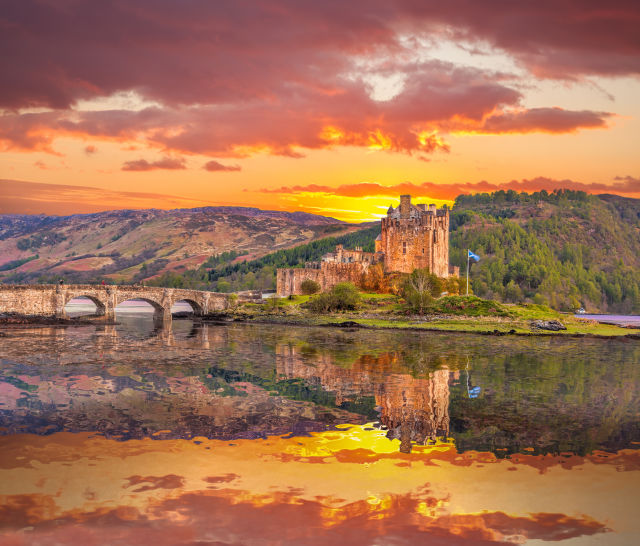
Eilean Donan is the one that most directly inspired DunBroch. The castle sits on a small island at the meeting point of three sea lochs in the western Highlands, connected to the mainland by a narrow stone bridge. Its Great Hall, with its deep shadows and dramatic firelit atmosphere, fired the Disney story team's imagination and became the template for the interiors of Merida's home.
Dunnottar changed the film's geography entirely. The Pixar team had originally planned to set DunBroch beside a loch in the Highlands, but after visiting Dunnottar's dramatic coastal location, a ruined fortress perched on a 160-foot sea stack and cut off from the mainland on three sides by sheer drops to the North Sea, they moved the castle to the coast instead.
Both castles are open to visitors and sit within a few hours of each other. Eilean Donan is near Dornie in the western Highlands and is one of the most photographed castles in Scotland. Dunnottar is about 15 miles south of Aberdeen on the east coast and is deeply under-visited by international tourists. Which is exactly why it's worth going.
You don’t need to be a Disney fan to appreciate these places. They stand on their own, from the history to the setting to the way each one fits naturally into its landscape. They were worth visiting long before they ever showed up in a film, and that still comes through when you see them in person. If you’ve seen the movies, there’s an added layer. Certain shapes and details start to feel familiar, even if you can’t quite place them at first. Seventy years after Disneyland opened, it’s a reminder that the magic didn’t start in California. It started in places like these.
Neuschwanstein Castle in Bavaria, Germany is the confirmed and official inspiration.
No, they're two separate Disney castles at two separate parks. Sleeping Beauty Castle is at Disneyland in Anaheim, California. Cinderella Castle is at Walt Disney World in Florida. Both were inspired by Neuschwanstein, and both were designed by the same Disney artist, Herbert Ryman. Neuschwanstein is the most direct inspiration for Sleeping Beauty Castle; Cinderella Castle draws on a wider mix of European châteaux.
Arendelle was confirmed by Disney to be based on several locations in Norway. Bergen's Bryggen wharf inspired the colorful harbor architecture, Akershus Fortress in Oslo inspired the castle exterior, and Nærøyfjord provided the sweeping fjord landscape. Hallstatt, Austria is widely cited by fans as a visual match, and it's striking, but Disney's art director pointed to Norway and Canada as his primary references and never officially confirmed Hallstatt.
Château de Chambord in France's Loire Valley. The château was built in 1519 and is open to visitors year-round.
Mont Saint-Michel in Normandy, France. A member of the Tangled production team confirmed that Disney wanted a Renaissance castle on a tidal island, exactly like Mont Saint-Michel, as the anchor for Rapunzel's kingdom. It's a UNESCO World Heritage Site and one of the most visited monuments in France.
Château de Chillon on Lake Geneva in Switzerland. The lakeside fortress has been in continuous use since the 12th century, sits on a limestone island near Montreux.
Two castles, each contributing something different. Eilean Donan Castle in the western Highlands, inspired the interiors and overall atmosphere of Castle DunBroch. Dunnottar Castle on the Aberdeenshire coast, changed the film's geography entirely. The Pixar team originally planned to set DunBroch by a loch, but after visiting Dunnottar they moved it to the coast. Both are open to visitors.
Yes, every castle in this article is open to the public. Neuschwanstein requires advance timed-entry tickets and is best reached as a day trip from Munich. Château de Chambord and Mont Saint-Michel are open year-round in France. Château de Chillon is a short train ride from Geneva. Eilean Donan and Dunnottar are both accessible in Scotland, and Akershus Fortress is easy to visit.
Disneyland's 70th Celebration began on May 16, 2025 and runs through August 9, 2026. The park opened its original gates on July 17, 1955.
Brave has the most directly documented research process, with the Pixar team making confirmed visits to multiple Scottish castles.