We use cookies to enhance your browsing experience, serve personalized content, and analyze our traffic. By clicking "Accept All" you accept this and consent that we share this information with third parties and that your data may be processed in the USA. For more information, please read our .
You can adjust your preferences at any time. If you deny, we will use only the essential cookies and unfortunately, you will not receive any personalized content.

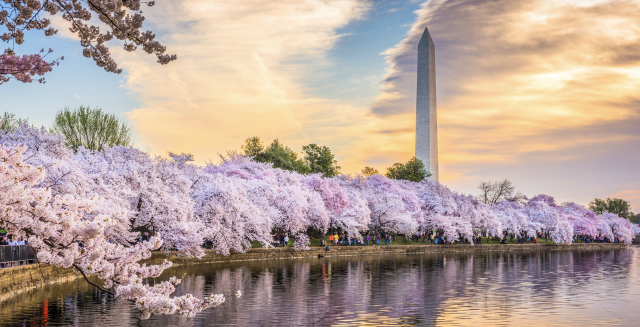
Washington D.C.’s cherry blossoms have officially reached peak bloom, and the city is in that brief, almost unreal moment where everything feels a little softer and brighter. If you’ve been thinking about making the trip, this is your window. Blooms usually last seven to ten days, and the clock is already ticking.
Peak bloom isn’t just a pretty phrase. It’s a specific milestone. The National Mall Service account announced on X just after 8am on Thursday that 70% of the Yoshino cherry blossoms around the Tidal Basin have now bloomed , which is the threshold that marks the moment the city has been waiting for.
Source: Screenshot of National Mall NPS page, @NationalMallNPS via X
This year, that moment arrived a few days earlier than expected. The National Park Service had predicted peak bloom somewhere between March 29 and April 1, so Thursday’s announcement came as a welcome surprise, especially after a winter that threw a more than 50-degree temperature swing at the trees in a single 24-hour period in mid-March.
The trees held up. The buds were still tight enough to handle the shift, and now more than 3,800 ornamental cherry trees across the Tidal Basin, East Potomac Park, and the Washington Monument grounds are doing exactly what they’re meant to do.
Originally a gift from Japan to the United States in 1912, the blossoms still draw more than 1.5 million visitors each spring, and once you see them in person, it’s easy to understand why.
The National Cherry Blossom Festival runs through April 12, and things are already in full swing.
Bloomfest brings daily performances to the Tidal Basin from March 27 through April 11, while the Blossom Kite Festival takes over the Washington Monument grounds on March 28. If you’re looking for something a little quieter, there are also afternoon teas, guided bike tours, and boat tours that let you take in the blossoms at a slower pace.
If you can’t make it in person, the festival’s live camera gives you a real-time look at the blooms.
The Tidal Basin is the main event, and during peak bloom, it gets busy fast. Sunrise sounds like the obvious move, but it tends to draw photographers aiming for the same soft light. Instead, National Mall spokesman Michael Litterst suggests aiming for around 10am or 2pm on a weekday, when things are a bit more manageable.
If you’d rather skip the crowds entirely, there are plenty of great alternatives. The National Arboretum, Stanton Park, and Dumbarton Oaks all offer cherry blossoms with far fewer people. National Harbor features the deeper pink Okame variety, which looks noticeably different from the pale Yoshino blooms. Lake Anne Plaza in Reston is another quiet option, where the trees frame the Van Gogh Bridge in a way that feels unexpectedly cinematic.
Branch Brook Park in Newark, New Jersey is home to more than 5,300 cherry trees, one of the largest collections in the country, with peak bloom expected between April 9 and April 16. The Brooklyn Botanic Garden’s Cherry Esplanade features 230 trees across 50 different varieties, which means the bloom season stretches over several weeks rather than just a few days.
Out west, Portland’s Japanese Garden is peaking right now, while Macon, Georgia, which calls itself a cherry blossom capital, has more than 350,000 Yoshino trees and has already hit peak bloom ahead of schedule.
If you’re thinking about heading to Washington, D.C., this is the moment to go. Peak bloom doesn’t last long, and the conditions that make the blossoms so beautiful also make them fragile. A stretch of heat, a heavy rain, or even a windy afternoon can bring the petals down almost overnight.
It’s part of what makes the experience feel so fleeting. For a few days, the city looks completely transformed, and then just as quickly, it shifts back. If you catch it at the right time, it’s worth it.
The National Park Service announced peak bloom on the morning of Thursday, March 26, a few days earlier than the predicted window of March 29 to April 1.
Blooms typically last seven to ten days, though weather can shorten that window. Heat, rain, and wind are the main factors.
The main display is around the Tidal Basin in West Potomac Park, with additional trees at East Potomac Park and the Washington Monument grounds. For fewer crowds, try the National Arboretum, Stanton Park, or Dumbarton Oaks.
The festival runs through April 12 and draws over 1.5 million visitors annually. Events include Bloomfest and the Blossom Kite Festival.
Around 10am or 2pm on a weekday. Sunrise tends to be busy with photographers.
National Harbor, Lake Anne Plaza in Reston, and Branch Brook Park in Newark are all strong alternatives.
Yes. The National Cherry Blossom Festival streams a live camera of the Tidal Basin.