We use cookies to enhance your browsing experience, serve personalized content, and analyze our traffic. By clicking "Accept All" you accept this and consent that we share this information with third parties and that your data may be processed in the USA. For more information, please read our .
You can adjust your preferences at any time. If you deny, we will use only the essential cookies and unfortunately, you will not receive any personalized content.

On May 8, 2026, Sir David Attenborough turns 100 years old, and the world is celebrating. From the Royal Albert Hall to the Natural History Museum, tributes are pouring in for the man who introduced millions of people to the wonders of the natural world. He's narrated gorillas, filmed underwater hippo fights, and once hung 250 feet up a rope to watch a million bats fly past. If anyone has earned a bucket list, it's him. So where does he actually go when he wants to feel close to nature? Here are the two places he loves most.
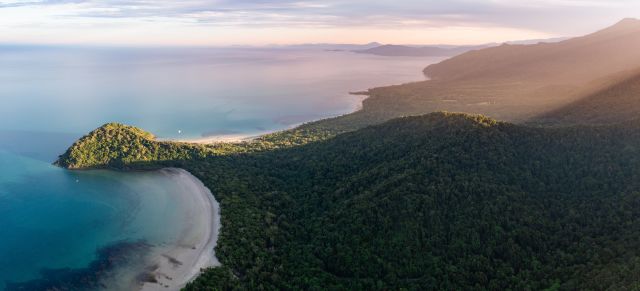
Attenborough has called the Daintree Rainforest “the most extraordinary place on Earth,” and it’s not hard to understand why. Even after a lifetime spent filming in the Arctic, the Galápagos, and the deep oceans, this is the place he continues returning to in interviews and documentaries alike.
This ancient rainforest has been growing for more than 180 million years, making it older than the Amazon by roughly 10 million years. Even more remarkably, it sits directly alongside the Great Barrier Reef, meaning two of the most biologically rich ecosystems on Earth meet along the same stretch of coastline. It’s the kind of landscape that makes you feel very small in the best possible way.
Attenborough first filmed there in 2008 for the Natural World series while tracking the elusive Southern Cassowary deep within the rainforest. The cassowary feels almost prehistoric in person — massive, silent, brightly colored, and slightly intimidating — exactly the sort of creature Attenborough has spent decades helping audiences appreciate and protect.
Today, travelers can explore the Daintree through crocodile-spotting river cruises, guided night walks, canopy boardwalks, and cultural tours led by the Kuku Yalanji people, whose connection to this land stretches back tens of thousands of years. It’s the kind of place where every sound feels ancient: rustling palms, distant bird calls, sudden movement in the undergrowth, and air so thick with life that it almost feels alive itself.
The rainforest is easily accessible from Cairns, though it still feels wonderfully remote once you’re inside it. Practical tip: the best time to visit is generally between May and October, when temperatures are milder, humidity drops, and road access is more reliable.
Closer to his home in the UK, Attenborough has repeatedly singled out the Farne Islands as one of his favorite places to experience wildlife. And honestly, during puffin season, the islands sound almost unreal.
Every year, roughly 40,000 pairs of puffins return to the Farnes alongside more than 150,000 seabirds in total, turning the cliffs into a chaotic blur of wings, squawking, and nonstop movement. Add in one of Europe’s most important colonies of Atlantic grey seals, and the entire place feels less like a quiet island chain and more like nature operating at full volume.
The islands appeared in Attenborough’s 2023 Wild Isles series, including memorable footage of puffins desperately trying to defend their chicks from opportunistic gulls. It’s exactly the kind of small but dramatic wildlife moment he’s spent decades helping audiences notice and care about. And if you want a preview before planning a trip, the Farne Islands puffin cam is streaming live through the end of July 2026.
To visit, travelers take a boat from Seahouses Harbour, and summer departures often sell out well in advance. Most landings happen on Inner Farne, where visitors are asked to keep a respectful distance from nesting birds, especially near the cliffs. One important thing to know ahead of time: dogs aren’t permitted on Inner Farne or Staple Island in order to protect the wildlife colonies.
There's a pattern to Attenborough's favorites: they're both ancient, both under threat, and both teeming with life that most of us wouldn't otherwise encounter. The Daintree faces ongoing pressure from climate change and deforestation. The Farne Islands depend on careful visitor management to protect their seabird populations. Loving these places means protecting them, and Attenborough has spent a century making that case with more charm and patience than most of us could manage.
Visiting either place, thoughtfully and responsibly, feels like a fitting way to celebrate a man who has spent his life showing us what we stand to lose. He said he'd hoped to celebrate his 100th quietly. We hope he gets at least a few minutes of that. Happy birthday, Sir David.
Yes. Sir David Attenborough turned 100 years old on May 8, 2026, and marked the milestone with a live celebration at the Royal Albert Hall in London, broadcast on BBC One.
Attenborough has described the Daintree Rainforest in North Queensland, Australia as "the most extraordinary place on Earth." He filmed there in 2008 and has cited its ancient age, biodiversity, and proximity to the Great Barrier Reef as what makes it so special.
He's said the Farne Islands off the Northumberland coast are his favorite spot in the UK. The islands are home to around 40,000 puffin pairs during breeding season and an internationally significant grey seal colony.
Yes. Boats depart from Seahouses harbour, and advance booking is recommended. Landing is on Inner Farne. Dogs are not allowed on Inner Farne or Staple Island, and visitors should keep at least 100 meters from cliff-nesting birds.
The dry season, May through October, is generally the best time to visit. Roads are more accessible, the heat is more manageable, and wildlife is active year-round.
Puffins, guillemots, Arctic terns, grey seals, and over 150,000 seabirds in total during peak breeding season. The puffin cam runs live through the end of July 2026.
He clearly does. The Farne Islands, which he named as his favorite place in the UK to observe nature, are home to around 37,000 pairs of puffins every breeding season.
The Southern Cassowary is the headline act, but the Daintree is also home to crocodiles, tree kangaroos, rare birds, and many species found nowhere else on Earth.
Over 180 million years old, making it the world's oldest tropical rainforest, older than the Amazon by around 10 million years.
He's cited its unmatched biodiversity, ancient history, and the meeting point of two World Heritage areas as the reasons it holds the top spot: the rainforest itself and the adjacent Great Barrier Reef.