We use cookies to enhance your browsing experience, serve personalized content, and analyze our traffic. By clicking "Accept All" you accept this and consent that we share this information with third parties and that your data may be processed in the USA. For more information, please read our .
You can adjust your preferences at any time. If you deny, we will use only the essential cookies and unfortunately, you will not receive any personalized content.

Zion National Park's most famous landscapes aren't exactly easy terrain. Steep grades, uneven canyon floors, sand, gravel, and rocky trails can make large parts of the park difficult or impossible to navigate in a standard wheelchair. Now Zion has added an Extreme Motus all-terrain wheelchair that visitors with mobility challenges can use for free.
Zion is believed to be the first U.S. national park to own and maintain this type of adaptive equipment itself for public use. Other parks have offered similar chairs through nonprofit partnerships, but Zion's chair belongs to the park and is checked out directly through park staff.
Zion is believed to be the first U.S. national park to own and maintain its own all-terrain wheelchair for public use.
The chair is an Extreme Motus, made by a Payson, Utah-based company.
It's free to use, first-come, first-served, with no advance reservations.
The chair was funded by a private donor through the nonprofit 2Live4.
It's available at the Zion Canyon Visitor Center information desk.
Both the user and an assistant must complete a waiver and brief training.
Either the user or assistant must provide identification and proof of insurance.
The chair is too long for the Zion shuttle, so users receive an accessibility pass allowing them to drive Zion Canyon Scenic Drive.
It's not self-powered, so users need an assistant to push it.
The Narrows, Angels Landing, Canyon Overlook, and Upper Emerald Pools are among the routes where the park's loaner chair cannot be used.
Zion's program stands out because the park itself owns and operates the equipment. Similar adaptive chairs are available elsewhere, including through nonprofit-supported programs at Redwood National and State Parks, but Zion's Extreme Motus is integrated directly into normal park operations rather than being owned and managed by an outside organization.
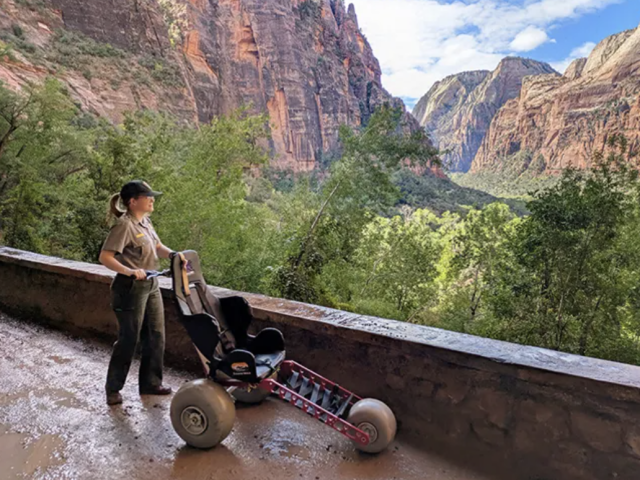
The chair is designed specifically for terrain that can stop a standard wheelchair almost immediately. It uses oversized, low-pressure Wheeleez balloon tires to move more smoothly across surfaces like sand, gravel, and uneven ground, while independent rear disc brakes give the assistant more control on slopes and rugged sections of trail.
Photo Courtesy of the National Park Service
The chair arrived at Zion in July 2025, funded by a private donor through 2Live4, a nonprofit that works to make adaptive outdoor equipment more accessible. The effort also connects back to Extreme Motus co-founder Ryan Grassley, who spent years developing the chair while taking his friend Sam Durst, who has cerebral palsy, on outdoor adventures throughout Utah.
Those trips helped shape the design into something made specifically for people who want to experience places that conventional mobility equipment often can't reach. Stories from the program's rollout have included families becoming emotional when they realize the chair exists, a pretty clear reminder of how often "accessible" outdoor recreation has historically meant a paved overlook rather than an actual trail.
The Extreme Motus is available at the Zion Canyon Visitor Center information desk on a first-come, first-served basis. There is currently only one chair, and the park does not accept advance reservations. Both the wheelchair user and their assistant must complete a waiver, while either the user or assistant needs to provide identification and proof of insurance.
A ranger gives users a short training session before checkout, covering the chair's features and safe operation. The chair must also be returned the same day, so this isn't equipment visitors can take away overnight or use outside the park.
Because the Extreme Motus measures about six feet long while in use, it exceeds the size limits for Zion's shuttle system. Instead, users receive an accessibility pass that allows them to drive and park along Zion Canyon Scenic Drive even during the season when most visitors are required to use the shuttle.
Photo Courtesy of the National Park Service
Zion recommends the chair for several areas of the park that can be difficult to navigate with a traditional wheelchair, including the Pa'rus Trail, Riverside Walk, Weeping Rock, and Lower Emerald Pools. More rugged options include parts of the West Rim, East Rim, Taylor Creek, and the Observation Point route via East Mesa, although park guidance notes that additional assistants may be useful on steeper or more demanding terrain.
There are also clear limits. The park's loaner chair cannot be used in the Narrows, despite Extreme Motus chairs having been taken there independently in the past. Angels Landing, Canyon Overlook, and Upper Emerald Pools are also among the routes where Zion does not permit or recommend use of the loaner chair.
That distinction matters because the goal isn't to suggest that one piece of equipment suddenly makes every trail accessible. What it does is dramatically expand the number and type of places some visitors can realistically experience.
Zion joins a small but growing group of parks experimenting with adaptive equipment, including state park systems and nonprofit-backed programs elsewhere in the country. What makes Zion especially interesting is its ownership model. Rather than relying on a third party to bring equipment in, the chair is part of the park's own visitor services.
That could make the program easier for other national parks to replicate. A single chair obviously doesn't solve every accessibility barrier, but it does move the conversation beyond ramps and viewpoints and toward actual access to trails, scenery, and experiences that many visitors have historically had to skip.
As the child of a father who has been paralyzed my entire life, accessibility is something I tend to notice wherever I go. I was in Zion just a couple of weeks ago, and even standing there looking at those canyon trails, I never would have imagined that an experience like this could be possible for someone using a wheelchair.
That's why this feels bigger than one new piece of equipment. Zion's chair won't make every trail accessible, but it opens up experiences that some families may have assumed were completely out of reach. Opening doors matters, especially in places where access has historically stopped at the paved overlook. If Zion's model works, hopefully it becomes something other national parks are eager to replicate.
Yes. The Extreme Motus is available free of charge on a first-come, first-served basis.
No. The park does not currently accept reservations for the chair.
The chair is available from the information desk at the Zion Canyon Visitor Center.
Both the user and assistant must complete waivers. Either the user or assistant must also provide identification and proof of insurance.
No. The chair is too long to fit within the shuttle's size restrictions. Users instead receive an accessibility pass that allows them to drive Zion Canyon Scenic Drive.
No. The Extreme Motus requires an assistant to push it, although its tires and braking system are designed to make rough terrain easier to manage than with a standard wheelchair.
Zion recommends routes including the Pa'rus Trail, Riverside Walk, Weeping Rock, and Lower Emerald Pools, along with several more rugged designated options. Conditions and individual mobility needs still matter.
No. The Narrows is listed among the routes where Zion's public loaner chair cannot be used.
Angels Landing, Canyon Overlook, Upper Emerald Pools, and the Narrows are among the routes where the chair cannot be used.
A private donor funded the chair through the nonprofit 2Live4.