
We use cookies to enhance your browsing experience, serve personalized content, and analyze our traffic. By clicking "Accept All" you accept this and consent that we share this information with third parties and that your data may be processed in the USA. For more information, please read our .
You can adjust your preferences at any time. If you deny, we will use only the essential cookies and unfortunately, you will not receive any personalized content.
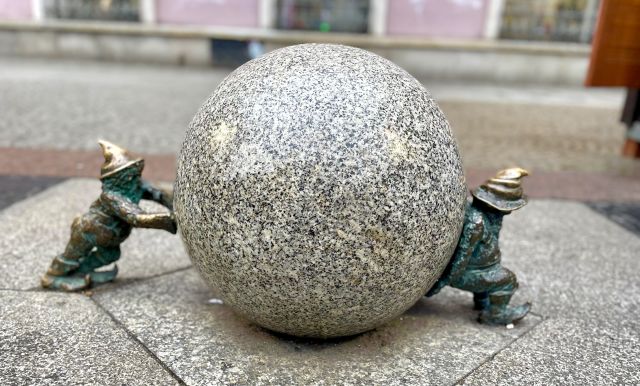
I visited Wrocław in December for the Christmas market and fully expected to spend my time doing the usual winter-city things: sipping something warm, admiring the lights, and pretending I was “just browsing” the ornaments. Instead, I was happily derailed by something much smaller. Wrocław’s gnomes (krasnale) are tiny bronze statues scattered across the city, and once you spot your first one, your brain switches into treasure-hunt mode.
You start scanning corners, peeking into doorways, and walking a little slower, because once you spot one gnome, you are convinced there are three more nearby. They are funny, oddly expressive, and genuinely woven into Wrocław’s identity.
The gnomes are not just cute street decorations. Their roots go back to the 1980s, when Wrocław became a center of creative resistance during communist rule in Poland. An underground protest movement known as the Orange Alternative used humor and absurdity to undermine authority without confrontation. One of their most recognizable tactics was painting dwarf graffiti over places where anti-government slogans had been censored, turning censorship itself into something openly ridiculous.
In 2001, that history took on a permanent form with the installation of Papa Dwarf (Papa Krasnal), the first official bronze gnome and a tribute to the Orange Alternative. From there, the idea spread quickly. Businesses, institutions, and neighborhoods began commissioning their own gnomes, each one tied to a place, a profession, or a local in-joke.
Konspirek (left): Paintbrush in hand, Konspirek honors Wrocław’s underground protest movement. A reminder that humor, art, and quiet rebellion once fought their battles on these streets.
Kolekcjoner (right): Armed with a magnifying glass and a serious eye for detail, the Collector hoards coins like a tiny financial strategist. Even gnomes plan for uncertain times.
The joy of the gnomes is how they change the way you move through the city. Many are positioned at street level and staged like miniature scenes: a gnome hard at work outside an office, one relaxing near a café, another quietly tucked beside a doorway you would normally walk past without noticing.
There are now hundreds of gnomes (approximately over 700!) across Wrocław, and the number keeps growing. The exact count changes year to year, which only adds to the appeal. You never feel finished. You just feel curious.
Krasnal Piernikarz (Gingerbread Dwarf): Forever surrounded by imaginary clouds of spice and sugar, this gnome is Wrocław’s tribute to gingerbread and sweet traditions. If you have a sweet tooth, he gets you.
You do not need a rigid plan to enjoy this. A loose route is more than enough.
Start in the Old Town around Rynek, where gnome density is high and wandering feels effortless. Use an official gnome map or listing to spot clusters rather than chasing every single statue. Treat the hunt as a loop: wander, spot a few, stop for coffee, repeat.
What makes this experience special is how naturally it fits into daily life. The gnomes are not staged attractions. They blend into the city, which makes finding them feel like a small, shared secret.
On the surface, the gnomes are pure whimsy. Underneath, they carry a deeper meaning. They are reminders that humor can be powerful, that creativity can outlast repression, and that a city can choose to remember its history in a way that feels light without being shallow.
Wrocław’s gnomes do more than decorate the streets. They slow you down. They make you look closer. And they quietly change the way you experience the city.
Piwożłopek (Beer-Drinker) and Pieseł Piwosz (Beerdog): Pints up, tails wagging. This beer-loving duo guards a local brewery and celebrates Wrocław’s devotion to good beer and better company.
What are the Wrocław gnomes?
Tiny bronze statues scattered across Wrocław, known locally as krasnale.
Why does Wrocław have gnomes everywhere?
They grew out of a 1980s protest movement that used dwarfs as a symbol of peaceful resistance.
Who was the first gnome?
Papa Dwarf (Papa Krasnal), installed in 2001.
How many gnomes are there?
Hundreds. Most estimates put the number at 700+.
Where can I get a gnome map?
At tourist information offices or on official Wrocław tourism sites.
Is gnome hunting free?
Yes. All gnomes are in public spaces.
Is this good for kids?
Yes. It works like a city-wide scavenger hunt.
When is the best time to look for gnomes?
Any season, with winter pairing especially well with the Christmas market.
Do I need a tour?
No. You can find plenty just by wandering the Old Town.
Why are the gnomes so popular?
They make you slow down and see the city differently.