We use cookies to enhance your browsing experience, serve personalized content, and analyze our traffic. By clicking "Accept All" you accept this and consent that we share this information with third parties and that your data may be processed in the USA. For more information, please read our .
You can adjust your preferences at any time. If you deny, we will use only the essential cookies and unfortunately, you will not receive any personalized content.

If you watched War Machine on Netflix this weekend and found yourself paying more attention to the scenery than the alien robot, you are not alone. Travel-minded fans started sharing filming locations online almost immediately after the movie premiered, turning the backdrop into an unexpected travel map for movie lovers. The good news is that most of those locations are real, accessible, and genuinely worth visiting on their own terms. Here is where War Machine was filmed and why those places deserve a spot on your travel list.
Alan Ritchson plays a grieving Army Ranger candidate known only as 81, carrying trauma from a failed rescue mission in Afghanistan, who finds himself forced into the leadership role he's been quietly avoiding. During the final stage of Ranger selection, the training exercise goes sideways when the recruits encounter a giant alien killing machine in the wilderness.
Think Predator if it were made in 2026 with a much bigger budget and a lead who looks like he bench presses helicopters for fun. It's not trying to be anything other than a big, bold action movie, and it largely delivers on that promise.
The cast includes Dennis Quaid, Stephan James, Jai Courtney, Esai Morales, Keiynan Lonsdale, and Daniel Webber.
Most of War Machine was filmed in the Australian state of Victoria, located in the southeastern part of the country and home to the city of Melbourne. While many travelers associate Australia with beaches and deserts, Victoria also includes mountain landscapes known as the Victorian Alps, part of the larger Australian Alps range.
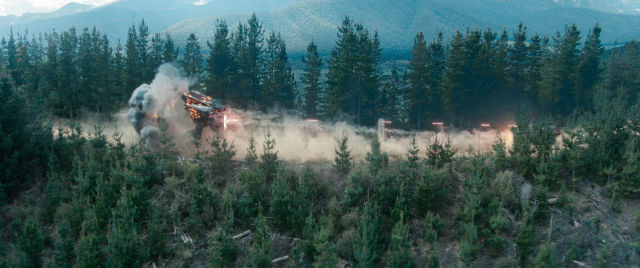
The movie’s wilderness scenes were filmed around the alpine towns of Bright and Myrtleford in the Ovens Valley, about three hours northeast of Melbourne.
These towns sit at the foothills of the Victorian Alps, a region known for hiking trails, cycling routes, ski areas, and dramatic autumn foliage that turns the valley gold each April and May.
The same forests and rugged mountain terrain that create the film’s most intense survival scenes are completely accessible to travelers willing to make the drive.
Bright has become one of Victoria’s favorite weekend destinations thanks to its relaxed mountain-town atmosphere, outdoor recreation, and surprisingly strong food scene for a regional town.
Interior scenes and studio work were completed at Docklands Studios Melbourne, one of Australia’s largest film production facilities.
Military training sequences were filmed at RAAF Base Williams in Laverton, an active Royal Australian Air Force base outside Melbourne. The base itself is not open to visitors, but many of the surrounding landscapes used in the film are easily accessible.
The production’s final filming stage moved to Queenstown, New Zealand, a resort town on the South Island that sits on the shores of Lake Wakatipu and is surrounded by steep alpine mountains.
For travelers unfamiliar with the region, Queenstown is widely considered the adventure capital of New Zealand, known for skiing, bungee jumping, jet boating, and dramatic mountain scenery.
The landscapes surrounding the town have made it a favorite filming location for major productions for decades.
Several of the film’s largest outdoor sequences were shot in the Kawarau River gorge near Queenstown.
The steep canyon walls, rushing river, and rugged terrain create dramatic natural landscapes that would cost millions to recreate on a soundstage. The surrounding mountains and glacial lakes provide the kind of scale and visual drama that action movies rely on.
Additional scenes were filmed in Wanaka and Alexandra, both located within driving distance of Queenstown. Wanaka sits about an hour north of Queenstown and is known for its lakefront setting and quieter atmosphere. Many travelers consider it one of the most beautiful towns in New Zealand and a more relaxed alternative during peak season.
Alexandra, farther inland, provided additional alpine terrain and rural scenery used in the production. For travelers, Alexandra is a quieter base for exploring Central Otago's famous cycling trails and wine country, with the Otago Central Rail Trail passing right through.
Yes, and easily. Here's the practical version:
Bright, Victoria is a three-hour drive from Melbourne and makes a perfect weekend trip, especially in autumn (April and May) when the valley turns gold. Think hiking, cycling, and very good food for a regional Australian town.
Myrtleford is just down the road from Bright and worth combining into the same trip. Quieter, less visited, and surrounded by the same alpine terrain used in the film.
Queenstown, New Zealand is one of the country’s best known travel destinations and has an international airport with connections through Auckland, Sydney, and Melbourne.
Wanaka, about an hour from Queenstown, was also used in production and is one of New Zealand's most underrated lake towns. Quieter than Queenstown, equally beautiful, and much easier to navigate in peak season.
Honestly, yes, as long as you go in with the right expectations. Audiences have been responding well to the film’s fast pacing, big action sequences, and its unapologetically old-school energy. Many viewers say it feels like a throwback to the kind of straightforward action movies that used to dominate theaters in the 1980s and 1990s.
Critics are more divided. Some see it as formulaic, while others appreciate that it doesn’t pretend to be anything more than a pure action ride. Ritchson leans fully into the role with a physically demanding, stoic performance. It may not be the kind of performance that wins awards, but it’s exactly what this movie calls for.
If you’ve already watched every season of Reacher twice and still want more Alan Ritchson charging toward danger, War Machine will probably feel like a bonus episode with a bigger budget. If you prefer action movies that have something deeper to say, this one may not land the same way. And honestly, there’s nothing wrong with either reaction.
The landscapes in War Machine were doing interesting things long before any cameras showed up. Victoria's alpine valleys and Queenstown's mountain ranges have been drawing travelers for decades, and the film just gives you a new excuse to add them to the list. Sometimes that's exactly enough.
War Machine was filmed primarily in Victoria, Australia, and Queenstown, New Zealand. Key Australian locations include the alpine towns of Bright and Myrtleford in regional Victoria, Melbourne, Docklands Studios Melbourne, and RAAF Base Williams in Laverton. New Zealand filming took place in Queenstown, Wanaka, and Alexandra on the South Island.
Most of them, yes. Bright and Myrtleford are popular tourism destinations in regional Victoria, accessible by car from Melbourne in about three hours. Queenstown and Wanaka in New Zealand are well-established travel destinations with international flight connections. The RAAF Base Williams military facility is not open to the public.
War Machine follows Army Ranger candidate 81, played by Alan Ritchson, whose training exercise during the final stage of Ranger selection turns into a fight for survival when the recruits encounter a giant alien killing machine in the wilderness. It also stars Dennis Quaid, Stephan James, and Jai Courtney.
No. They share a title but have nothing to do with each other. The 2017 War Machine was a political satire about the war in Afghanistan starring Brad Pitt. The 2026 version is a sci-fi action thriller about Army Rangers and an extraterrestrial threat.
War Machine premiered on Netflix globally on March 6, 2026. It had a limited theatrical release in Australia on February 12, 2026.
If you enjoy old-school action movies in the Predator tradition, yes. It's fast, visually impressive, and doesn't overstay its welcome at 1 hour and 46 minutes. Critics have been mixed, but audience scores skew positive.
Bright is approximately a three-hour drive northeast of Melbourne via the Hume Freeway and Great Alpine Road. It's a popular weekend destination for Melburnians and one of the most scenic drives in Victoria.