We use cookies to enhance your browsing experience, serve personalized content, and analyze our traffic. By clicking "Accept All" you accept this and consent that we share this information with third parties and that your data may be processed in the USA. For more information, please read our .
You can adjust your preferences at any time. If you deny, we will use only the essential cookies and unfortunately, you will not receive any personalized content.

Each winter, a city in northeastern China becomes home to the largest ice festival in the world. In Harbin, enormous buildings are carved from river ice, illuminated from within, and opened to visitors for a limited stretch of the season. The result is a temporary city made entirely of ice, and one of the most distinctive winter travel experiences anywhere.
Harbin is known for its long, deeply cold winters, conditions that make the Harbin International Ice and Snow Festival possible at an unmatched scale. Ice is harvested directly from the frozen Songhua River, cut into massive blocks, and assembled into full-scale structures designed to stand for weeks at a time.
The festival is open now and typically runs through late February, depending on weather conditions.
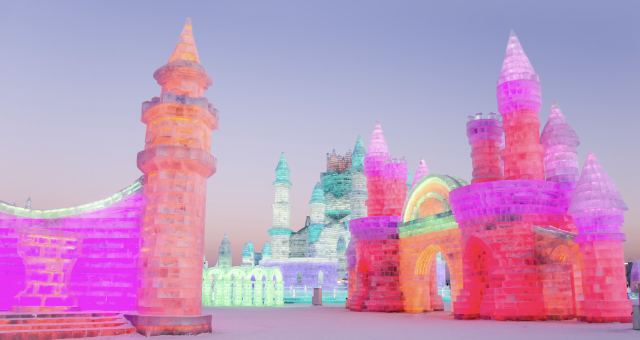
At the center of it all is Harbin Ice and Snow World, a vast outdoor park laid out like a temporary district of the city. Towers, bridges, and palace-like complexes form walkable streets and plazas, all constructed entirely from ice. After sunset, lighting embedded within the structures brings the park to life, with color and transparency shifting as visitors move through the space. Rising above the ice structures is the park’s snowflake-shaped Ferris wheel, which offers elevated views over the illuminated ice city and underscores the sheer scale of the festival from above.
Rather than a single installation, Ice and Snow World functions as a fully realized neighborhood, one that exists only during the coldest weeks of the year.
While Ice and Snow World draws the most attention, the festival extends across several locations in Harbin. Sun Island features monumental snow sculptures created by international artists, many of them several stories tall and best viewed during daylight hours. Zhaolin Park, closer to the city center, showcases traditional ice lantern displays rooted in Harbin’s long-standing winter culture.
Across the festival, winter activities are integrated into many areas, including ice skating, tubing, beginner-friendly ski zones, and long ice slides, making the experience interactive as well as visual.
Harbin’s climate is central to the festival’s scale and longevity. Average daytime temperatures in January and February hover around 9°F, with nighttime lows often near -11°F. These sustained subfreezing conditions allow large ice structures to remain stable for weeks.
Visitors should plan for insulated outerwear, winter boots, gloves, and face protection. Heated indoor areas and food halls throughout the festival help balance time outdoors.
Most travelers plan two to three days in Harbin to see the main festival sites without rushing. Ice and Snow World is best visited in the late afternoon and evening, when lighting effects are fully visible. Because this is Harbin’s busiest travel season, accommodations and tickets can book up during peak weeks.
For official updates, hours, and ticket information, visit the festival’s official website:
Where is the Harbin Ice and Snow Festival held?
The festival takes place in Harbin, the capital of Heilongjiang Province in northeastern China. Major venues include Ice and Snow World, Sun Island, and Zhaolin Park.
How long does the festival run?
The festival typically runs from early January through late February, depending on weather conditions.
Is this really the largest ice festival in the world?
Yes. The Harbin International Ice and Snow Festival is widely regarded as the largest ice and snow festival globally, based on scale, duration, and the size of its ice architecture.
How cold does it get in Fahrenheit?
Daytime temperatures in midwinter average around 9°F, with nighttime lows near -11°F, and colder periods are possible.
How much time should visitors plan?
Two to three days is ideal for seeing Ice and Snow World, Sun Island, and central Harbin without feeling rushed.
Is the festival family-friendly?
Yes. Many areas include ice slides, skating zones, and winter activities suitable for children, though proper cold-weather clothing is essential.
Do U.S. travelers need a visa to visit Harbin?
Most American travelers will need a visa to visit mainland China. Entry requirements can change, so travelers should confirm current rules before planning.