We use cookies to enhance your browsing experience, serve personalized content, and analyze our traffic. By clicking "Accept All" you accept this and consent that we share this information with third parties and that your data may be processed in the USA. For more information, please read our .
You can adjust your preferences at any time. If you deny, we will use only the essential cookies and unfortunately, you will not receive any personalized content.

For decades, the idea of staying overnight on the Moon lived firmly in the realm of science fiction. That’s now changing. A space startup called GRU Space has unveiled plans for what it says will be the world’s first hotel on the Moon, designed for wealthy space travelers who want to do more than just orbit Earth. If everything stays on schedule, the first guests could arrive in the early 2030s.
While the price tag puts this experience far outside the reach of most travelers, the project marks a major shift in how we think about travel, tourism, and humanity’s future beyond Earth.
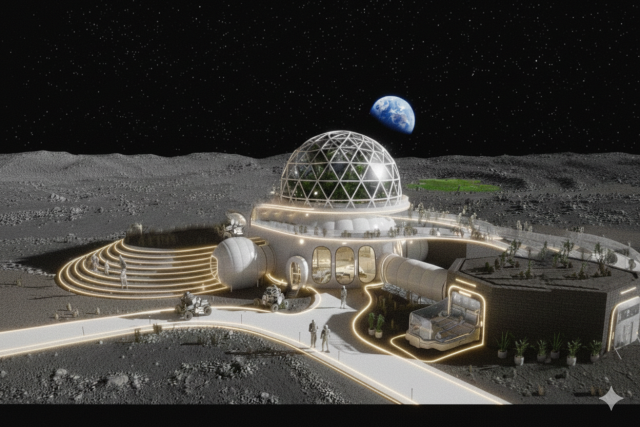
GRU Space’s lunar hotel is planned as a modular habitat set directly on the Moon’s surface. The first phase features an inflatable structure designed to host up to four guests for multi-day stays, with later phases expanding the hotel using materials made from lunar soil to increase capacity to around ten guests. The project is led by Skyler Chan, Founder and CEO of GRU Space, who previously worked on vehicle software at Tesla, helped build a NASA-funded 3D printer launched into space, and graduated early from UC Berkeley’s EECS program to focus on making humanity interplanetary.
Guests aren’t just stopping by the Moon. They’re meant to spend real time there. Instead of a brief visit lasting a few hours, they would sleep, float, eat, and settle into daily life on the lunar surface. Rooms are envisioned with large viewing windows offering constant views of the Moon below and Earth hanging in the distance.
Note: The image above is an AI-generated concept rendering for illustrative purposes only. It does not represent real facilities and is not affiliated with, approved by, or produced by GRU Space.
Planned activities include guided moonwalks, driving lunar rovers, low-gravity golf, and surface exploration, all supported by trained professionals and advanced life-support systems.
Note: The image above is an AI-generated concept rendering for illustrative purposes only. It does not represent real facilities and is not affiliated with, approved by, or produced by GRU Space.
You can’t book a date yet, but you can apply. GRU Space is currently accepting applications for early access to the lunar hotel. Applicants must pay a $1,000 non-refundable application fee. If selected, they may then be invited to place a fully refundable deposit of either $250,000 or $1 million, depending on the reservation tier.
Final pricing hasn’t been announced yet, but the company expects the total cost to exceed $10 million per guest once the hotel opens. Guests would also need to meet strict medical, financial, and training requirements, since traveling to and staying on the Moon is far more demanding than any trip on Earth.
According to GRU Space’s timeline, the project is planned in stages. Construction payloads are expected to land on the Moon around 2029, followed by habitat setup and astronaut training in the early 2030s. If everything stays on track, the first guests could arrive soon after.
This timeline fits with broader efforts to establish a long-term human presence on the Moon, including upcoming lunar missions planned by NASA and other space agencies.
At first glance, a Moon hotel sounds like the ultimate luxury travel flex. But for GRU Space, tourism is only part of the picture. The company sees the hotel as a first step toward living off Earth for the long term. Learning how to build, maintain, and live inside structures on the Moon is seen as essential before humans can settle places like Mars.
In that sense, the hotel isn’t just about travel. It’s about building the foundation for future lunar bases, research stations, and eventually entire communities beyond Earth.
Note: The image above is an AI-generated concept rendering for illustrative purposes only. It does not represent real facilities and is not affiliated with, approved by, or produced by GRU Space.
It’s ambitious, expensive, and technically challenging, but it isn’t pure fantasy. Private spaceflight, lunar landers, inflatable habitats, and robotic construction are all being actively developed right now. GRU Space has funding, a public roadmap, and a clear idea of where it wants to go, even if the path there is anything but simple. This is still frontier territory, and delays or detours are very much on the table. Even so, the fact that you can apply for a Moon hotel in 2026 says a lot. Space travel is no longer just about exploration or science missions. It’s starting to look a lot like an industry.
And one day, it may just be another place you book a stay—complete with a view that’s hard to top.
Editor’s note: We sincerely hope the name GRU is an intentional nod to Despicable Me and Gru’s lifelong dream of stealing the Moon. If so, respect.
Main image and above image are AI-generated concept renderings for illustrative purposes only. They do not represent real facilities and are not affiliated with, approved by, or produced by GRU Space.
Can anyone stay at the Moon hotel?
No. This experience is designed for ultra-high-net-worth travelers who meet strict medical, financial, and training requirements. Spaceflight experience may be required.
How much does it cost to stay at the Moon hotel?
Final pricing has not been set, but GRU Space estimates costs will exceed $10 million per guest. Applicants must also pay a $1,000 non-refundable application fee and place a large refundable deposit if selected.
When will the Moon hotel open?
If timelines hold, construction could begin around 2029, with the first guests arriving in the early 2030s.
Where on the Moon will the hotel be located?
GRU Space has not publicly disclosed the exact location, but it is expected to be placed in a region suitable for long-term habitation and construction.
Is this just a concept, or is it actually happening?
The project is in early development but is real. Applications are open, funding exists, and a phased construction timeline has been announced, though regulatory and technical approvals are still required.
Will there be other Moon hotels in the future?
Possibly. As lunar infrastructure expands, tourism could follow. This hotel is widely seen as a first step rather than a one-off experiment.