
We use cookies to enhance your browsing experience, serve personalized content, and analyze our traffic. By clicking "Accept All" you accept this and consent that we share this information with third parties and that your data may be processed in the USA. For more information, please read our .
You can adjust your preferences at any time. If you deny, we will use only the essential cookies and unfortunately, you will not receive any personalized content.
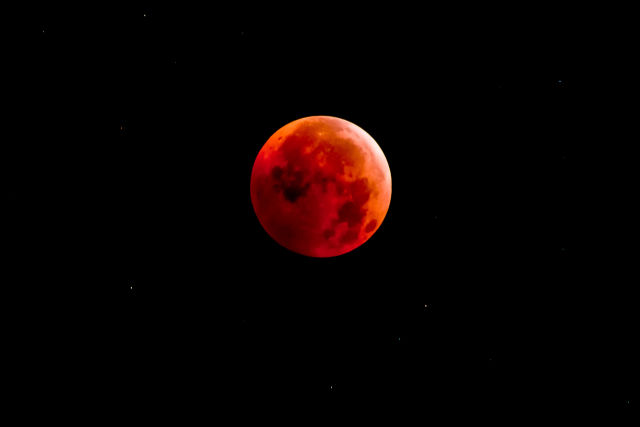
Early Tuesday morning, the moon over North America will slowly darken, then turn a deep copper red as it passes fully into Earth’s shadow. For nearly an hour, a total lunar eclipse will be visible without special glasses, telescopes, or tickets. Just clear skies and a little willingness to wake up early.
This is the first total lunar eclipse of the year and the last one visible anywhere on Earth until late 2028. If you are in the United States, Canada, or Mexico, this is your window. Here is exactly when to look up and how to make sure you do not miss it.
All times below are Eastern Time. Adjust for your time zone.
3:44 a.m. ET: The moon enters the penumbra. Subtle dimming begins.
4:50 a.m. ET: The moon enters the darker umbra. A curved shadow appears.
6:04 a.m. ET: Totality begins. The moon turns red.
6:33 a.m. ET: Peak red coloration.
7:03 a.m. ET: Totality ends.
On the West Coast, totality occurs between roughly 3:04 a.m. and 4:03 a.m. local time, with darker skies and arguably the best viewing conditions.
On the East Coast, sunrise begins as totality ends, which may wash out some of the red glow. You will still see the eclipse, but the contrast will be softer.
If you are in central time zones, you are in a sweet spot between dark skies and convenient timing.
Clear weather will determine everything.
Forecast models currently suggest:
Best odds for clear skies: California, Nevada, Oregon, Washington, Arizona, Colorado, New Mexico
Favorable conditions: Much of inland western U.S. and parts of Mexico
More uncertain: Central and northern U.S.
Variable but possible: Parts of New York State and New England
If clouds are a concern, head toward open areas away from city lights. A flat western horizon is especially helpful if the moon is setting during totality in your location.
During a total lunar eclipse, Earth moves directly between the sun and the moon. The moon enters the darkest part of Earth’s shadow, known as the umbra.
But the moon does not disappear. Sunlight bends through Earth’s atmosphere, which filters out blue light and allows red and orange wavelengths to reach the lunar surface. The result is a copper or crimson glow.
The exact shade depends on what is in the atmosphere at the time. Dust, smoke, or volcanic particles can deepen the red tone. For about 59 minutes, the moon will look as though it has borrowed every sunrise and sunset on Earth at once.
If you are on the East Coast or in eastern Canada, you may notice something unusual near sunrise. In some locations, the sun and the eclipsed moon can briefly appear in the sky at the same time.
This effect, called a selenelion, happens because Earth’s atmosphere bends light slightly near the horizon. It is subtle, but if you have a clear view and low horizon, it can feel surreal.
You do not need special equipment. Unlike a solar eclipse, a lunar eclipse is safe to watch with the naked eye.
For the best experience:
Step outside 20 to 30 minutes before totality
Let your eyes adjust to the darkness
Avoid bright phone screens
Use binoculars if you want to see surface detail
If photographing, stabilize your phone or camera
The most important factor is simply being outside at the right time.
Total lunar eclipses are not rare in general, but long gaps between total events do happen.
After this March 3 eclipse, there will not be another total lunar eclipse anywhere until late 2028.
You don't need to travel, and you don't need reservations to see. it. You just need an alarm clock and reasonably cooperative weather. If skies clear tonight, North America gets a front row seat.
The eclipse begins subtly at 3:44 a.m. ET. Totality begins at 6:04 a.m. ET. Adjust for your time zone.
No. Lunar eclipses are completely safe to view without protection.
Yes. The total lunar eclipse is visible across most of North America, weather permitting.
No. This eclipse is not visible from Europe.
Totality lasts about 59 minutes.
The next total lunar eclipse occurs in late 2028.