We use cookies to enhance your browsing experience, serve personalized content, and analyze our traffic. By clicking "Accept All" you accept this and consent that we share this information with third parties and that your data may be processed in the USA. For more information, please read our .
You can adjust your preferences at any time. If you deny, we will use only the essential cookies and unfortunately, you will not receive any personalized content.

Good news for night owls in the northern half of the country: the Northern Lights could make an appearance across parts of the US this Thursday night, October 1, with better chances heading into Friday.
A coronal mass ejection (CME) that left the sun on September 28 is heading toward Earth, and NOAA’s Space Weather Prediction Center is forecasting active conditions with the potential for a G1 (Minor) geomagnetic storm on October 2.
We’ll be straight with you, though: this isn’t looking like a massive aurora event. The CME is expected to deliver more of a glancing blow than a direct hit. Thursday night is a maybe, Friday is looking more promising, and the closer you are to the Canadian border, the better your chances.
Northern Lights could be visible across parts of the northern US on October 1–2
Thursday night is a maybe, but Friday offers the better chance
Alaska and states along the Canadian border have the best odds in the US
Canada has even better chances, particularly farther north
Best viewing is generally between 10 pm and 2 am local time from a dark spot with a clear view north
Your phone’s night mode may pick up colors that aren’t visible to the naked eye
Check cloud cover and live aurora forecasts before heading out, since conditions can change quickly
Maybe, but we wouldn’t cancel your Thursday night plans just yet.
NOAA expects Earth’s magnetic field to stay mostly quiet through October 1, with Kp values around 1 to 2 for much of the day. At those levels, the aurora generally stays well north of most of the Lower 48.
The big question is when the CME actually arrives.
NASA modeling estimates arrival between 00:05 and 03:15 UTC on October 2, with a margin of error of roughly seven hours. For those of us in the US, that puts the estimated arrival sometime Thursday evening, although CME forecasts can shift considerably.
Eastern (EDT): 8:05 pm to 11:15 pm
Central (CDT): 7:05 pm to 10:15 pm
Mountain (MDT): 6:05 pm to 9:15 pm
Pacific (PDT): 5:05 pm to 8:15 pm
Alaska (AKDT): 4:05 pm to 7:15 pm
There’s a pretty big caveat here: the arrival could shift by several hours in either direction.
Basically, don’t treat these times like an appointment with the aurora. If the CME arrives early and conditions line up, Thursday night could suddenly become much more interesting.
If conditions reach G1 levels, states along the Canadian border have the best shot.
That includes Alaska, Washington, Idaho, Montana, North Dakota, South Dakota, Minnesota, Wisconsin, Michigan, Maine, Vermont and New Hampshire.
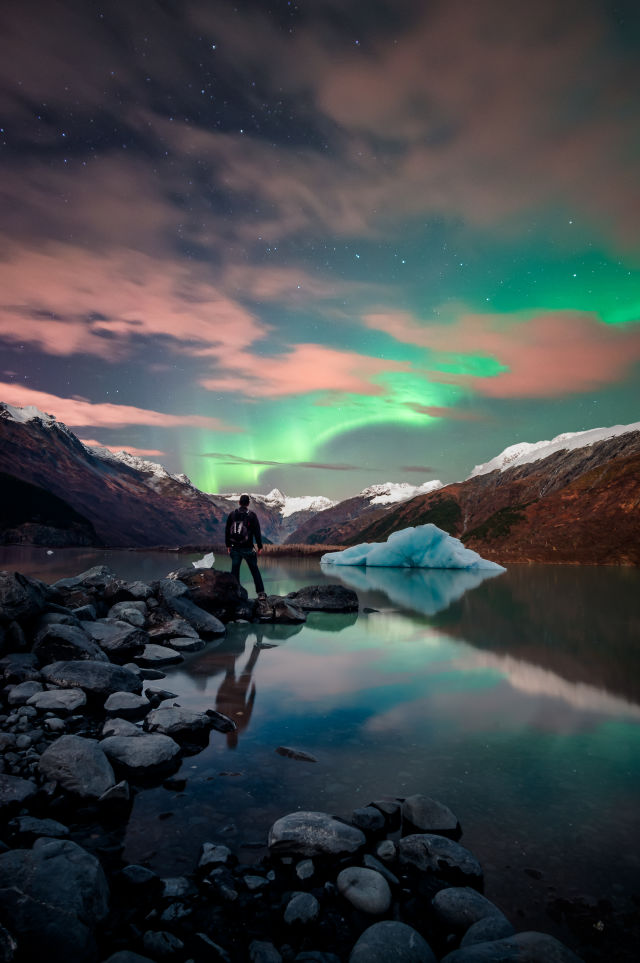
Don’t necessarily expect the entire sky to turn neon green, though. In much of the Lower 48, the aurora may appear as a faint glow very low on the northern horizon. Your phone’s night mode may actually pick up green, pink or purple colors that aren’t obvious to the naked eye.
Alaska is a different story and could see much stronger displays depending on conditions.
If the storm overperforms and reaches G2 (Moderate) levels, aurora visibility could potentially extend farther south into places including Oregon, Wyoming, Nebraska, Iowa, Illinois, Indiana, Ohio, Colorado, Pennsylvania and New York.
But that’s the more optimistic scenario. NOAA currently puts the chance of a minor geomagnetic storm on October 2 at around 30%, with a 10% chance of moderate storm conditions.
So yes, there’s a chance. Just pack some patience with that jacket.
Source: Screenshot from NOAA website, September 30th
For actually seeing the aurora, darkness matters just as much as geomagnetic activity.
In general, 10 pm to 2 am local time is a good window to head outside, particularly from somewhere with dark skies and a clear northern horizon.
Thursday 8 pm–11 pm ET: Kp 2.33
Thursday 11 pm–Friday 2 am ET: Kp 2.67
Friday 2 am–5 am ET: Kp 2.67
Friday 5 am–8 am ET: Kp 3.33
Friday 8 am–11 am ET: Kp 3.67
Friday 11 am–2 pm ET: Kp 4.67
Friday 2 pm–5 pm ET: Kp 4.00
Friday 5 pm–8 pm ET: Kp 3.33
There’s one annoying catch: the strongest forecast period currently falls during daylight hours across most of the Lower 48.
That’s why Friday night is still worth watching. Geomagnetic activity doesn’t simply switch off when a forecast block ends, and elevated conditions can linger after a CME arrives. A stream of faster solar wind from a coronal hole is also expected to reach Earth around October 3.
Alaska gets a bit of an advantage here, since the predicted peak begins around 7 am AKDT, when parts of the state may still have usable darkness.
The Kp index runs from 0 to 9 and is used to measure disturbances in Earth’s magnetic field.
As a rough guide, Kp 5 corresponds to a G1 geomagnetic storm and can sometimes bring the Northern Lights into states along the Canadian border.
At Kp 6, visibility can extend farther south into portions of the Midwest, Northeast and northern Rockies.
But Kp isn’t the only thing that matters. Cloud cover, light pollution, your latitude and the orientation of the solar wind can make the difference between seeing a decent aurora and seeing absolutely nothing.
The formula is pretty simple: go north, go dark and find an unobstructed view of the northern horizon.
You don’t necessarily need to drive for hours. A dark lakefront, rural field or hilltop away from city lights can make a huge difference.
Alaska: Fairbanks, Chena Hot Springs and Murphy Dome are among the country’s best aurora destinations. Fairbanks sits beneath the auroral oval, meaning you don’t necessarily need a major geomagnetic storm to see the lights.
Minnesota: Voyageurs National Park is one of our favorite options, especially around Rainy Lake and Ash River. It’s an International Dark Sky Park with huge open views over the water.
Michigan: Headlands International Dark Sky Park near Mackinaw City gives you a dark, north-facing view over the water without much city glow getting in the way.
North Dakota: Theodore Roosevelt National Park has more than 70,000 acres and very little light pollution. Buck Hill and River Bend Overlook are particularly good spots for open skies.
Wisconsin: Bayfield and the Apostle Islands shoreline give you a huge northern horizon over Lake Superior.
Idaho: Farragut State Park and Mineral Ridge near Coeur d’Alene offer dark skies without having to venture ridiculously far from civilization.
Maine: Acadia National Park is one of the darkest major destinations on the East Coast. Sand Beach and Jordan Pond are both worth considering if skies are clear.
Washington, Montana, Vermont and New Hampshire are also in play. Wherever you go, get away from major city lights and make sure nothing is blocking your view north.
Yes, and Canada gets the better end of this forecast.
Because much of the country sits closer to or underneath the auroral oval, conditions that only produce a faint glow along the US border can create a much better show farther north.
In places like Yellowknife and Whitehorse, you don’t necessarily need this particular CME at all.
Northwest Territories: Yellowknife is one of the best aurora destinations in North America and has a decent chance even before the stronger conditions arrive.
Yukon: Whitehorse and the surrounding wilderness are another strong option, with plenty of dark skies and a location much closer to the auroral oval.
Alberta: Jasper National Park is a huge Dark Sky Preserve, and Wood Buffalo National Park is home to some seriously dark skies. Banff can work too, particularly if activity strengthens Friday.
Saskatchewan and Manitoba: Churchill is an obvious pick, but rural areas away from Saskatoon, Regina and Winnipeg can also work well. The wide-open prairie horizon is a major bonus.
Ontario: Torrance Barrens Dark-Sky Preserve in Muskoka and Bruce Peninsula National Park are good options if activity holds into Friday night.
Quebec: Mont-Mégantic International Dark Sky Reserve is another solid pick, particularly if the storm reaches G1 levels.
British Columbia: Northern BC and the Rockies have the better odds. Farther south, you’ll need stronger conditions and very dark skies.
And yes, if you’re already close to the Canadian border, crossing into Canada can improve your chances simply by moving you farther north. Just remember the passport.
You don’t need professional equipment to see the aurora, but a little preparation goes a LONG way.
Get away from city lights. The darker your surroundings, the better. If possible, put at least 30 to 60 minutes between you and a major city.
Look north. At weaker G1 levels in the Lower 48, the aurora is more likely to appear as a glow low on the northern horizon than directly overhead.
Check the clouds before you leave. A great aurora forecast means absolutely nothing if you’re sitting under a solid layer of clouds.
Watch the moon. The moon will be around 73% illuminated on October 1, so moonlight could wash out some of the fainter aurora. Keep it behind you when possible.
Give your eyes time to adjust. Spend 15 to 20 minutes away from bright lights and phone screens before deciding there’s nothing there.
Use your phone’s night mode. Prop your phone against something or use a tripod and let it take a longer exposure. Your camera can often detect green and pink colors that look gray or barely visible to your eyes.
Check live aurora data before driving anywhere. Aurora forecasts can change quickly once a CME reaches Earth, so NOAA’s live aurora maps will be much more useful than a forecast made hours earlier.
If the aurora decides not to cooperate this time, we’re only getting into the good part of Northern Lights season.
Aurora viewing across Alaska and northern Canada generally gets much better once the long, dark nights return, making late September through March a great time to plan a trip specifically around seeing the lights.
Fairbanks, Yellowknife, Whitehorse and the Canadian Rockies are all much better bets than hoping for a rare display farther south.
And yes, we’ll be keeping an eye out for flight and hotel deals to get you there this winter.
Possibly. Alaska has the best chance, while states along the Canadian border could see activity if the incoming CME arrives earlier or stronger than forecast. NOAA currently expects relatively quiet conditions through much of October 1, with better chances as conditions become more active on October 2.
The best practical viewing window is generally around 10 pm to 2 am local time, when skies are darkest. NOAA’s strongest currently forecast activity occurs during daylight hours on Friday, so the big question is whether elevated activity continues into Friday night.
Under stronger G1 conditions, Alaska, Washington, Idaho, Montana, North Dakota, South Dakota, Minnesota, Wisconsin, Michigan, Maine, Vermont and New Hampshire have some of the better chances. If conditions strengthen beyond the current forecast, visibility could extend farther south.
Around Kp 5 can bring the aurora into some northern US states. At Kp 6 or higher, visibility can potentially extend farther south into portions of the Midwest, Northeast and Rockies. Kp is only one factor, though, and dark skies and cloud cover matter too.
Yes. Canada generally has better odds than the Lower 48 because much of the country sits closer to the auroral oval. Yellowknife and Whitehorse are particularly strong options, while Jasper, the Prairies, northern British Columbia, Ontario, and Quebec could benefit if geomagnetic activity strengthens.
Potentially. The moon is around 73% illuminated on October 1, so its light can make faint aurora harder to spot. Try to keep the moon behind you and get as far away from artificial light as possible.
Absolutely. Turn on night mode, keep your phone as still as possible, and point it toward the northern horizon. Modern phone cameras can often capture green, pink, and purple aurora that looks much fainter to the naked eye.