We use cookies to enhance your browsing experience, serve personalized content, and analyze our traffic. By clicking "Accept All" you accept this and consent that we share this information with third parties and that your data may be processed in the USA. For more information, please read our .
You can adjust your preferences at any time. If you deny, we will use only the essential cookies and unfortunately, you will not receive any personalized content.

If you have ever wanted to see a city turn into one big, joyful street party, this is it. New Orleans does Mardi Gras as a whole season, not a single event, with stacked parade weekends, marching bands, costumes, food, and “how is this real life” energy that somehow feels both chaotic and deeply organized at the same time. Here’s what Mardi Gras is, why people plan trips around it, and what you should expect when you show up.
“Mardi Gras” literally means Fat Tuesday, the final day before Ash Wednesday and the start of Lent. It takes place at the end of the Carnival season, a period of celebration that traditionally begins on January 6 (Twelfth Night) and unfolds over several weeks.
In New Orleans, the terms are sometimes used interchangeably in everyday conversation, but they are not the same thing. Carnival refers to the full season of events and traditions, while Mardi Gras is the final and most celebrated day within that season. When people say they are “going to Mardi Gras,” they usually mean visiting during the busiest stretch of Carnival leading up to Fat Tuesday.
Mardi Gras Day in 2026 falls on Tuesday, February 17, marking the final and most celebrated day of the Carnival season. While Fat Tuesday itself is iconic, most visitors plan their trips around the long weekend leading up to it, when the parade calendar becomes dense and the city shifts into full festival mode.
From Thursday through Monday before Mardi Gras Day, major parades roll back-to-back along Uptown routes, neighborhoods set up early in the day, and street closures become routine rather than occasional. This is the period when New Orleans feels most transformed, not just by the scale of the events, but by how fully daily life bends around the parade schedule.
Mardi Gras is often misunderstood as a single rowdy street party. In reality, it is a large, scheduled public festival with very different moods depending on where and when you participate.
Some areas deliver big parade spectacle, with towering floats, signature throws, dense crowds, and a true bucket-list atmosphere. Other areas lean more neighborhood-focused, with smaller crowds, easier logistics, and a calmer, more local feel.
Mardi Gras Day itself has a distinct rhythm. Costumes appear everywhere, traditions unfold in real time, and the city feels unusually unified in celebration. It can get loud and energetic, especially at night, but with thoughtful planning around parade routes and timing, most visitors find it exciting rather than overwhelming.
Krewes
Parades are organized by krewes, social organizations that design floats, choose themes, toss throws, and often host formal balls. Major krewes anchor the final days of Carnival and draw enormous crowds.
Mardi Gras Colors
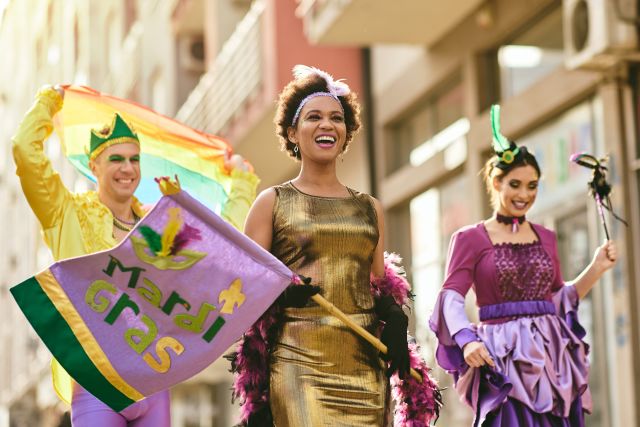
Purple, green, and gold dominate the season. They’re traditionally associated with justice, faith, and power and appear on everything from costumes to cakes.
Throws
The beads and trinkets tossed from floats are called throws. People come prepared with bags and straps, and most leave with far more beads than expected.
King Cake
King cake is a ring-shaped pastry, usually brioche-like, topped with icing and purple, green, and gold sugar. A small baby figurine is hidden inside. Tradition holds that whoever finds it brings the next cake or hosts the next gathering.
For most visitors, this is the stretch of Carnival that defines the trip.
Some Parades Highlights From Thursday Through Monday, February 12–16, 2026
Krewe of Muses (Thursday, Feb 12): Known for its sharp satire and signature hand-decorated shoes, Muses is one of the most popular Thursday-night parades. It blends humor, elaborate floats, and highly sought-after throws, drawing large crowds along Uptown routes.
Krewe d’Etat (Friday, Feb 13): Krewe d’Etat is a politically satirical parade with theatrical floats and irreverent commentary on current events. It is smaller than the superkrewes but widely loved for its creativity and wit.
Krewe of Endymion (Saturday, Feb 14): One of the largest and most visually impressive parades of the season, Endymion features massive, high-tech floats and draws enormous crowds. It is often considered a must-see for first-time visitors.
Krewe of Bacchus (Sunday, Feb 15): Bacchus is known for its celebrity monarchs and oversized floats. The parade is visually impressive, relatively family-friendly, and consistently one of the most attended events of Carnival.
Krewe of Orpheus (Monday, Feb 16, Lundi Gras): Orpheus closes out the major nighttime parades with dramatic floats and a strong musical focus. It serves as the final lead-in to Mardi Gras Day.
Tuesday, February 17, 2026
If you experience only one day of Carnival, this is the classic choice.
Mardi Gras Day begins early. By sunrise, crowds are already gathering along St. Charles Avenue, in the French Quarter, and throughout Uptown. Families set up ladders for children, friends stake out sidewalk space, and brass bands warm up in the distance. The city feels electric but joyful, more celebratory than chaotic.
Krewe of Zulu (Morning)
Zulu is one of the oldest and most culturally significant Mardi Gras parades, founded in 1909. Known for its vibrant costumes, walking clubs, and live brass bands, Zulu reflects deep African American traditions within New Orleans Carnival history. Its most famous throws are the hand-painted coconuts, which have become treasured keepsakes for parade-goers. Catching one is considered a badge of honor.
Krewe of Rex (Late Morning)
Rex is the official organizer of Mardi Gras Day and the symbolic centerpiece of the season. Established in 1872, Rex introduced many of the traditions now associated with Mardi Gras, including the official purple, green, and gold color scheme. The Rex parade formally marks the height of Carnival and symbolically brings the celebration to a close at noon.
At noon, the Mayor symbolically hands over the key to the city to Rex, and later that evening, Rex meets the Queen of Comus at the historic Rex Ball. By midnight, Carnival officially ends. Police clear Bourbon Street, mounted officers sweep the crowds away, and the city shifts almost instantly from celebration to Lent.
Ash Wednesday arrives the next morning.
Mardi Gras Day is loud, colorful, and steeped in tradition, but it is also deeply ceremonial. It is not just a party. It is the culmination of weeks of parades, history, and ritual that define New Orleans culture.
Where you choose to experience Mardi Gras shapes the entire day.
Classic parade watching happens along St. Charles Avenue, where many of the major Uptown parades roll beneath oak trees and historic mansions. The atmosphere here tends to feel celebratory and communal rather than chaotic, with families, locals, and longtime visitors setting up early and staying all day.
High-energy nightlife is most visible in the French Quarter, especially after dark. Bourbon Street draws large crowds, open-container revelers, and late-night parties. It is vibrant and loud, but it represents only one slice of Mardi Gras culture.
Family-friendly viewing is easiest during daytime parades and in more residential sections of Uptown routes, where there is more space to move, children sit on ladders waiting for beads, and the focus feels more rooted in neighborhood tradition than spectacle.
Mardi Gras can look overwhelming from the outside, but in reality it is layered. It can be a neighborhood gathering, a cultural tradition, a historic ceremony, or a late-night party, depending on where you stand. Choosing the right setting makes all the difference, and for many visitors, it is what turns Carnival from something loud into something unforgettable.
When is Mardi Gras 2026 in New Orleans?
Mardi Gras Day is Tuesday, February 17, 2026.
What is Mardi Gras?
It is Fat Tuesday, the final day of the Carnival season and the day before Ash Wednesday.
Is Mardi Gras the same as Carnival?
No. Carnival refers to the full season of celebrations, while Mardi Gras is the final and most celebrated day within that season.
What is king cake?
A sweet, ring-shaped cake decorated in Mardi Gras colors, traditionally with a small baby figurine hidden inside.
Which parades are most popular before Mardi Gras Day?
Endymion on Saturday and Bacchus on Sunday are major draws, followed by Orpheus on Lundi Gras.
Is Mardi Gras family-friendly?
Yes, particularly along Uptown parade routes and during daytime events. The party reputation mostly comes from late-night hotspots.