We use cookies to enhance your browsing experience, serve personalized content, and analyze our traffic. By clicking "Accept All" you accept this and consent that we share this information with third parties and that your data may be processed in the USA. For more information, please read our .
You can adjust your preferences at any time. If you deny, we will use only the essential cookies and unfortunately, you will not receive any personalized content.

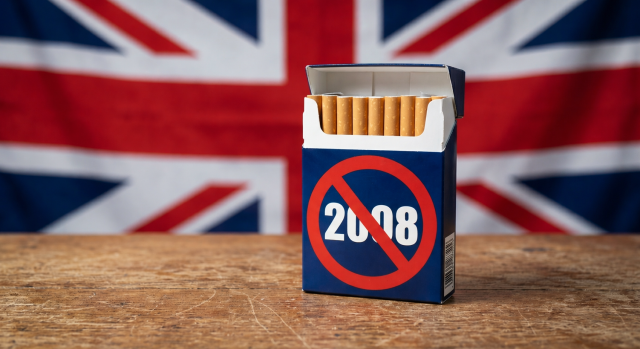
The UK is about to make history. The Tobacco and Vapes Bill has cleared both houses of Parliament and needs only King Charles III's signature to become law. Anyone born on or after January 1, 2009 will never legally be able to buy cigarettes in Britain — ever. For travelers heading to the UK, some things are changing. For American visitors in particular, this is also a good moment to understand where Britain fits into Europe's much smokier picture.
The mechanics are a bit more nuanced than a simple age cutoff. Instead of setting a fixed legal age, the law raises the minimum age to purchase tobacco by one year, every year, starting January 1, 2027. The long-term effect is the same: anyone born after 2008 will never legally be able to buy tobacco. The ban applies across all four parts of the UK — England, Scotland, Wales, and Northern Ireland — and was developed in coordination with each of their governments.
Retailers who sell tobacco to underage customers will face financial penalties, including standard fines of around £200, which is roughly $270. The law also gives the government broader authority to regulate tobacco and vaping products, including control over flavors, packaging, and advertising.
The bill doesn’t just focus on cigarettes. It also tightens the rules around vaping, expanding existing smoking restrictions into more public spaces. Vaping will now be banned in places like children’s playgrounds, outside schools and hospitals, and in cars when someone under 18 is present, bringing it in line with current smoking rules. Most indoor spaces that are already smoke-free will also become vape-free.
At the same time, the law stops short of banning vaping altogether. Adults aged 18 and over can still legally buy vaping products, and use will remain allowed in outdoor settings like pub gardens, beaches, and private outdoor spaces. Smoking and vaping in private homes is unchanged. The overall approach is fairly targeted: reduce exposure for children while still allowing adults to use vaping, especially as a way to move away from cigarettes.
The UK becomes only the second country in the world to implement a generational smoking ban of this kind, with the Maldives currently having a similar policy in place. A more instructive comparison, though, might be New Zealand, which was the first to pass a generational ban before reversing it after a change in government in 2023. It’s a reminder that even ambitious public health policies can be vulnerable when political priorities shift.
UK Health Secretary Wes Streeting described the move as “an historic moment for the nation’s health,” framing it as a long-term investment in prevention rather than treatment. Health Minister Baroness Merron, speaking in the House of Lords as the bill passed its final stage, called it “the biggest public health intervention in a generation.” Not everyone agrees. Conservative Lord Naseby raised concerns about the impact on retailers, arguing that the government had overlooked industry feedback and suggesting that education, rather than prohibition, would have been a more effective approach.
If you’ve ever landed in Paris, Rome, or Athens and felt like you’d stepped into a different era, you’re not wrong. Smoking is simply more visible across much of Europe than it is in the U.S. Right now, about 24% of adults in the EU smoke regularly, according to Eurostat. In the U.S., that number is closer to 10%, after decades of steady decline. In places like Bulgaria and Greece, more than a third of the population still smokes, and even Germany sits at around that EU average.
The UK has been moving in a different direction for a while now. Even after leaving the EU, its smoking rate has dropped to around 12% and continues to fall, down from over 20% just a little more than a decade ago. This new generational ban is really an extension of that trend rather than a sudden shift.
For American travelers, the UK often feels closer to home when it comes to smoke-free spaces. But once you cross into France or head further south, the difference becomes more noticeable. Outdoor cafés, restaurant terraces, and bar seating areas tend to be far more relaxed about smoking, and it can take a minute to readjust if you’re used to stricter rules back home.
For most visitors, day-to-day life in the UK won’t feel dramatically different once this law takes effect. Smoking has already been banned indoors for years, covering workplaces, restaurants, pubs, and most public spaces. What’s changing now is the expansion into certain outdoor areas, including playgrounds, spaces outside schools and hospitals, and cars carrying anyone under 18, where both smoking and vaping will no longer be allowed.
At the same time, some familiar parts of travel remain unchanged. Pub gardens and outdoor hospitality spaces are still permitted, so sitting outside with a drink won’t be affected. Hotels can continue to offer designated outdoor smoking areas. And if you’re a smoker visiting the UK, you can still legally buy cigarettes as long as you were born before January 1, 2009. The ban is designed to phase out future access, not restrict current adult visitors.
What you’ll notice, though, is a gradual tightening of where smoking feels acceptable. Indoor options are already gone, and with more outdoor restrictions in place, it becomes harder to find places, especially near schools or hospitals, where lighting up feels normal.
The UK has spent fifteen years quietly becoming one of Europe's least smoky destinations, and this law is the logical endpoint of that journey. Whether you're a nonsmoker who wants to know what to expect, or a smoker planning ahead, it's worth knowing where Britain stands and where it's going.
It makes it illegal for anyone born on or after January 1, 2009 to ever legally buy cigarettes or tobacco products in the UK. The law raises the minimum purchase age by one year, every year, starting in 2027.
The bill still needs royal assent from King Charles III, which is considered a formality. The age increases will begin on January 1, 2027.
Not in the same way. Adults 18 and over can still buy vaping products. The bill does tighten vaping rules in public spaces and vehicles carrying minors, but it doesn't create the same generational purchasing ban for vapes.
The Maldives currently has a similar law. New Zealand was the first to introduce one but reversed it in 2023 after a change of government. The UK is now the second country with such a ban in force.
Pub gardens and outdoor hospitality venues are not affected by the new rules. You can also smoke in your hotel room if the hotel permits it, or in any private outdoor space. The new outdoor restrictions apply to playgrounds, areas outside schools and hospitals, and cars carrying under-18s.
The law governs purchasing within the UK, not what you arrive with. If you were born before January 1, 2009, you can still buy cigarettes legally in the UK regardless of where you're from.
Retailers face financial penalties for selling tobacco to those not legally entitled to purchase it, including standard fines of around £200 (roughly $270).
The U.S. raised its federal minimum tobacco purchase age to 21 in 2019, and about 61% of Americans are now covered by fully smoke-free indoor air policies. But there's no equivalent generational ban at the federal level, and coverage varies significantly by state. Secondhand smoke still kills more than 41,000 nonsmoking American adults every year and costs the country $5.6 billion annually in lost productivity.
Significantly. About 24% of EU adults smoke regularly, compared to around 10% of U.S. adults. Some countries — Bulgaria and Greece among them — have rates above 35%. The UK is an outlier on the lower end at around 12%, and falling. American travelers used to strict smoke-free environments at home often find continental Europe a noticeable adjustment.
Yes. Communities that enact comprehensive smoke-free laws see up to a 17% reduction in hospital heart attack admissions. Studies also consistently show that smoke-free policies do not negatively affect sales or employment in the hospitality industry, which is the most common objection raised by opponents.