We use cookies to enhance your browsing experience, serve personalized content, and analyze our traffic. By clicking "Accept All" you accept this and consent that we share this information with third parties and that your data may be processed in the USA. For more information, please read our .
You can adjust your preferences at any time. If you deny, we will use only the essential cookies and unfortunately, you will not receive any personalized content.

Self-driving wheelchairs are already operating at several U.S. airports, and passengers with limited mobility can pick a destination and be carried through the terminal without needing someone to push them the whole way. Miami and Los Angeles introduced commercial WHILL service for American Airlines customers in 2024, Anchorage added autonomous chairs for Alaska Airlines passengers in 2026, and San José now offers its own self-driving option on a limited basis. For travelers who can use them independently, the biggest benefit may be simple: more control over how and when they move through the airport.
Programs are already live at several U.S. airports rather than still being tested for a future rollout.
Top speed sits at 2.2 mph, just under a normal walking pace and entirely sensor-controlled.
Riders request one through their airline ahead of travel, since there's no walk-up kiosk.
Sensors trigger automatic stops using front, side and rear detection the moment something enters the chair's path.
San José's chairs are free to use, though the schedule rotates and isn't guaranteed trip to trip.
Traditional wheelchair service still exists alongside these programs as an added option, not a staffing replacement.
Autonomous mobility services are designed to give some air travelers with limited mobility another option for reaching their gate.
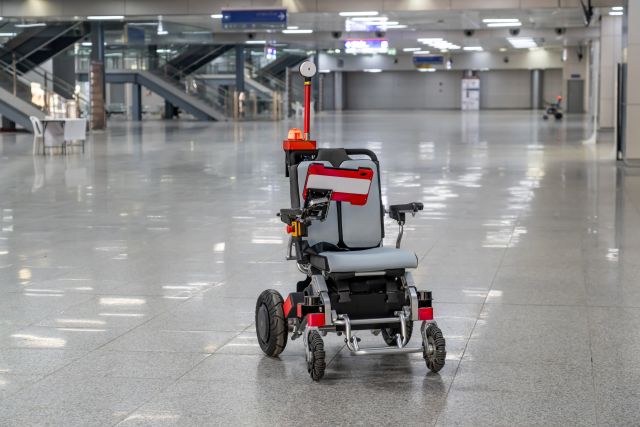
WHILL's autonomous power chairs are a bit like a very polite airport robot that happens to have a seat attached. Unlike a standard airport wheelchair, nobody needs to steer these. The rider just picks a destination on a touchscreen, and the chair takes it from there, following a mapped route while its sensors keep watch for anything in the way.
They're built mainly for travelers with reduced mobility who want a little more control over their own trip through a big terminal. Most of the current U.S. programs run on WHILL vehicles, though San José's system uses Blueberry Technology's chairs known as BBGo.
The equipment itself is fairly standardized: automatic braking, front, side and rear sensors, an emergency stop button, a seatbelt, and enough room for a typical carry-on. It's less about flashy tech and more about giving riders a steady, predictable way to get from one end of a terminal to the other on their own terms.
WHILL's autonomous mobility service allows eligible passengers to select a destination and travel through the airport independently. Screenshot: WHILL
Miami was first out of the gate, deploying ten chairs that were soon carrying around 120 passengers a day. LAX followed through the same WHILL and Envoy Air partnership, and both airports had quietly been testing the technology since 2022 before moving into full commercial service.
Here's the full list where the technology is operating as of 2026:
Los Angeles International (LAX) — Full commercial WHILL deployment through American Airlines, operating in Terminal 4 and connections to Tom Bradley International
Miami International (MIA) — Full commercial WHILL deployment through American Airlines and Envoy Air, running in Concourses D and E
San José Mineta International (SJC) — Blueberry's BBGo chairs, offered on a limited, rotating basis rather than a permanent schedule
Seattle-Tacoma (SEA) — WHILL pilot with Alaska Airlines in the C and D concourses
Detroit Metro (DTW) — WHILL pilot program at the McNamara Terminal
Ted Stevens Anchorage International (ANC) — The newest addition, launching its WHILL service with Alaska Airlines in March 2026

You need to agree with the cookies and privacy policy of this external service to view the content
Airport wheelchair assistance usually means waiting for a staff member who can help get you from check-in to the gate. For many travelers, that works exactly as it should. But during busy periods, it can also mean extra waiting and less flexibility once you're inside the terminal.
Autonomous chairs give some passengers another option. They’re not replacing the people who help with transfers, bags, or more hands-on support. Instead, they let travelers who are comfortable using the technology move through the airport a little more independently, on their own timing.

You need to agree with the cookies and privacy policy of this external service to view the content
These aren't self-serve kiosks you can just hop into. You'll want to request mobility assistance through your airline ahead of travel and ask specifically whether an autonomous chair is available. Since most programs are still pilots or run on a limited rotation, availability isn't guaranteed for every trip.
At San José Mineta International Airport (SJC) especially, service dates and times shift based on operational needs, so it's worth checking with airport staff the day you fly instead of assuming it'll be there.
Autonomous mobility chairs usually need to be requested in advance through the passenger’s airline.
WHILL says its autonomous service is now running across dozens of airports and other facilities worldwide, with deployments spanning North America, Europe, and Asia. Airports including Heathrow, Paris-Orly, Copenhagen, Munich, Barcelona, Singapore, and Tokyo Haneda have also tested or rolled out autonomous mobility systems of their own.
That doesn't mean every airport is about to swap out wheelchair attendants for robots. The more realistic future is probably a mix, with human assistance still there for passengers who need it and autonomous chairs offering a second option for those who want more independence. Airports are complicated enough as it is. More choices here is simply a good thing.
Singapore Changi Airport has deployed up to 18 WHILL autonomous mobility chairs, making it WHILL’s largest airport rollout to date.
Autonomous wheelchairs won't solve every accessibility challenge in air travel, but this is one piece of airport tech that feels genuinely useful rather than just futuristic. If you've ever needed mobility support and spent part of your trip waiting for someone to become free, having another way to reach the gate could make a real difference. As terminals keep growing and staffing stays tight, this kind of independence is likely to keep expanding rather than stay a novelty.
Confirmed U.S. deployments include Miami, Los Angeles, and Anchorage, while San José currently offers Blueberry autonomous chairs on a limited basis. Detroit has also tested WHILL technology for Delta passengers.
Passengers select a destination on a touchscreen and the chair follows a mapped route. Sensors detect obstacles and can automatically slow or stop the device.
Policies vary by airport and airline. San José explicitly lists its autonomous chair service as complimentary, while airline-operated services are generally part of requested mobility assistance.
Not necessarily. Availability and eligibility depend on the airport, airline, and service provider, and some passengers may need to be screened by staff before using an autonomous chair.
No. Airports continue offering conventional wheelchair assistance, and human support remains necessary for many travelers and situations.
At some airports, the first step is requesting ordinary wheelchair assistance through your airline. Whether an autonomous chair is available may then depend on the airport and your individual mobility needs.