We use cookies to enhance your browsing experience, serve personalized content, and analyze our traffic. By clicking "Accept All" you accept this and consent that we share this information with third parties and that your data may be processed in the USA. For more information, please read our .
You can adjust your preferences at any time. If you deny, we will use only the essential cookies and unfortunately, you will not receive any personalized content.

If you’ve found yourself unexpectedly invested in curling this Olympics, welcome. I sat down intending to “just check the score” and resurfaced four hours later emotionally attached to rock trajectory. At one point, I half expected Marc Kennedy to poke the stone again just to see the internet combust in real time.
Here’s the part that feels almost too poetic: for a sport unfolding on immaculate ice in northern Italy during Milano Cortina 2026, the story actually begins on a tiny, uninhabited island off Scotland’s west coast.
Rising dramatically out of the Firth of Clyde, Ailsa Craig looks like the setting of a gothic novel. It is windswept, uninhabited, and quietly responsible for one of the most precise pieces of equipment in modern sport.
For well over a century, this island has supplied the specific granite used for elite curling stones. According to reporting in Scientific American, Olympic stones are sourced primarily from Ailsa Craig in Scotland and the Trefor granite quarry in Wales. The reason is not tradition. It's geology.
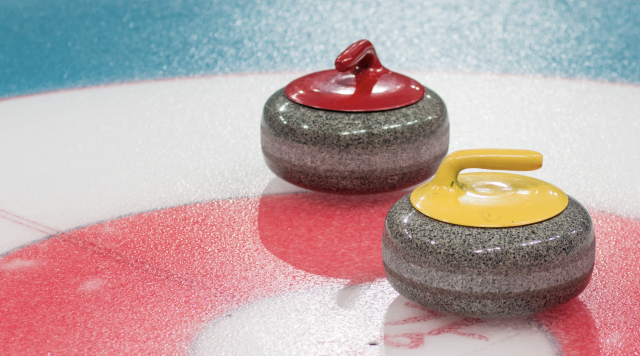
Curling stones have to survive decades of hard collisions without cracking. They must glide predictably across pebbled ice. They must hold a line when sweepers lean in and adjust their path by inches. That requires granite with very specific mineral properties: grain size, porosity, and fracture resistance all matter.
Manufacturers often use Ailsa Craig’s “blue hone” granite for the running surface because it is fine-grained and less porous, which helps with smooth, consistent glide. Tougher granite varieties are used for the striking band, where stones absorb repeated impacts. What looks like tradition is, in reality, careful geology and deliberate design working together.
Even if the granite begins on a remote island, the stones do not shape themselves.
Kays Scotland, based in Mauchline, East Ayrshire, produced the new stones delivered for Milano Cortina 2026, and the process is still stubbornly hands-on in the best way. For a single stone, Reuters reports up to five hours of hands-on work, moving from assembly and polishing into balancing, inspection, and final testing.
That time adds up quickly because they make more stones than the Games will ever put on the ice. For 2026, 164 stones were made, but only 132 are being used, with the rest functioning as backups and alternates that only matter if something fails a check or takes damage.
Also, these things are not dainty. Each stone comes in just under 44 pounds, which is a fun fact until you remember they are shipped in crates across borders and then treated like priceless museum objects the second they arrive.
As for cost, this is not the kind of gear you pick up on a whim. The Guardian reported a stone costs about £750, which is roughly $950 to $1,000 depending on exchange rates. That price makes more sense once you remember the raw material comes from a protected island and the finishing work is still craft.
Curling looks deceptively calm until you begin to understand how much precision is layered beneath it, from the island quarry and the mineral composition of the granite to the shaping process, the preparation of the ice, and the sweepers reading fractions of movement in real time.
An entire Olympic moment can hinge on a narrow ring of blue hone granite that only touches the ice along a band just a few millimeters wide, carved from rock formed tens of millions of years ago and finished by human hands in a small Scottish workshop. There is something quietly extraordinary about that chain of events, stretching from an uninhabited island in the North Atlantic to the brightest stage in international sport.
And now every time a stone glides into the house, I am thinking about a tiny Scottish island that most of us had never heard of a week ago.
Why is Ailsa Craig granite special?
Its microgranite includes varieties used for different jobs, including a low-permeability stone used for the running surface that helps maintain consistent glide and resist damage over time.
How much do Olympic curling stones cost?
A stone is reported at around £750, roughly $950 to $1,000 depending on exchange rates.
How long does it take to make one?
Reuters reports up to five hours of hands-on work per stone, from assembly through polishing and testing.
How many stones were made for Milano Cortina 2026?
164 were made, but only 132 are used in competition, with additional stones serving as backups.
What is “double-touching” in curling?
It refers to illegally touching the stone after release while it is still in forward motion. Depending on the situation and rules in force, that can lead to the stone being removed from play.