We use cookies to enhance your browsing experience, serve personalized content, and analyze our traffic. By clicking "Accept All" you accept this and consent that we share this information with third parties and that your data may be processed in the USA. For more information, please read our .
You can adjust your preferences at any time. If you deny, we will use only the essential cookies and unfortunately, you will not receive any personalized content.
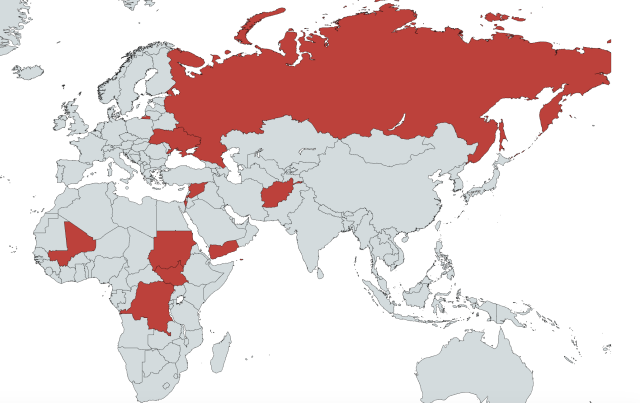
Every year, researchers measure something most of us hope we never personally experience: how peaceful the world really is. The latest full dataset comes from the 2025 Global Peace Index. While it reflects conditions measured last year, it offers the clearest picture of which countries are expected to remain the most dangerous heading into 2026.
This is not a tourism ranking. It is not a judgment on people or culture. The Global Peace Index measures structural instability — armed conflict, militarization, political violence, and societal safety. And in several parts of the world, those pressures remain severe.
Below are the five countries that ranked lowest in overall peacefulness, counted down from 5 to 1 based on the 2025 Global Peace Index:
Yemen ranked among the least peaceful countries in the 2025 Global Peace Index, reflecting years of civil war and prolonged instability. Conflict has weakened infrastructure, strained healthcare systems, and contributed to widespread food insecurity. A significant portion of the population continues to rely on humanitarian assistance, underscoring how deeply the crisis has affected everyday life.
The Democratic Republic of the Congo ranked among the least peaceful countries in 2025, largely due to ongoing instability in its eastern regions. Armed groups operate in areas where state control remains limited, contributing to cycles of violence and displacement. The ranking reflects persistent structural challenges rather than a single event or moment in time.
Sudan saw one of the sharpest declines in peacefulness in recent years. Fighting between rival military factions has disrupted major cities and forced millions from their homes. Access to food, healthcare, and basic security remains constrained in many areas, contributing to its low standing in the Global Peace Index entering 2026.
Ukraine ranked as the second least peaceful country in the 2025 Global Peace Index, reflecting the continued impact of Russia’s invasion. Active combat zones, damaged infrastructure, and the displacement of millions continue to shape daily life across much of the country. While many communities have shown extraordinary resilience, sustained state-based conflict keeps Ukraine among the most dangerous countries in the world in 2026 based on current rankings.
Russia ranked as the least peaceful country in the 2025 Global Peace Index. Ongoing war, increased military spending, geopolitical isolation, and high conflict-related fatalities significantly affected its score. The ranking reflects prolonged state-based conflict and elevated militarization, conditions that continue to influence its stability heading into 2026.
Each faces sustained instability linked to conflict, governance challenges, regional tensions, or prolonged humanitarian crises.
The Global Peace Index evaluates 23 indicators across three categories:
Ongoing domestic and international conflict
Societal safety and security
Degree of militarization
The Global Peace Index looks at factors like conflict deaths, political instability, terrorism impact, homicide rates, displacement, military spending, and access to weapons. It does not evaluate hotel districts or individual neighborhoods. Instead, it assesses structural instability at the national level.
Many of the countries at the bottom of the index are experiencing prolonged wars rather than short-term disruptions. As a result, analysts expect much of this list to remain similar through 2026 unless meaningful peace agreements or political shifts occur. Behind every ranking are millions of people navigating complex realities that extend far beyond a single data point.
The same Global Peace Index that identifies the most dangerous countries in the world also ranks the safest.
According to the 2025 Global Peace Index, the most peaceful countries heading into 2026 are:
These countries consistently score well across the same 23 indicators used to measure instability, including low violent crime, limited militarization, stable governance, and strong public institutions. Iceland, which has held the top position for more than a decade, has no standing army and continues to report some of the lowest crime rates globally.
The contrast is important. The methodology is identical. What differs is exposure to conflict, institutional strength, and levels of militarization.
Many of the countries listed above are currently under “Do Not Travel” advisories from multiple governments due to active conflict or terrorism risks. Conditions can vary within borders, but national-level instability significantly increases systemic risk.
Always check official government travel advisories and confirm whether your travel insurance covers conflict-related disruptions.
The most dangerous countries in the world in 2026, based on the 2025 Global Peace Index, highlight where conflict and instability remain most concentrated right now. These rankings are not just headlines. They reflect ongoing conditions that shape daily life for millions of people.
Global realities shift. Conflicts escalate and ease. Political landscapes change. But heading into 2026, this data offers a clear starting point for understanding where national-level risk is highest. Sometimes the most useful thing we can have is a clear, steady view of the bigger picture.
What is currently the most dangerous country in the world?
According to the 2025 Global Peace Index, Russia ranked as the least peaceful country entering 2026.
What does the Global Peace Index measure?
The Global Peace Index measures 23 indicators including conflict deaths, political instability, militarization, terrorism impact, homicide rates, and internal displacement.
Are these rankings based on 2026 data?
The rankings are based on the 2025 Global Peace Index, which provides the most recent comprehensive dataset heading into 2026.
Does this mean every part of these countries is unsafe?
Not necessarily. The index measures national-level structural instability. Conditions may vary regionally.
What is the safest country in the world in 2026?
Iceland remains the most peaceful country according to the 2025 Global Peace Index, followed by Ireland and Austria.