We use cookies to enhance your browsing experience, serve personalized content, and analyze our traffic. By clicking "Accept All" you accept this and consent that we share this information with third parties and that your data may be processed in the USA. For more information, please read our .
You can adjust your preferences at any time. If you deny, we will use only the essential cookies and unfortunately, you will not receive any personalized content.

The State Department has issued or upgraded travel advisories for more than a dozen countries across the Middle East.
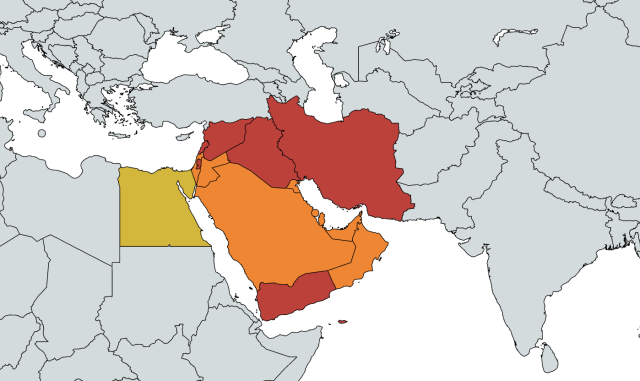
The guidance isn’t the same for every country. Some are at Level 4 Do Not Travel. Others are at Level 3 Reconsider Travel. One, Egypt, remains at Level 2. And the situation on the ground, including which airports are open and which borders are passable, is different in every location.
Here is what the State Department is saying about each country as of March 3, 2026, sourced directly from official @TravelGov guidance.
The State Department uses a four-level system for travel advisories. Understanding what each level means is important before reading the country-by-country breakdown below.
Level 1 — Exercise Normal Precautions: The lowest level. Standard travel risks apply.
Level 2 — Exercise Increased Caution: There are specific safety concerns worth knowing about. Travel is not discouraged, but awareness matters
Level 3 — Reconsider Travel: The risks are significant. The State Department is not telling you not to go, but is strongly recommending you think carefully before doing so.
Level 4 — Do Not Travel: The highest level. The State Department is actively advising Americans not to travel to these countries.
(Source: Screenshot of @TravelGov post on X, March 4)
As of March 3, the State Department has also issued a Worldwide Caution, meaning Americans everywhere, not just in the Middle East, are advised to stay alert and follow guidance from the nearest U.S. Embassy.
Five countries in the region are currently at the highest advisory level. Americans in these countries should leave as soon as it is safe to do so.
Americans in Iran are advised to shelter in place. If it is safe to do so, the State Department is urging Americans to leave Iran now by land. There are no commercial flights operating out of Iran. For those who cannot leave, the guidance is to find a secure location within your residence or a safe building, stay away from windows, and have a supply of food, water, and medications.
There is no U.S. Embassy in Iran.
The State Department is strongly encouraging Americans in Iraq to depart as soon as conditions allow. The guidance notes that conditions can change rapidly, and Americans should monitor the situation carefully. Those who remain should stay away from areas that could be targeted and exercise extreme caution.
Limited commercial flights are departing from Beirut, though the State Department notes they are subject to change or cancellation. Americans in Lebanon who wish to depart should consider doing so now while options remain available. Those who choose to stay should shelter in place when not traveling for essential needs.
Americans in Syria can depart via commercial air from Damascus and Aleppo, though options are limited. Americans in Syria who need emergency assistance but are unable to reach the U.S. Interests Section of the Embassy of Czechia should contact the U.S. Embassy in Amman, Jordan.
The U.S. has no direct embassy presence in Syria.
Limited commercial flights are available from Aden, though the State Department cautions that availability is extremely restricted. Yemen was already at Level 4 before the current conflict and conditions remain extremely dangerous throughout the country.
(Source: Screenshot of Travel.State.Gov Website)
Eight countries and territories across the region have been upgraded to Level 3. These countries have not been placed at the highest warning level, but the State Department has raised their advisory status in response to the current conflict and is advising Americans to carefully reconsider travel to each one.
Bahrain International Airport and the country’s airspace are currently closed. The King Fahd Causeway land border connecting Bahrain to Saudi Arabia remains open, but the State Department notes that operating status may change without notice. Americans in Bahrain who want to leave should consider using the causeway to reach Saudi Arabia, where commercial flights are available from Riyadh and Jeddah.
Commercial flights are departing Jordan, making it one of the more viable exit routes in the region right now. Americans currently in Jordan who wish to leave should act while commercial options remain available.
Kuwait’s airspace remains closed. The land border with Saudi Arabia remains open, though the State Department notes it cannot guarantee safety for those who choose to depart by land. Americans in Kuwait who want to leave should consider traveling overland to Saudi Arabia and departing from Riyadh or Jeddah.
Flights are currently departing from Oman, and the land border with the UAE is open. The State Department cautions that hotels in the UAE are overwhelmed and flight availability is limited. Americans in Oman should exercise extreme caution in making travel decisions and confirm any onward options before moving.
Hamad International Airport has suspended all aircraft movements due to the closure of Qatari airspace. Qatar’s maritime routes also remain closed. The Salwa land border crossing to Saudi Arabia is open. Americans in Qatar who want to leave should consider traveling overland to Saudi Arabia. The State Department notes it cannot guarantee safety for those using this option.
Saudi Arabia is currently one of the most viable exit points from the region. Commercial flights are departing from Riyadh and Jeddah, though availability is limited and subject to change or cancellation. Americans currently transiting through or stuck in the region should consider Saudi Arabia as a primary exit hub where options exist.
Some international flights are departing from UAE airports, and the land border with Oman and Saudi Arabia is open. However, hotels in the UAE are reported to be overwhelmed, and flight availability remains limited. Americans who cannot leave immediately should shelter in place at their hotel or residence, stay away from windows, and leave only for essential needs. The UAE also serves as a charter flight hub for State Department–assisted departures.
The West Bank is at Level 3. Gaza remains at Level 4. The State Department is advising Americans in Israel, the West Bank, and Gaza to shelter in place until further notice. Personnel and their family members at the U.S. Embassy in Jerusalem and the Embassy Branch Office in Tel Aviv are currently doing the same. Americans in these areas are advised to remain in their residence, hotel, or another secure structure and stay away from windows. Anyone considering traveling to a land border crossing should first consult guidance from Israel’s Home Front Command.

(Source: Screenshot of @TravelGov post on X, March 4)
Egypt remains at Level 2 and has not been upgraded in connection with the current conflict. The State Department’s assessment is that the overall security situation in Egypt has not changed materially. Cairo International Airport is currently one of the most functional departure hubs in the region. Americans in the Middle East who are trying to find a way home and have access to Egypt should consider routing through Cairo.
Regardless of which country you’re in, here are the steps the State Department recommends:
Enroll in STEP (Smart Traveler Enrollment Program) at step.state.gov to receive security alerts directly from the nearest U.S. Embassy
Call the State Department 24/7 at +1-202-501-4444 (from abroad) or +1-888-407-4747 (from the U.S. and Canada)
Do not go to an airport without confirmed flight details from your airline first
If you’re in a country with closed airspace, ask about overland options to neighboring countries with open airports
If you cannot leave, shelter in place, stay away from windows, and limit movement to essential needs only
Keep your passport accessible and ensure it has not expired
Share your location and travel plans with family or trusted contacts back home
Monitor updates at travel.state.gov/destination for the latest country-specific guidance
The situation across the Middle East is changing rapidly. Advisory levels that are at Level 3 today could be upgraded to Level 4 with little warning, and the availability of flights and border crossings is shifting daily. The most important thing is to stay connected to official guidance, act while options are still available, and not wait for conditions to deteriorate further before making a decision.
For the full and most current travel advisory for each country, visit travel.state.gov.
As of March 3, 2026, Iran, Iraq, Lebanon, Syria, and Yemen are all at Level 4. Gaza is also at Level 4 within the Israel advisory.
As of March 3, commercial flights are operating from Cairo (Egypt), Riyadh and Jeddah (Saudi Arabia), Amman (Jordan), Aden (Yemen, limited), Damascus and Aleppo (Syria, limited), and some UAE airports with restrictions. Bahrain, Kuwait, Qatar, and Iran have closed airspace.
The UAE is at Level 3 Reconsider Travel. Some flights are departing, but hotels are overwhelmed and conditions are unpredictable. Americans in the UAE who cannot leave should shelter in place and avoid unnecessary movement.
Egypt remains at Level 2 Exercise Increased Caution, unchanged by the current conflict. Cairo is currently one of the most functional departure hubs in the region for Americans trying to get home.
Hamad International Airport is closed and Qatari airspace is shut. The Salwa land border crossing to Saudi Arabia is open. Americans in Qatar who want to leave can use that crossing to reach Saudi Arabia, though the State Department cannot guarantee safety for those using this option.
The State Department is advising Americans in Iran to shelter in place and leave by land if it is safe to do so. There is no U.S. Embassy in Iran. Americans should call +1-202-501-4444 for consular assistance.
Saudi Arabia is at Level 3 Reconsider Travel, but it is currently one of the most accessible exit points in the region. Commercial flights are departing from Riyadh and Jeddah, though availability is limited and subject to change.
Americans abroad can call +1-202-501-4444 around the clock. From the U.S. or Canada, the number is +1-888-407-4747. You can also enroll in STEP at step.state.gov to receive alerts directly from your nearest U.S. Embassy.