
We use cookies to enhance your browsing experience, serve personalized content, and analyze our traffic. By clicking "Accept All" you accept this and consent that we share this information with third parties and that your data may be processed in the USA. For more information, please read our .
You can adjust your preferences at any time. If you deny, we will use only the essential cookies and unfortunately, you will not receive any personalized content.
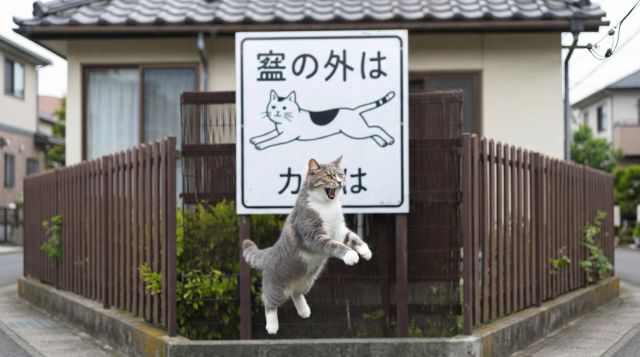
If you have ever wished road safety felt less like a lecture and more like a Studio Ghibli subplot, Japan quietly delivered.
In the countryside of Kitakami City, Iwate Prefecture, there is a bright yellow road sign featuring what appears to be a cat mid-flight. Not casually crossing. Not stretching in a sunbeam. Fully airborne, as if it has committed to the jump with its whole soul. The text reads 「ネコ飛出し注意」 which translates to “Caution: Cats may dash out,” or more charmingly, “Watch out for jumping cats.”
It looks like a joke you would buy in a souvenir shop.
It is not.
The key word here is tobidashi, which means to dash out suddenly. It is commonly used on Japanese traffic signs to warn drivers that something might bolt into the road without warning. Children use it. Deer use it. And, in certain neighborhoods, cats absolutely use it.
Anyone who has ever lived near an outdoor cat understands the physics involved. A cat resting peacefully by a stone wall can transform into a streak of panic in half a second. Rural and residential areas in Japan often have narrow lanes, small bridges, garden hedges, and blind corners where cats nap like they pay rent. When a car approaches, they do what cats everywhere do best, which is commit fully to chaos.
The sign exists because this scenario happens often enough that someone said, “We should probably warn people.”
This is the part that makes it even better.
Many of these cat warning signs are not part of a grand national program. They are often installed by local residents or neighborhood associations who know that drivers need a gentle reminder to slow down. In other words, this is community-level problem solving with surprisingly strong graphic design.
Instead of a harsh red warning filled with urgency, you get a bright yellow sign with a leaping silhouette that catches your eye and makes you smile just long enough to ease off the gas. It is functional, but it does not feel scolding. It feels like your neighbor politely saying, “By the way, the cats here are dramatic.”
For context, Japan does use standardized animal warning signs in rural areas, particularly for deer, which are a major hazard in some regions. Those are typically yellow triangles with official silhouettes. The cat versions, by contrast, tend to feel more local and specific, which is part of their charm.
This sign has appeared on Reddit multiple times, usually posted with the simple question, “What does this say?” The translation threads are where it truly shines. Once people learn that it means “Watch out for jumping cats,” the comments quickly shift from confusion to delight.
One of my favorite exchanges began with someone confidently declaring, “It’s raining cats,” which was almost immediately followed by a perfectly timed “Hallelujah.” The internet, for once, understood the assignment.
We are conditioned to expect road signs to be aggressively boring and universally identical. Seeing one that looks like it belongs in an animated film disrupts that expectation in the best way. It is practical, culturally specific, and unintentionally meme-ready.
Cats have been part of Japanese life for more than a thousand years. They were originally brought to protect temple scrolls from rodents, and over time they became symbols of luck and protection. The iconic maneki-neko figurine, the little cat with the raised paw you see in shop windows, is rooted in that tradition.
So when you see a sign that asks drivers to protect a cat rather than treat it as a nuisance, it fits within a longer story about coexistence. Roads are not framed solely as car space. They are shared space.
The sign is not whimsical for whimsy’s sake. It is a gentle reminder that something small and alive may be part of the same landscape you are moving through.
If you are driving in rural Japan and you see one of these signs, take it seriously. Slow down. A cat may indeed appear out of nowhere with the confidence of an Olympic long jumper.
If you are walking, you will probably smile first and then glance toward the bushes, because now you know what is possible.
Travel is often about big landmarks and famous sights. Sometimes, though, it is about noticing a hyper-local detail that quietly reveals how a place thinks. In Kitakami, and in other neighborhoods like it, someone cared enough about cats to put up a sign and ask drivers to pay attention.
That small act tells you more than you might expect.
It means “Caution: Cats may dash out” or “Watch out for jumping cats.”
One well-known example is in Kitakami City, Iwate Prefecture in northern Japan.
Many are installed by local communities rather than as part of a nationwide signage system, although Japan also has standardized animal warning signs in other regions.
Yes. Cats are widely associated with good fortune and protection.
It is practical first. The fact that it is unintentionally delightful is a bonus.