We use cookies to enhance your browsing experience, serve personalized content, and analyze our traffic. By clicking "Accept All" you accept this and consent that we share this information with third parties and that your data may be processed in the USA. For more information, please read our .
You can adjust your preferences at any time. If you deny, we will use only the essential cookies and unfortunately, you will not receive any personalized content.

A powerful earthquake struck off the northeastern coast of Japan on Monday afternoon, triggering tsunami warnings across several prefectures and prompting urgent evacuation orders for hundreds of thousands of coastal residents. Authorities have warned that the initial waves may not be the largest, and that the situation remains active.
The Japan Meteorological Agency recorded a 7.5 magnitude earthquake at approximately 4:52 p.m. local time on Monday, with its epicenter about 100 kilometers off the coast of Iwate Prefecture in northeastern Japan, at a depth of 10 kilometers. The US Geological Survey recorded the quake at 7.4 magnitude. Buildings in Tokyo shook for several minutes. The JMA initially recorded the quake at 7.3 before revising it upward twice.
Source: Screenshot from Japan Meteorological Agency (JMA), April 2026
Japan’s Meteorological Agency has issued a tsunami warning for parts of northern Japan, including Iwate Prefecture and areas of Hokkaido and Aomori, where waves of up to about 10 feet (3 meters) are possible. A wider tsunami advisory is also in place for nearby coastal regions, including Miyagi and Fukushima, with expected waves of up to around 3 feet (1 meter).
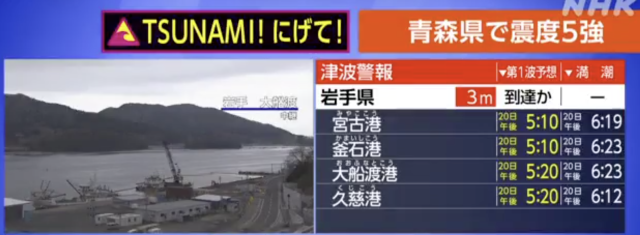
Initial waves have already reached shore. The largest so far was about 2.6 feet (80 centimeters) at Kuji Port in Iwate. Other locations have seen smaller waves, including about 1.3 feet (40 centimeters) at Miyako, 1 foot (30 centimeters) at Hachinohe in Aomori, and roughly 8 inches (20 centimeters) at Urakawa in Hokkaido. Officials are warning that these early waves may not be the largest, and stronger surges could still follow.
Television networks across Japan interrupted programming with urgent alerts in both Japanese and English: “Tsunami! Evacuate! Don’t turn back.”
Source: Screenshot NHK News (@nhk_news) via X, April 2026
Prime Minister Sanae Takaichi established an emergency task force shortly after the earthquake struck and urged all residents in tsunami warning zones to evacuate to higher ground without delay.
"Residents in areas where tsunami warnings have been issued should immediately evacuate to higher ground or safer locations such as evacuation buildings," Takaichi told reporters. She confirmed that human and material damage was being assessed, adding: "We will receive detailed reports shortly and proceed with disaster response efforts."
A Maritime Self-Defense Force helicopter was deployed over the Sanriku coast to conduct damage assessment.
The Tohoku Shinkansen bullet train line running between Tokyo and Shin-Aomori has been suspended following a power outage caused by the earthquake. The Akita Shinkansen Line has also halted operations, and services between Akita Station and Morioka Station have been suspended. Ships at Hachinohe Port were filmed sailing out to sea following the tsunami warning, a standard safety procedure as vessels are safer in deeper water.
Source: Screenshot JRE_Super_Exp (@JRE_Super_Exp) via X, April 2026
No abnormalities have been reported at the Fukushima Daiichi or Daini nuclear power plants, or at the Onagawa plant in Miyagi Prefecture. Checks are ongoing at all three facilities. The significance of this monitoring is not lost on Japanese authorities: the 2011 Tohoku earthquake, a magnitude 9.0 event that left nearly 20,000 people dead, triggered a catastrophic meltdown at Fukushima that took years to bring under control.
The Pacific Tsunami Warning Center confirmed that the earthquake does not pose a tsunami threat to Hawaii or the broader Pacific region. In a statement issued shortly after the quake, officials said that a destructive Pacific-wide tsunami is not expected, adding that no action is required for Hawaii residents. The PTWC said the statement would be its final one on the event unless new data emerged.
The quake's impact, while severe along Japan's northeastern coastline, has not generated the kind of ocean-wide wave propagation that would put more distant Pacific nations at risk.
The Japan Meteorological Agency has warned that the region should expect additional strong earthquakes over the coming week, with the highest risk concentrated in the next two to three days. Residents have been urged to remain alert for landslides as well as seismic aftershocks.
Japan is one of the most earthquake-prone nations on earth, sitting on the Ring of Fire and accounting for around 20% of all earthquakes of magnitude 6 or above recorded globally. A tremor of some kind occurs in the country approximately every five minutes.
The regions now under tsunami warning are the same communities devastated by the Great East Japan Earthquake on March 11, 2011. That magnitude 9.0 quake sent waves as high as 130 feet (40 meters) into Japan’s northeastern coast, killing nearly 20,000 people and displacing more than 125,000.
That history still shapes how both officials and residents respond today. As new warnings were issued Monday, anchors across multiple Japanese news networks repeated a familiar message on air: “Remember 3/11.”
This is a developing situation, and this article will be updated as more information becomes available.
The Japan Meteorological Agency recorded the earthquake at 7.5 magnitude. The US Geological Survey recorded it at 7.4. It struck approximately 100 kilometers off the coast of Iwate Prefecture at a depth of 10 kilometers.
Tsunami warnings covering waves of up to 3 meters have been issued for Iwate Prefecture and parts of Hokkaido and Aomori. Tsunami advisories for waves of up to 1 meter cover additional parts of those prefectures as well as Miyagi and Fukushima.
Prime Minister Takaichi confirmed that human and material damage is being assessed. Specific figures have not yet been confirmed. This is a developing situation.
No abnormalities have been reported at Fukushima Daiichi, Fukushima Daini, or the Onagawa plant. Checks are ongoing at all three facilities.
Yes. The Japan Meteorological Agency has warned of potential aftershocks and further strong earthquakes over the next week, with the highest risk in the next two to three days.
The 2011 Tohoku earthquake measured magnitude 9.0, significantly larger than today's quake. It triggered waves of up to 40 meters, killed nearly 20,000 people, and caused the Fukushima nuclear disaster. Today's earthquake, while serious, is a different scale of event. Authorities are nonetheless treating it with the full weight of that historical memory.
No. The Pacific Tsunami Warning Center confirmed there is no tsunami threat to Hawaii or the wider Pacific, and said no action is required for residents outside of Japan's affected prefectures.