We use cookies to enhance your browsing experience, serve personalized content, and analyze our traffic. By clicking "Accept All" you accept this and consent that we share this information with third parties and that your data may be processed in the USA. For more information, please read our .
You can adjust your preferences at any time. If you deny, we will use only the essential cookies and unfortunately, you will not receive any personalized content.

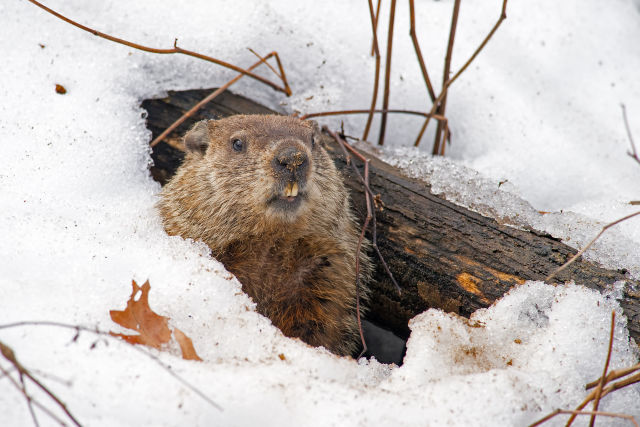
Every year on February 2, thousands of people willingly wake up in the middle of the night, bundle themselves into an impressive number of layers, and travel to rural Pennsylvania to wait for a groundhog to emerge from a tree stump and predict the weather.
On paper, this sounds like a terrible plan. In real life, it is genuinely fun, oddly joyful, and far more memorable than it has any right to be.
Today is Groundhog Day. Again.
If you have ever watched Groundhog Day, you already understand the atmosphere in Punxsutawney on the morning of February 2nd. The ceremony, the excitement, and the shared understanding that this is all a little ridiculous and that everyone has committed to it anyway.
That feeling is not accidental. It is the point.
Punxsutawney leans fully into that energy. There are tuxedos and top hats before sunrise, fireworks lighting up the dark, music playing to keep a frozen crowd awake, and people chanting enthusiastically for Punxsutawney Phil. The main event takes place at Gobbler’s Knob, a wooded clearing just outside town where the ceremony has been held for well over a century. Crowds begin arriving long before dawn, often around 3 a.m.
Shortly after 7 a.m., members of the Punxsutawney Groundhog Club’s Inner Circle lift Phil from his stump. According to tradition, Phil delivers his forecast in “Groundhogese,” which is translated for the crowd by the club’s president.
If Phil sees his shadow, the prediction is six more weeks of winter. If he does not, an early spring is on the way. When we went, Phil saw his shadow. The reaction was instant and collective: a groan, followed by laughter, followed by applause anyway. Someone nearby yelled, “See you tomorrow!!,” which turned out to be the exact reaction I did not even know I was hoping for.
No one pretends this is science. That, very intentionally, is part of the charm.
Phil has been making predictions since 1887, making Groundhog Day one of the longest-running folk traditions in the United States. According to the Punxsutawney Groundhog Club, he is the same groundhog every year, sustained by a secret “Elixir of Life” that grants him longevity and wisdom. This explanation is delivered with a straight face and is best accepted in the same spirit.
For most of the year, Phil lives in a climate-controlled habitat beside the Punxsutawney Memorial Library. He relocates to Gobbler’s Knob for the annual ceremony.
Phil is not a meteorologist, and no one involved pretends otherwise.
According to long-term tracking, Phil’s predictions have been correct about 39 percent of the time since records began in 1887. Over the past decade, that number drops closer to 30 percent. The National Oceanic and Atmospheric Administration has politely described his forecasting skill as “limited.”
And yet, the crowd still shows up.
Groundhog Day has never been about accuracy. It is about marking the midpoint between winter and spring, offering a narrative pause during the coldest stretch of the year, and giving people something lighthearted to hold onto when February feels endless.
The tradition traces back to European weather folklore tied to Candlemas, a Christian feast day marking the midpoint between the winter solstice and the spring equinox.
German settlers brought similar customs to Pennsylvania, originally involving animals like badgers. In their absence, the groundhog became the stand-in.
After the first officially recorded Groundhog Day ceremony took place in 1887, a local newspaper editor declared Punxsutawney’s groundhog the nation’s official weather-predicting animal. The tradition stuck, grew, and eventually became one of America’s most recognizable seasonal rituals.
If you are planning to attend the official ceremony at Gobbler’s Knob, one detail matters more than any other.
You will need to take a bus.
Parking near the ceremony site is extremely limited, and road closures mean most visitors park in downtown Punxsutawney and use designated shuttle buses to reach Gobbler’s Knob. On February 2, buses are not just recommended. They are often the only way in.
Shuttles begin running very early, often before 4:30 or 5:00 a.m., to accommodate the crowds. Plan for an early arrival and cold conditions. If you prefer a quieter experience, you can also visit Phil year-round at the Punxsutawney Memorial Library, which does not require a shuttle.
Groundhog Day works because it asks very little of us and gives something back anyway. It is not about being right. It is about showing up. There is something refreshing about a tradition that continues even when everyone knows it is mostly symbolic. You gather. You wait. You listen. You laugh. And then you go home slightly warmer, if only because you shared the experience with thousands of strangers doing the exact same thing.
And next year, you might just do it again.
What is Groundhog Day?
Groundhog Day is a yearly tradition held on February 2 in which a groundhog predicts whether winter will continue for six more weeks or end early.
Where does the ceremony take place?
The official ceremony happens at Gobbler’s Knob, just outside Punxsutawney, Pennsylvania.
What time does Punxsutawney Phil make his prediction?
Phil typically appears around 7:25 a.m. Eastern Time.
How accurate is Punxsutawney Phil?
Historically, Phil’s predictions have been correct about 39 percent of the time overall, and roughly 30 percent over the past decade.
Is Groundhog Day free to attend?
Yes. The ceremony is free and open to the public.
What happens if Phil sees his shadow?
If Punxsutawney Phil sees his shadow, tradition says there will be six more weeks of winter. If he does not, an early spring is predicted.
Do you need a bus to get to Gobbler’s Knob?
Yes. Due to limited parking and road closures, shuttle buses from downtown Punxsutawney are the primary way to reach the ceremony site on February 2.
Can you see Punxsutawney Phil outside of Groundhog Day?
Yes. Phil lives at the Punxsutawney Memorial Library the rest of the year and can be visited without attending the February 2 event.
Is Groundhog Day family-friendly?
Yes. The event is festive, lighthearted, and welcoming to all ages, though it does involve early hours and cold weather.