We use cookies to enhance your browsing experience, serve personalized content, and analyze our traffic. By clicking "Accept All" you accept this and consent that we share this information with third parties and that your data may be processed in the USA. For more information, please read our .
You can adjust your preferences at any time. If you deny, we will use only the essential cookies and unfortunately, you will not receive any personalized content.

The US Embassy in Paris issued an updated demonstration alert on October 5, 2026, warning Americans that student protests across France have turned violent in places, while the State Department's travel advisory for France stays at Level 2. That means no one is telling you to cancel your trip. The unrest is centered on high schools and universities, not tourist sites, and most visitors will notice little beyond a closed Metro station. Still, more than 6,000 people have been arrested in two weeks, so it's worth knowing where the flashpoints are and which dates to watch.
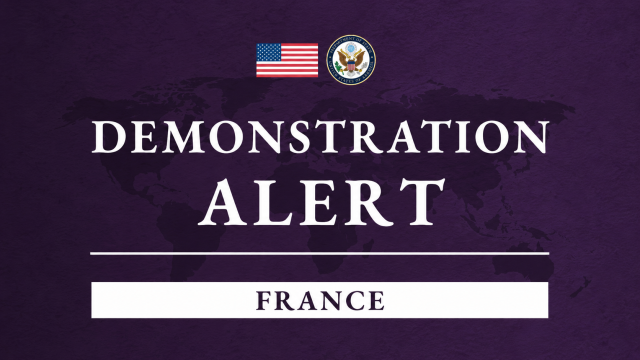
The October 5 embassy alert says some student protests have turned violent and tells Americans to avoid demonstration areas and allow extra travel time.
France stays at Level 2, the State Department's "exercise increased caution" tier, citing terrorism and unrest. The level has not been raised.
More than 250,000 people marched nationwide on October 6, including 56,000 in Paris, by the interior ministry's count. Organizers put it at 450,000.
488 people were arrested October 6, on top of roughly 6,100 arrests the interior ministry had already counted, most of them minors.
At least 215 teenagers were injured in the clashes so far, along with 85 school staff and more than 700 police officers, the government says.
More than half of high schools in France were blockaded or closed on October 6, according to the High School Students Union.
A five-day flight crew strike is called for October 17 to 21, covering Air France, Transavia and other carriers under French labor law.
Yellow Vest protests may return on October 17, the same day the flight crew strike is due to begin.

You need to agree with the cookies and privacy policy of this external service to view the content
The protests started in late September in the Paris suburbs, where high school students began blocking school entrances over teacher shortages, overcrowded classrooms and deteriorating buildings. The movement spread quickly, first across the Paris region and then to cities including Lille, Marseille, Lyon, Nice, Rennes and Nantes.
Some of the blockades have led to clashes with police, and Prime Minister Sébastien Lecornu has described the unrest as the most violent student demonstrations in decades. The biggest day of action so far came on October 6, when teachers and parents joined students in the streets. France’s Interior Ministry said more than 250,000 people marched nationwide.
The next thing to watch is what happens at the end of October, when ministers are expected to present proposals on staffing and school repairs.
The October 5 update is a demonstration alert, which is the kind of message an embassy sends to Americans already in the country when something local could affect their plans. In this case, it warns about possible school closures, reduced public services and transportation disruptions, and advises travelers to avoid protest areas, leave extra time for getting around and keep an eye on local news.
That’s different from France’s broader travel advisory, which changes much less often and uses the State Department’s 1-to-4 scale. France remains at Level 2, meaning travelers are advised to exercise increased caution because of terrorism and unrest. It is not at Level 3, “reconsider travel,” or Level 4, “do not travel.”
For travelers, the distinction matters. A demonstration alert may mean changing your route or allowing more time to get around, but by itself it generally isn’t the kind of change that triggers an airline refund or coverage under a standard travel insurance policy.
The State Department's TravelGov account shared the embassy's demonstration alert on October 5. Source: @TravelGov via X.
In Paris, the biggest impact for visitors is likely to be around the march route rather than the major tourist sights. The October 6 demonstration started at Place de la République, and six Metro stations in the 11th arrondissement were closed for the day. Police said around 300 people, many of them hooded or masked, were involved in clashes there, while the rest of the march passed without major incident. The Louvre is about a mile and a half west of République, and the Eiffel Tower is much farther across the city.
Elsewhere in France, disruptions have been more concentrated around high schools in the mornings and around the edges of larger demonstrations. Police used tear gas and water cannons during protests in Strasbourg, Rennes and Toulouse on October 6. Drivers have another issue to watch: fuel shortages were affecting roughly 15% of gas stations nationwide as of October 5, so it may be worth filling up before your tank gets too low.
Place de la République on an ordinary day. The square was the starting point of the October 6 student march in Paris.
The date most likely to touch an American itinerary is October 17, when five French pilot and cabin crew unions begin a five-day strike that runs through October 21. The notice covers crews employed under French labor law, which means Air France, Transavia France and Corsair. A Delta or United transatlantic flight isn't part of it, though an Air France-operated codeshare is.
The strike lands on the first weekend of France's Toussaint school holidays, and no airline had published a cancellation schedule as of October 6. Calls for renewed Yellow Vest protests name the same Saturday, and some students want fresh demonstrations as soon as Thursday, October 8. If your dates are flexible, the simplest move is to avoid flying a French airline between October 17 and 21.
The dates to watch if you're traveling to France this month, as announced by October 6.
A few habits make the next three weeks easier:
Check the RATP app or ask your hotel front desk each morning, since Metro closures are announced ahead of marches.
Book refundable or changeable rates for anything between October 17 and 21.
Leave extra time for airport transfers on protest days.
Enroll in the State Department's Smart Traveler Enrollment Program (STEP) so embassy alerts reach your phone.
France in October still has plenty going for it, from chestnut trees turning along the Seine to shorter museum lines. A little homework each morning goes a long way right now. Keep your plans loose around mid-October, give yourself more time than you think you need, and there's a good chance you'll come home with the trip you were hoping for.
The State Department has kept France at Level 2, which asks travelers to exercise increased caution rather than reconsider the trip. The protests are concentrated around schools and march routes, so avoiding those areas is the main advice.
France is at Level 2 of 4, "exercise increased caution," because of terrorism and unrest. The October 5 demonstration alert did not change that level.
The October 6 march started at Place de la République in eastern Paris, and six nearby Metro stations were closed for the day. Major sights such as the Louvre and the Eiffel Tower are well away from that area.
Not because of the student protests. A separate strike by French pilots and cabin crew is called for October 17 to 21, and airlines hadn't released cancellation plans as of October 6.
Possibly. Under EU rules, short-notice cancellations can qualify for €250 to €600 (around $285 to $680) per passenger, and a strike by an airline's own crew often doesn't exempt the airline. You're owed a refund or rebooking either way.
That's a personal call, but nothing in the official guidance asks Americans to stay home. If you'd rather wait, check your airline's change policy first, since an embassy alert alone rarely qualifies for a refund.
Enroll in the free Smart Traveler Enrollment Program, known as STEP, before you leave. Alerts then arrive by email, and the embassy can reach you in an emergency.