We use cookies to enhance your browsing experience, serve personalized content, and analyze our traffic. By clicking "Accept All" you accept this and consent that we share this information with third parties and that your data may be processed in the USA. For more information, please read our .
You can adjust your preferences at any time. If you deny, we will use only the essential cookies and unfortunately, you will not receive any personalized content.

Artificial intelligence is about to enter one of the busiest stretches of U.S. airspace. The FAA is expected to begin testing its new SMART traffic-management system around Washington, D.C., as early as Monday, September 21, according to The Wall Street Journal and Scripps News.
The technology will initially support flights serving Ronald Reagan Washington National Airport (DCA), Washington Dulles International Airport (IAD) and Baltimore/Washington International Thurgood Marshall Airport (BWI). But despite the AI label, SMART isn't replacing air traffic controllers. It's designed to help them see potential congestion and disruptions earlier.
SMART stands for Strategic Management of Airspace, Routes and Trajectories, and it's a cloud-based traffic prediction tool.
Three airports go first, Reagan National, Dulles International and BWI Marshall, all in the DC metro area.
Air Space Intelligence built it, a Boston-headquartered technology company with a Washington office that won the FAA contract in June.
It analyzes weather and schedules together with airport capacity, airspace conditions and other constraints to flag likely congestion and route conflicts before they play out.
Controllers stay in charge, since the tool is a support system, not a replacement for air traffic controllers or a solution to staffing shortages.
A roughly 90-day test comes first, according to FAA Administrator Bryan Bedford, before the agency considers a wider rollout.
Transportation Secretary Sean Duffy says it's been three decades since a comparable FAA software upgrade, part of a broader push to replace aging air traffic technology.
SMART is less like an AI air traffic controller and more like a very sophisticated planning assistant.
According to the FAA's announcement of the new system, SMART continuously analyzes airline schedules, weather, airport capacity, airspace conditions and operational restrictions. The goal is to predict where congestion could develop before aircraft depart rather than waiting for bottlenecks to form and then reacting to them.
That could mean spotting a line of thunderstorms heading toward a commonly used flight corridor and recommending another route or departure time before dozens of planes end up waiting on the ground.
The FAA says its current systems often require controllers to pull information from numerous screens and spreadsheets. SMART is intended to bring more of that information together in one place so the FAA, airlines and other operators are working from the same picture.
The FAA's new SMART system will support traffic management around Reagan National, Dulles International and BWI Marshall while human controllers remain in charge.
Washington, D.C. is a particularly complicated place to test a system designed to manage congestion.
The region's three major airports feed into crowded and closely managed airspace, and Reagan National's primary runway handles more than 90% of the airport's traffic. The airport authority has described it as the busiest runway in the United States, averaging more than 800 takeoffs and landings per day in recent years.
Travelers have already seen how quickly a problem at the region's air traffic control facilities can spread. Earlier this year, a chemical smell at the Potomac TRACON facility triggered ground stops at Reagan, Dulles and BWI, creating delays across the Washington area.
That's exactly the kind of ripple effect SMART is being designed to help manage more efficiently.
The FAA says SMART could help reduce flight delays, but the new system won't eliminate them altogether.
The technology is intended to reduce delays, improve traffic flow and increase airspace capacity by identifying problems earlier. Rather than waiting until flights are stacked up or aircraft need to be rerouted at the last minute, traffic managers could have more time to make adjustments before planes leave the gate.
The project is part of a much larger agreement with Air Space Intelligence. The contract could be worth up to $875 million over 12 years, according to current reporting.
There are still plenty of things SMART can't fix. Thunderstorms can close airspace, mechanical problems can ground aircraft and the FAA continues to deal with air traffic controller staffing shortages.
So while SMART could help keep some disruptions from snowballing, don't expect DCA, IAD and BWI to suddenly become delay-free airports.
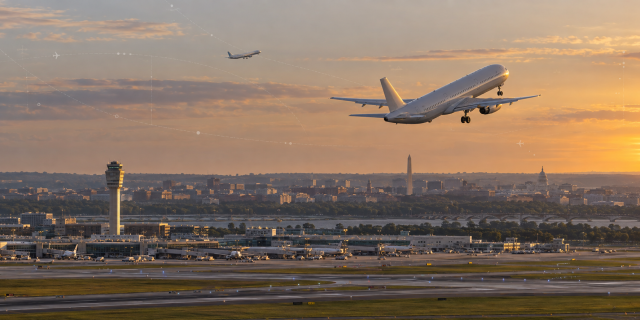
Reagan National is expected to join Washington Dulles and BWI Marshall in the first Washington-area deployment of the FAA's SMART traffic management technology.
The broader U.S. air traffic control system is in the middle of a major modernization push.
FAA Administrator Bryan Bedford told lawmakers in September that controllers still work across multiple separate screens and data systems. The agency's new technology strategy is intended to bring that information together while adding predictive tools that can help anticipate congestion instead of simply responding once it happens.
Transportation Secretary Sean Duffy has also repeatedly described parts of the country's air traffic infrastructure as decades old. Scripps News reported that Duffy said it had been roughly 30 years since the FAA implemented a comparable upgrade to its software.
SMART is one part of that much larger overhaul rather than a stand-alone AI experiment.
The Washington rollout is essentially the first big real-world test.
Bedford has said the initial phase will run for roughly 90 days, giving the FAA and airlines time to compare SMART's predictions with what actually happens in the airspace and determine how much confidence operators can place in its recommendations.
The FAA hasn't officially announced September 21 as a firm launch date. Its own June announcement said only that initial SMART operations would begin in fall 2026, while the more specific Monday launch date comes from reporting by the Wall Street Journal and other outlets.
If that first phase goes well, the FAA plans to expand the technology more widely across the National Airspace System.
AI-assisted planning tools may give FAA traffic managers more time to respond to weather, congestion and other disruptions affecting flights.
For passengers, the interesting part of SMART is that you may never actually notice it working. If the technology does what the FAA hopes, the benefit might be something as simple as your plane taking a different route around storms, leaving at a slightly adjusted time or avoiding the chain reaction that turns one delayed flight into dozens more.
It won't eliminate disruptions, which means it's still worth knowing your rights when a flight is delayed or canceled. But giving traffic managers better information earlier could make the system more resilient when weather, congestion or other problems start stacking up.
And for anyone who has watched a 20-minute airport delay mysteriously become three hours, that's a pretty interesting use of AI.
SMART stands for Strategic Management of Airspace, Routes and Trajectories. It's a cloud-based FAA system that uses predictive analytics and AI to examine schedules, weather, airport capacity and airspace conditions before flights depart.
The first rollout is expected to cover Ronald Reagan Washington National Airport, Washington Dulles International Airport and Baltimore/Washington International Thurgood Marshall Airport.
No. Air traffic controllers remain responsible for safely separating aircraft and managing flights. SMART provides predictions and routing recommendations to support those decisions.
The Wall Street Journal reported that the Washington-area rollout could begin as early as Monday, September 21, 2026. The FAA's official public timeline says initial operations will begin in fall 2026.
That's the goal. The FAA says SMART is designed to identify congestion earlier, improve traffic flow and reduce delays and cancellations. The first roughly 90-day test will help determine how well it works before any wider rollout.
Eventually, that is the plan. FAA officials have said they want to evaluate the Washington rollout first before expanding SMART more broadly across the U.S. air traffic system.