We use cookies to enhance your browsing experience, serve personalized content, and analyze our traffic. By clicking "Accept All" you accept this and consent that we share this information with third parties and that your data may be processed in the USA. For more information, please read our .
You can adjust your preferences at any time. If you deny, we will use only the essential cookies and unfortunately, you will not receive any personalized content.

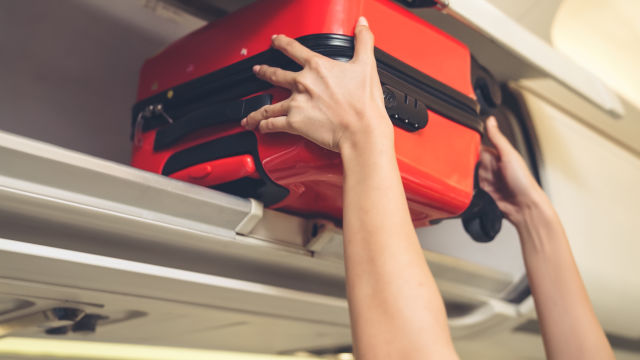
After more than a decade of stalled negotiations, the European Union finally did it. Starting in 2027, airlines operating flights to and from EU airports will be required to include a carry-on bag in the base price of every ticket. No more paying extra to put your roller bag in the overhead bin. The deal also locks in financial compensation for flight delays of three or more hours. It's a genuine win for travelers, and if you're flying out of a US airport, you might be wondering: when does something like this happen here?
Free carry-on bags become a legal right for all EU flight passengers starting in 2027, bundled into every base fare.
Budget airlines like Ryanair, easyJet, and Wizz Air will be required to restructure how fares are presented and priced.
Flight delay compensation of €250 to €600 (roughly $275 to $660) is preserved for delays of three or more hours.
A cheaper opt-out fare is still allowed for passengers who choose to travel without a carry-on bag.
No equivalent US law exists protecting carry-on bag access, and budget carriers can charge up to $99 at the gate.
US Congress introduced the FAIR Fees Act to ban unreasonable airline fees, but it has never passed into law.
Five US airlines collected over $12 billion in seat selection fees alone between 2018 and 2023, per a Senate report.
Transatlantic travelers flying into or out of the EU will benefit from the new rules on those routes starting in 2027.
Every airline operating flights to or from an EU airport will be required to include two things in every base fare: a small personal item that fits under the seat in front of you, and a wheeled carry-on bag of up to 7kg. Both have to be included in the price you see advertised. Not added at checkout. Not unlocked by a loyalty card. Just included.
Airlines are allowed to offer a cheaper ticket to passengers who voluntarily choose to skip the carry-on. That option can still exist. But the fare that includes the bag has to be the standard offer, and every passenger has to be given access to it.
The deal also keeps existing delay protections in place. If your flight arrives more than three hours late, you're entitled to between €250 and €600 (roughly $275 to $660) depending on the distance of your flight. That right was under threat during negotiations, and it survived.
The EU first proposed updating its air passenger rights rules back in 2013. What followed was more than a decade of stalled talks, airline lobbying, and disagreements between EU member states. Some countries wanted to weaken the delay compensation rules. Airlines pushed to raise the threshold for compensation from three hours to five, which would have let a lot of delays go unpaid. Budget carriers argued that forcing carry-on bags into the base fare would drive up ticket prices for everyone.
Negotiations in the final days ran past 5 a.m. on multiple sessions. The European Parliament held firm on the three-hour compensation trigger and on the carry-on requirement, and in the end, both survived into the final text. It's a genuine consumer win, even if it took an unreasonable amount of time to get there.
If you're flying domestically, the picture isn't great. Southwest used to be the one airline that included a carry-on and two checked bags for free on every fare. That era is effectively over. For everyone else, it depends entirely on what fare class you booked.
On legacy carriers like American, Delta, and United, Basic Economy passengers get a personal item only. No overhead bin. If you show up at the gate with a roller bag on a Basic Economy ticket, you're paying to check it, and it won't be cheap. Budget carriers are a whole other level: Frontier and Spirit charge between $60 and $99 just to use the overhead bin, and the fee goes up the longer you wait to pay it.
Checked bag fees have been part of US air travel since 2008, when airlines introduced them during a fuel crisis and promised they'd be temporary. They were not temporary. Today, American Airlines charges $50 for a first checked bag on domestic routes. And there is no longer a single major US carrier offering free checked bags to the general public.
The US has had its own version of this fight. The FAIR Fees Act, introduced in Congress in 2023, would have prohibited airlines from charging excessive fees for basic services including carry-on bags and seat reservations. It was never passed into law.
The Department of Transportation has made some progress on transparency. Rules introduced in recent years require airlines to disclose fees upfront so travelers can see the real cost of a ticket before booking. That's a meaningful step, but disclosure isn't the same as a ban, and carry-on fees remain fully legal across the US market.
The scale of the revenue involved helps explain why reform is slow going. A Senate subcommittee report found that five US airlines collected more than $12 billion in seat selection fees alone between 2018 and 2023. Baggage fee revenue grew by more than 30 percent between 2018 and 2022, outpacing overall airline revenue growth by a wide margin. There is currently no active federal legislation that would ban carry-on fees or cap what airlines can charge for overhead bin access.
Honestly, not anytime soon. The EU took 13 years and still had to compromise on some of its original demands. In the US, airline industry lobbying is powerful, Congress moves slowly on aviation issues, and the political climate isn't especially friendly to new mandates on private businesses right now.
That said, airline fees are one of the rare things that genuinely annoy people across party lines. Nobody is thrilled about paying $75 to put a bag in the overhead bin. The question isn't whether American travelers are frustrated, they obviously are. It's whether that frustration ever turns into legislation that actually makes it to the finish line.
For now, the best you can do is work around the system. A co-branded airline credit card will often waive bag fees for you and anyone traveling with you. Booking a fare above Basic Economy usually restores carry-on access. And if you're flying to or from Europe after 2027, that overhead bin is yours by law. The EU spent 13 years fighting for it. Might as well enjoy it.
Only if you're flying on a route to or from an EU airport. If you're booking a transatlantic flight departing from or arriving in Europe, the new rules will apply to that trip starting in 2027.
The new legislation is expected to take effect in 2027, after formal adoption by both the European Parliament and EU Council.
Airlines can offer a cheaper fare to passengers who voluntarily choose to travel without a carry-on. But a fare that includes the bag must be offered to every passenger as the standard option.
Between €250 and €600 (roughly $275 to $660) depending on flight distance, for delays of three or more hours at their final destination.
Legacy carriers like American, Delta, and United allow carry-ons on standard fares but not on Basic Economy. Budget carriers like Frontier and Spirit charge $60 to $99 for overhead bin access depending on when you pay.
No. The FAIR Fees Act was introduced in Congress in 2023 but never passed. There is currently no federal law protecting carry-on bag access for US travelers.
Holding a co-branded airline credit card is the most reliable method. Most major carrier cards waive the first checked bag fee and sometimes carry-on fees for the cardholder and travel companions on the same booking.