We use cookies to enhance your browsing experience, serve personalized content, and analyze our traffic. By clicking "Accept All" you accept this and consent that we share this information with third parties and that your data may be processed in the USA. For more information, please read our .
You can adjust your preferences at any time. If you deny, we will use only the essential cookies and unfortunately, you will not receive any personalized content.

Europe’s long-delayed ETIAS travel authorization is still officially listed for a late 2026 launch, but that timeline is looking less certain by the day. New reporting suggests the rollout may slip into 2027 because of ongoing complications with Europe’s separate biometric border system, known as EES. When ETIAS does go live, Americans and other visa-free travelers will need to apply online before visiting 30 European countries, including 29 Schengen countries plus Cyprus. The fee is set at €20 (around $23) and the good news is that this is not a visa.
ETIAS is not live yet, so US travelers do not need to apply for trips happening right now.
The official EU timeline still says ETIAS will start in the last quarter of 2026.
New reporting suggests the rollout may be delayed again and pushed into 2027.
The fee is set at €20, which is about $23 using current exchange rates.
Travelers under 18 or over 70 are exempt from paying the €20 fee, about $23.
ETIAS will apply to 30 European countries, including 29 Schengen countries plus Cyprus.
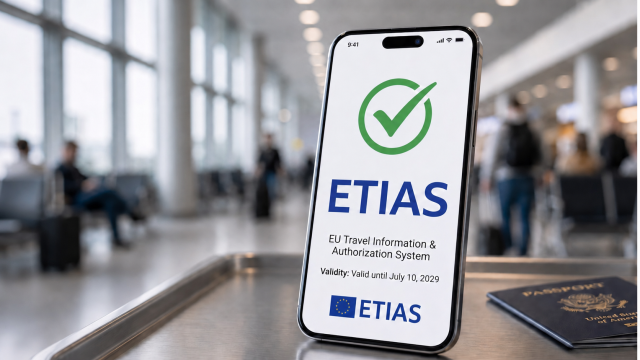
Approved authorizations will be valid for up to three years, or until the traveler’s passport expires.
ETIAS is not a visa, and it does not change the usual 90-day short-stay rule.
ETIAS stands for the European Travel Information and Authorisation System, which is exactly the kind of name you would expect from a cross-border government program. For travelers, the idea is simpler than the name: it is an online pre-travel authorization for people who can already visit Europe without a visa.
That includes US passport holders. Americans will still be visa-free travelers for short stays, but once ETIAS becomes mandatory, they will need approval before entering the participating European countries.
The closest comparison is ESTA, the pre-travel authorization used by the United States for many visa-free visitors. ETIAS is not meant to replace passport control, and it does not guarantee entry at the border. It just adds a screening step before the trip begins.
The ETIAS fee is set at €20 per applicant, which works out to roughly $23 at current exchange rates. That is more than double the original €7 fee, about $8, that had been discussed for years.
Travelers under 18 or over 70 will not have to pay the €20 fee, about $23. That does not mean they can skip ETIAS entirely. It just means their application should be free once the system opens.
Once approved, ETIAS will be valid for up to three years, or until the passport used in the application expires, whichever comes first. So if your passport expires next year, your ETIAS will too. Europe loves a technicality.
Officially, the EU still says ETIAS will start operations in the last quarter of 2026. No exact date has been announced, and the EU says travelers do not need to take any action yet.
The reason this is worth watching now is that the Financial Times reported this week that the launch may be delayed into 2027. The delay is tied to Europe’s separate Entry/Exit System, or EES, which handles biometric border checks for non-EU travelers at Schengen borders. EES requires first-time non-EU visitors to register fingerprints and a facial image when entering the Schengen Area, and the rollout has already caused queue concerns at airports and border crossings.
That matters because ETIAS is supposed to come after EES is working properly. ETIAS is the paid online travel authorization that Americans and other visa-free travelers will eventually need before visiting participating European countries. It is not a visa, and it does not replace a passport. Think of it more like Europe’s version of ESTA: a pre-travel screening step that happens before you board, not a new border check at the airport.
ETIAS will apply to visa-free travelers entering 30 European countries for short stays. That includes the 29 Schengen countries plus Cyprus, so it covers most of the European destinations Americans visit most often.
For US travelers, that means ETIAS will eventually be required for trips to places like France, Italy, Spain, Greece, Germany, Portugal, Switzerland, Austria, Iceland, and Norway. The United Kingdom and Ireland are not part of ETIAS, so trips there will follow their own entry rules.
ETIAS also does not change the basic short-stay limit. Americans can generally visit the Schengen Area for up to 90 days in any 180-day period. ETIAS gives you permission to travel to the border, but it does not guarantee entry and it does not let you stay longer.
This is the part travelers should pay attention to right now: ETIAS applications are not open yet, and no official ETIAS authorization can currently be issued.
That means any website claiming it can process your ETIAS today is not official. Some third-party sites may use official-looking branding, search ads, or urgent language to make it seem like travelers need to act now. Others may charge extra “service” fees for something they cannot actually provide yet. Until the system goes live, no company or website can get you an approved ETIAS authorization.
When ETIAS does launch, travelers should apply through the official EU ETIAS website or the official ETIAS mobile app. The EU says the start date will be announced in advance, so for now the best move is very boring and very correct: wait for the official launch date before entering your passport details or paying anyone.
If you’re traveling to Europe in the next few months, you probably do not need to change anything. ETIAS is not live yet, and US travelers are still entering Europe under the existing passport rules.
The bigger question is for trips in late 2026 or early 2027. If you’re booking Europe for that window, keep ETIAS on your radar, but do not pay anyone for an application until the EU officially opens the system.
When ETIAS finally does arrive, it should feel more like a pre-trip chore than a major travel barrier. It is another form, another fee, and another thing to remember before heading to the airport. Annoying? Yes. Vacation-ending? No.
For now, ETIAS is still a future travel requirement, not something US travelers need to deal with today. The EU’s official timeline still points to a late 2026 launch, but with new reporting suggesting a possible delay into 2027, the safest answer is simple: wait for the official start date.
When ETIAS does arrive, it will add one more step to planning a Europe trip. Americans will need to apply online, pay the €20 fee, and make sure the authorization is linked to the same passport they are using to travel. But it will not be a visa, it will not change the 90-day rule, and it should not stop anyone from planning a European vacation.
Until applications officially open, do not pay a third-party site or enter your passport details anywhere claiming to offer ETIAS approval now. Europe may be adding more paperwork, but at least for the moment, US travelers can keep planning trips the old-fashioned way: passport first, ETIAS later.
Officially, ETIAS is still listed for the last quarter of 2026. However, new reporting suggests the launch may be delayed until 2027.
ETIAS will cost €20 per applicant, which is about $23 at current exchange rates.
No. ETIAS is a travel authorization for visa-free travelers. US passport holders will still be visa-free for short stays.
No. ETIAS is not live yet, and applications are not open.
ETIAS will be valid for up to three years, or until the passport used in the application expires, whichever comes first.
Travelers under 18 or over 70 are exempt from paying the €20 fee, about $23. They are still expected to need ETIAS authorization once it becomes mandatory.
ETIAS will apply to 30 European countries, including 29 Schengen countries plus Cyprus.
No. ETIAS does not change the usual short-stay rule, which is generally 90 days in any 180-day period for the Schengen Area.
Travelers should use the official EU ETIAS website or official ETIAS mobile app once applications open. Avoid third-party sites claiming early access.