We use cookies to enhance your browsing experience, serve personalized content, and analyze our traffic. By clicking "Accept All" you accept this and consent that we share this information with third parties and that your data may be processed in the USA. For more information, please read our .
You can adjust your preferences at any time. If you deny, we will use only the essential cookies and unfortunately, you will not receive any personalized content.

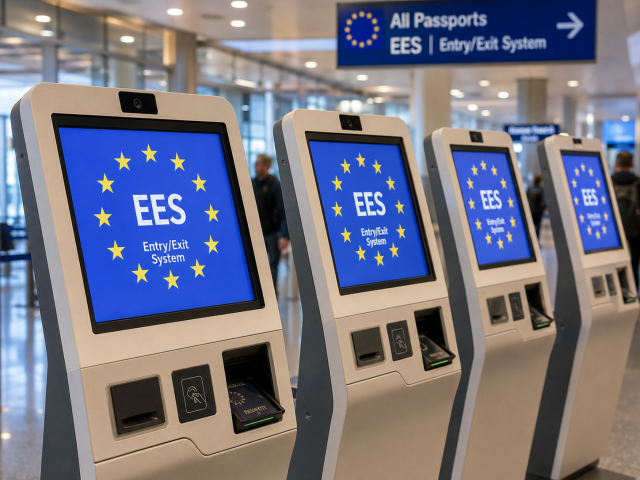
Europe’s new biometric border system was supposed to make arrivals safer and eventually faster. At some airports, it’s doing the opposite.
Airlines and airport groups are now asking the European Union to temporarily suspend the Entry/Exit System, better known as EES, whenever border facilities can’t handle the number of arriving passengers. They’re warning that the worst may still be ahead, with European airports expecting around 40 million more passengers in July and August than they handled during the previous two months.
EES became fully operational on April 10, 2026, following a gradual rollout that began in October 2025.
Most American tourists are affected, along with other non-EU travelers visiting the Schengen Area for a short stay.
Travelers generally provide fingerprints and a facial image when they first register in the system.
Border lines have reached five hours during some peak travel periods, according to European aviation groups.
Passengers have missed flights and connections, while some planes have reportedly departed with empty seats because travelers were still stuck at border control.
Airports and airlines want EES suspended when lines become unmanageable throughout July and August.
The EU says the system works normally at most border crossings, but it has promised more support for airports and countries still experiencing problems.
EES isn’t the same as ETIAS, which isn’t expected to begin until later in 2026.
The EU Entry/Exit System is a digital border system used to register non-EU nationals entering 29 European countries for short visits of up to 90 days within a 180-day period.
Instead of receiving a traditional passport stamp, travelers have their passport information, entry and exit dates, facial image, and fingerprints recorded electronically. The system is designed to identify travelers who overstay, use fraudulent documents, or attempt to enter under a different identity.
For most Americans traveling to Europe on vacation, registration happens when they first enter the Schengen Area. That means someone flying from New York to Rome through Paris will normally complete EES checks in Paris, not Rome.
Once a traveler’s information is stored, later border crossings should require only biometric verification. In practice, however, airports have reported cases where travelers were asked to register again because records weren’t available or systems weren’t communicating properly.
The problem isn’t one single broken machine or airport. It’s a combination of slow processing, technical problems, understaffed border control points, and infrastructure that wasn’t designed for hundreds of passengers arriving at once.
In February, ACI Europe, Airlines for Europe, and the International Air Transport Association warned that three major problems were already affecting the rollout: too few border control officers, unresolved problems with automated gates and kiosks, and limited use of the EU’s pre-registration app.
The European Commission has said registration takes around 70 seconds when EES is working properly. That doesn’t sound especially long until several international flights arrive at the same time. Even a small delay for each person can quickly turn into hours for everyone at the back of the line.
Airports also say the system hasn’t been consistent. Some kiosks aren’t fully operational, some countries have been unable to use the pre-registration technology, and passengers who’ve already registered sometimes have to repeat the process.
On July 1, ACI Europe, Airlines for Europe, and IATA sent an open letter to European Commission President Ursula von der Leyen, saying the rollout had reached a “critical point.”
The groups said border waits had climbed to as long as five hours during peak periods. Passengers had missed connections, been left standing outside terminals and on exposed airport aprons, and remained trapped at border control while their flights prepared to leave.
In some cases, planes reportedly departed with empty seats because ticketed passengers were still stuck at border control when the gates closed.
The industry groups aren’t asking the EU to abandon EES permanently. They want countries to have the authority to completely pause the system whenever passenger numbers exceed what border facilities can realistically process. During those periods, airports would return to normal passport checks and stamping until the lines were under control.
The disruption isn’t happening everywhere, and airport conditions can change quickly. However, several popular vacation airports have already been singled out for particularly serious problems.
Ryanair listed seven airports experiencing major disruption:
Tenerife South
Palma de Mallorca
Alicante
Málaga
Milan Bergamo
Kraków
Paris Beauvais
The airline warned that lines could get worse as European school vacations begin and passenger volumes increase in mid-July.
Berlin Airport has reported waits of up to two hours for some non-EU travelers. Lisbon has also needed additional support to handle its border lines, while the operator of Rome Fiumicino and Ciampino warned that the airports may need to suspend biometric registration to avoid a summer “disaster.”
These reports don’t mean every traveler will face hours in line. The EU says EES is working without major problems at most of its roughly 1,500 border crossing points. Still, the delays have been severe enough at certain airports to cause missed flights and widespread operational problems.
The European Commission hasn’t agreed to shut EES down across Europe.
EU Migration Commissioner Magnus Brunner said the system is working well in most countries and at most airports. He argued that some of the worst delays may also be connected to inadequate staffing, limited infrastructure, or a lack of automated border-control equipment rather than EES alone.
Current rules already allow countries to temporarily stop collecting biometric data during busy periods until early September. The aviation industry says that flexibility hasn’t been enough and wants airports to be able to suspend EES completely when lines become unmanageable.
The Commission has promised additional help for countries still facing problems, and officials are scheduled to meet with aviation industry representatives on July 7. The EU also points to the system’s security results. Since the gradual rollout began in October 2025, EES has recorded around 110 million border crossings and prevented more than 44,000 people from entering, mainly because they lacked the correct documents or visas.
There’s no way to know exactly how long border control will take on a specific day, but travelers can reduce the risk of a delay turning into a missed flight or connection.
Build additional time into any itinerary that requires you to pass through an external Schengen border. This is especially important if you’re entering Europe for the first time since EES launched.
Arriving at the airport earlier won’t always fix the problem, particularly when the delay is at immigration after landing. It can still help when leaving the Schengen Area, though, especially at airports already reporting long lines.
A 90-minute connection may look reasonable under normal circumstances. It becomes much riskier when you have to register fingerprints, collect luggage, change terminals, or check in again.
Airlines generally have more responsibility to help when an entire journey is booked on one ticket. Separate-ticket connections generally offer less protection if a border delay causes you to miss the next flight.
Your EES check normally happens at the first external border where you enter the Schengen Area, not necessarily your final destination.
For example:
New York to Paris to Rome: EES in Paris
Boston to Lisbon to Barcelona: EES in Lisbon
Chicago to London to Madrid: EES in Madrid, because the UK isn’t in the Schengen Area
This is the airport where you need to be most careful about your connection time.
Some airports or national authorities may temporarily pause biometric collection when lines become too long. Travelers shouldn’t count on that happening.
Prepare as though you’ll need to complete the full process, even if someone who traveled through the same airport a week earlier didn’t.
The EES doesn’t apply to every non-EU citizen. Holders of residence permits, long-stay visas, and certain residence cards may be exempt.
Travelers who live in an EU or Schengen country should carry their valid residence document and show it to the border officer. The EU provides a full list of EES exemptions.
Airports may issue arrival recommendations or warnings when border-control lines become unusually long. Check your departure airport, arrival airport, airline app, and email before leaving.

Europe’s new border system isn’t causing chaos at every airport, and many travelers are completing EES checks without major problems. But five-hour waits, missed flights, and planes departing with empty seats are more than ordinary rollout issues. With passenger numbers expected to rise sharply in July and August, travelers should leave additional time, avoid risky connections, and check where they will first enter or leave the Schengen Area.
Yes. Most US citizens visiting the Schengen Area for tourism or business for up to 90 days are required to register.
Yes, children are included in the system. Children under 12 generally don’t have their fingerprints collected, but they may still need a facial image and passport registration.
Your biometric information is recorded when you first register. On later trips, border officials should normally verify your existing record, although technical issues may occasionally require information to be collected again.
No. EES is the biometric border system already in use. ETIAS will be a separate online travel authorization for visa-exempt visitors. ETIAS isn’t operating yet, and the EU currently expects it to launch during the final quarter of 2026.
Normally, no. Once you’ve entered the Schengen Area, there usually aren’t EES checks when traveling between participating countries. You’ll encounter the system when crossing an external Schengen border, such as arriving from the United States or departing Europe for the UK.
Not necessarily. Airlines have reported delaying some departures, but planes have also left without passengers who remained trapped in border-control lines.
Coverage depends on the policy, and border-control delays may be excluded. Read the missed-departure and missed-connection terms carefully, particularly when flights are booked separately.