We use cookies to enhance your browsing experience, serve personalized content, and analyze our traffic. By clicking "Accept All" you accept this and consent that we share this information with third parties and that your data may be processed in the USA. For more information, please read our .
You can adjust your preferences at any time. If you deny, we will use only the essential cookies and unfortunately, you will not receive any personalized content.

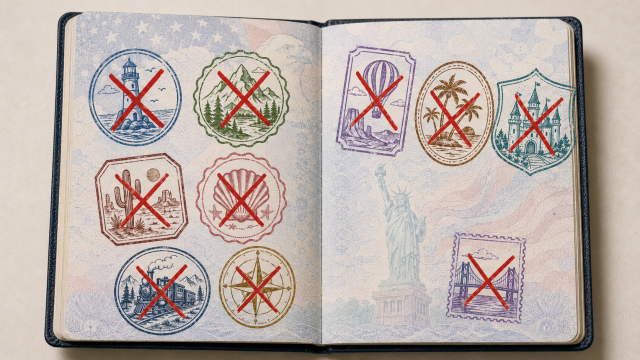
Souvenir passport stamps are everywhere: national parks, theme parks, museums, and even the United Nations headquarters in New York hands them out. They're a fun way to document your travels, and it's easy to see why people want them alongside their real entry stamps. But the U.S. Department of State has issued a clear reminder that those novelty stamps don't belong inside your official passport, and that putting them there could create real problems at the border.
Souvenir and novelty stamps are not allowed in U.S. passports, according to a recent warning the State Department posted on Instagram and X.
U.S. passports are official government documents, and only authorized immigration officials may add stamps or markings of any kind.
A U.S. traveler was denied entry into Poland for writing in her passport, and another was nearly denied boarding in South Korea over a misidentified stamp.
Use a dedicated travel journal, notebook, or stamp booklet to collect souvenir stamps instead of your actual passport.
The EU's Entry/Exit System (EES) has already replaced physical passport stamps across all 29 Schengen Area countries.
Stamps from national parks and the United Nations still count as unauthorized markings and can cause problems at the border.
In recent posts on Instagram and X, the State Department reminded Americans that U.S. passports are official government documents, and unofficial markings of any kind aren't permitted. The agency advised travelers to keep novelty and souvenir stamps in a notebook or journal instead.
That guidance is backed up by language printed inside every U.S. passport book, which states that the document must not be altered or damaged, and that only authorized officials may place stamps or make notations inside it. Since souvenir stamps come from tourist attractions rather than immigration authorities, they technically qualify as unauthorized markings, even if most travelers don't realize it.
Image source: Screenshot from @TravelGov account on X, June 8th
Some travelers have already learned this the hard way. A U.S. citizen was denied entry into Poland after border officials determined that her passport had been defaced, not with souvenir stamps, but with handwritten notes she'd added beneath visa stamps from past trips. She told officials she simply didn't know it was prohibited.
In a more recent case, a traveler transiting through South Korea's Incheon Airport was nearly denied boarding after a Jeju Air employee mistook a legitimate Andorra immigration stamp for a novelty one. A manager ultimately intervened and allowed the traveler through, but the experience was rattling enough that the traveler said they planned to get a new passport when they got home.
The lesson from both cases is the same: border officials and airline staff have wide discretion, and anything in your passport that looks unofficial can raise a red flag, even if it isn't one.
Here's a bit of travel irony: just as souvenir stamps are growing more popular, official passport stamps are becoming rarer. The European Union's Entry/Exit System (EES) has replaced traditional passport stamping across the 29-country Schengen Area, using biometric data and digital records to track entries and exits instead. Australia has also phased out stamps as standard practice, though travelers can still request one from an officer. Canada similarly encourages the use of electronic kiosks and eGates, with stamps available on request.
For travelers who love a well-stamped passport as a record of their adventures, that's a bittersweet reality. The official stamps are getting harder to come by, and the souvenir ones were never allowed in the first place.
A nice journal or dedicated stamp booklet holds up better to daily wear than a passport anyway. If you're someone who loves documenting your travels, now's a good time to invest in a proper keepsake book. Your passport will thank you, and so will the border agent on your next trip.
No. The U.S. State Department advises against placing any unofficial or novelty stamps inside your U.S. passport, regardless of where they come from. The National Park Service's "Passport to Your National Parks" program is meant to be used with its own dedicated booklet, not your official travel document.
Your passport could be considered defaced or altered, which may make it invalid. At a minimum, unofficial markings can raise questions at passport control and potentially result in delayed entry or denial of boarding by airline staff.
Yes. Border officials and airline employees have discretion over what they flag, and an unfamiliar or unofficial-looking stamp can be enough to cause problems, even if it turns out to be legitimate.
Use a dedicated travel journal, blank notebook, or a stamp booklet designed for that purpose. Several programs, including the National Park Service's passport program, sell their own booklets specifically for collecting souvenir stamps.
No. The EU's Entry/Exit System (EES) has replaced traditional passport stamping across the 29-country Schengen Area. Non-EU travelers now have their biometric data recorded digitally instead of receiving a physical stamp.
Yes. The same rules that prohibit souvenir stamps also cover handwritten notes or annotations added by travelers themselves. A U.S. citizen was denied entry into Poland after writing airport names and destinations beneath her visa stamps.
The State Department recommends keeping souvenir and novelty stamps in a notebook or journal, and limiting any markings in your actual passport to your signature and emergency contact information only.