We use cookies to enhance your browsing experience, serve personalized content, and analyze our traffic. By clicking "Accept All" you accept this and consent that we share this information with third parties and that your data may be processed in the USA. For more information, please read our .
You can adjust your preferences at any time. If you deny, we will use only the essential cookies and unfortunately, you will not receive any personalized content.

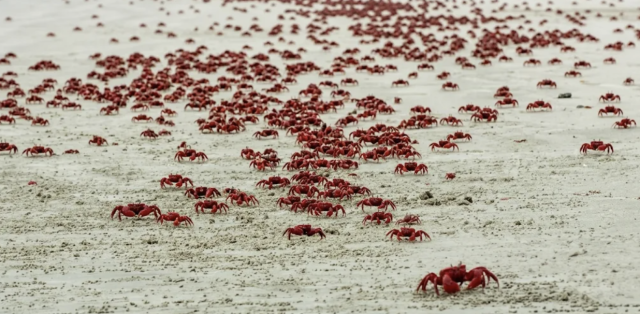
Tens of millions of red crabs have begun their annual march across Australia’s Christmas Island, filling roads and purpose-built crossings on November 14 and 15. The island has bridges for them, barriers to guide them and road closures when there are simply too many to share the pavement.
What’s happening now is the journey to the coast. The crabs are heading there to mate, but the journey doesn’t end when they reach the water. Males dig burrows near the shore, where females stay as their eggs develop. Then, before dawn on a falling high tide, the females gather at the water’s edge to release them. December 5–6 is one possible spawning window this season. Until then, there’s a lot of walking, digging and waiting to do.
The 2026 Christmas Island red crab migration is underway, with Euronews reporting tens of millions of crabs on the move on November 14 and 15.
Possible spawning dates for the 2026 red crab migration are December 5 and 6, 2026, and January 2 and 3, 2027
Red crabs time their spawning for before dawn on a receding high tide during the moon's last quarter
Christmas Island sits about 930 miles (1,500 kilometers) off the Australian mainland, and Qantas flies there twice a week from Perth, according to the island's tourism association.
American travelers need an approved Electronic Travel Authority before flying to Australia, and the Australian Department of Home Affairs runs the application.
More than 100 million red crabs live on Christmas Island, and the island's tourism association says they can be seen all year, though the mass migration happens once a season.

You need to agree with the cookies and privacy policy of this external service to view the content
The crabs leave their forest burrows when the first heavy rain of the wet season arrives, according to Parks Australia, and this year that trigger came in time for the roads to fill on November 14 and 15. What most visitors miss is that the road crossings are only the first act. The island's tourism association breaks the migration into stages that unfold over about a month.
The march (happening now): Males head down to the lower terraces first and dig burrows, then females follow and mating takes place roughly two weeks before spawning. Males then turn around and climb back to the plateau.
The spawn (possible December 5 and 6): Females stay in damp burrows for about two weeks while their eggs develop, and a single crab can carry up to 100,000 of them. Around the moon's last quarter they gather on the shoreline, then release the eggs into the sea before dawn as the high tide turns. Spawning can repeat over five or six consecutive mornings.
The babies (roughly three to five weeks later): Larvae hatch the moment eggs touch the water, and most are eaten by fish, manta rays, and visiting whale sharks. In most years few baby crabs make it back ashore, but once or twice a decade a huge cohort survives, which is enough to keep the population going.
Timing is the one thing nobody can promise. If rain arrives close to the ideal spawning date, the crabs hurry, and if the schedule is disrupted, the tourism association notes that they can complete spawning one lunar month later. That is why the January 2 and 3 dates are on the calendar as a backup.
Baby red crabs, only about 5 millimeters across, swarm a coastal rock after leaving the sea, the first step of a roughly nine-day climb back to the forest.
Christmas Island doesn't wait for the crabs to arrive before getting ready. Months ahead, Parks Australia clears underpasses, builds crab bridges, and installs kilometers of roadside barriers, along with road signs made for the occasion. The barriers funnel crabs toward the crossings, and the tourism association says the island has what it describes as the world's only crab bridge, built over one of its busiest roads.
This is what the crabs will walk over: a steel crab bridge arching above one of Christmas Island's busiest roads, which the tourism association describes as the only one of its kind in the world.
For visitors, that planning has a practical side. Some road sections close for part or all of the day at peak times, often at short notice, but you can park and walk carefully among the crabs, and the bridges are good places to stand and watch the flow. Public notice boards and local radio carry updates on where the crabs are heading.
The crabs have faced some serious threats over the years. Invasive yellow crazy ants have killed tens of millions of them by spraying formic acid. To fight back, park staff introduced a tiny parasitic wasp that targets an insect the ants depend on for food.
Today, the island's tourism association estimates that more than 100 million red crabs live on Christmas Island. That's a lot of little legs making their way to the beach every year.
A Christmas Island red crab makes its way across a road during the annual migration, when millions of crabs leave the forest and head toward the coast to breed.
Reaching Christmas Island from the U.S. is really two trips in one: a long haul to Perth, then a short hop out to the island. Here is the order that keeps you from buying flights you cannot use.
Apply for your Australian Electronic Travel Authority through the official ETA app, which the Australian Department of Home Affairs lists as the route for eligible passport holders. Do this before you buy nonrefundable flights.
Book your flight from the U.S. to Perth (PER), which for most departure cities means a connection through an Australian gateway such as Sydney or Melbourne.
Book Perth to Christmas Island on Qantas, which runs two flights a week from the international terminal, and plan to arrive at the airport at least two hours early.
Reserve a room and a rental car at the same time, because the island has no public transport or taxis.
Booking notes: The island leg does not require a separate visa, but every traveler needs photo identification, and the tourism association strongly recommends travel insurance that covers flight disruptions and medical evacuation. Capacity is the real constraint. Accommodations, car rentals, and flights fill up early during crab season, so treat December and January availability as limited.
If you want a guided option: Australian Geographic Travel runs a 12-day Christmas Island and Cocos (Keeling) Islands trip with return Perth flights included. It lists departures on November 30 and December 28, 2026, and the operator says the tour sells out quickly, so check availability before you plan around it.
Many travelers fly into Paris and commute to Versailles for the ball. The palace is about 30 to 45 minutes by car or 40 to 60 minutes by train, depending on where you are staying.
The easiest and most popular option is the RER C train to Versailles Château Rive Gauche, which is about a 10 to 15 minute walk from the palace. A round-trip train ticket is usually around $8. You can also take Line L from Saint-Lazare or Line N from Montparnasse if those stations are closer to your hotel.
The Grand Masked Ball is more than a party. It is an immersive theatrical experience that blends history, artistry and pure spectacle. From illuminated gardens to performers drifting among the guests, from the pulse of the Orangery dance floor to sunrise over the palace grounds, every moment feels cinematic.
If you want a travel experience in 2026 that is rare, immersive and truly unforgettable, this is the night to plan your trip around.
The migration began on November 14 and 15, and the Christmas Island Tourism Association lists December 5–6 as possible spawning dates, with January 2–3, 2027, as a backup if weather or rainfall disrupts the schedule.
American travelers need an approved Australian Electronic Travel Authority (ETA) to enter Australia. The tourism association says the flight from Perth to Christmas Island requires no separate passport or visa check, but travelers must carry photo identification.
Fly to Perth, Australia, usually with one or more connections, then catch the twice-weekly Qantas flight to Christmas Island. The final flight takes about 3.5 hours, so plan for a long journey and leave some flexibility in your schedule.
Popular viewing spots include Drumsite, Flying Fish Cove, Ethel Beach, and Greta Beach. The island's specially built crab bridges are also great places to watch the migration as thousands of crabs make their way across the roads.
Yes, and renting a car is highly recommended because Christmas Island has no public transportation. However, roads can close at short notice when the crabs are moving. Follow local signs, drive slowly, and never drive over crabs.
The crabs spend most of the year in the island's forests, but when the wet season arrives, millions head toward the coast to breed. Rainfall helps trigger the migration, while spawning is timed to the tides and phases of the moon.
Yes, but watch your step! During the migration, crabs can cover roads, walking trails, and even beaches. Visitors can experience the spectacle up close, but should avoid touching or picking up the crabs and give them plenty of room to move.
The migration typically unfolds over several weeks, depending on rainfall and weather conditions. The crabs travel from the forest to the coast, mate, and eventually release their eggs into the ocean. The actual spawning event is much shorter and usually happens before dawn.