We use cookies to enhance your browsing experience, serve personalized content, and analyze our traffic. By clicking "Accept All" you accept this and consent that we share this information with third parties and that your data may be processed in the USA. For more information, please read our .
You can adjust your preferences at any time. If you deny, we will use only the essential cookies and unfortunately, you will not receive any personalized content.

Christopher Nolan's The Odyssey opens July 17, 2026, and it's already one of the most anticipated films of the year. Starring Matt Damon as Odysseus, the film was shot entirely on location across six countries, using real beaches, ancient castles, volcanic islands, and glacial landscapes to bring Homer's epic poem to IMAX screens. If you're wondering where Nolan actually took his cast and crew, and which of those places you can visit yourself, here's the complete breakdown of every confirmed filming location.
The Odyssey is Christopher Nolan's adaptation of Homer's ancient Greek epic poem, following Odysseus, king of Ithaca, on his ten-year journey home after the fall of Troy. Along the way he faces monsters, vengeful gods, treacherous seas, and no shortage of mythological detours, including a one-eyed giant, a sorceress who turns men into pigs, and a nymph who'd very much prefer he never leaves her island. It's one of the oldest stories in Western literature, and Nolan is bringing it to IMAX for the first time.
The confirmed cast includes:
Matt Damon as Odysseus
Tom Holland (role unconfirmed, believed to be Telemachus)
Anne Hathaway as Penelope
Zendaya as Athena
Charlize Theron as Calypso
Lupita Nyong'o (role unconfirmed)
Robert Pattinson (role unconfirmed)
Jon Bernthal (role unconfirmed)
Travis Scott in an undisclosed role
The Odyssey was filmed across six countries, with key locations including the Aït Benhaddou village in Morocco, Voidokilia beach in Greece, the island of Favignana in Italy, the Hjörleifshöfði mountain in Iceland, Findlater Castle in Scotland, and the White Dune near Dakhla in Western Sahara.
Principal photography began on February 25, 2025, shot entirely using new IMAX film technology, with Hoyte van Hoytema serving as cinematographer. The production moved country to country over roughly six months, with Nolan choosing real historical and geographical locations rather than studio recreations wherever possible.
Here's the full country-by-country breakdown of where it was shot:
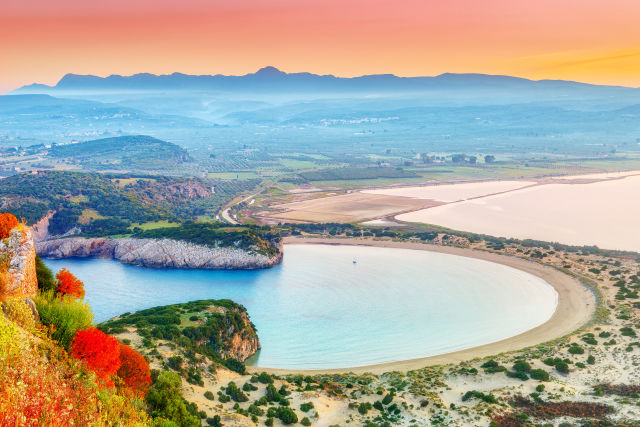
The Greek portion of the shoot took place across Messinia, a sun-soaked region of the Peloponnese that already feels like it belongs in an epic. Filming ran from March 10 to 21, 2025, with scenes shot at Nestor’s Cave above Voidokilia Beach, where the Cyclops Polyphemus sequence was filmed, along with Almyrolakkas Beach in Gialova, the Venetian-era Methoni Castle, and the coastal town of Pylos.
Voidokilia Beach is one of those places that almost doesn’t look real. It forms a near-perfect horseshoe of golden sand, with clear blue water curling into the bay and Nestor’s Cave sitting high above it. Local legend has long tied the cave to King Nestor from Homer’s Odyssey, so using it for the Cyclops sequence feels almost too perfect. Ancient myth, dramatic cliffs, unreal beach. Greece really did understand the assignment.
Methoni Castle brings a completely different kind of cinematic drama. The Venetian-era fortress sits right on the edge of the sea, connected to land by a narrow promontory and a small bridge, with waves on almost every side. During filming, Tom Holland was spotted aboard a large wooden ship just offshore, wearing a brown cloak over a wine-red tunic as the boat moved toward the castle with extras dressed as Greek warriors. You can visit both Voidokilia and Methoni easily from Pylos, and the whole region still has that rare feeling of being not just beautiful, but genuinely ancient.
The first scenes were filmed in late February 2025 in Morocco, with Aït Benhaddou near Ouarzazate standing in for Troy at the end of the Trojan War. Filming also took place in Essaouira, Marrakech, Tahannaout, and El Haouz.
Aït Benhaddou is a UNESCO World Heritage site and one of those places that instantly looks cinematic. The fortified clay village has been used by filmmakers for decades because it reads immediately as ancient, dramatic, and important. For Nolan’s opening scenes showing the fall of Troy, it makes complete sense. The warm red earth, narrow passageways, and fortress-like scale already do so much of the storytelling before a single line is spoken.
Morocco has been a go-to filming location for epic productions for generations, from Lawrence of Arabia to Gladiator to Game of Thrones. Nolan’s decision to begin the film here gives the Trojan War sequences a grounded, sun-baked authenticity that a fully CGI city would struggle to match. It feels dusty, ancient, and real, which is exactly what Troy needs to be.
Italy is where the film seems to lean most fully into the mythological heart of The Odyssey, especially the sea-bound stretches of Homer’s poem. Much of the production centered on Favignana, a small island off the western coast of Sicily, also known as Goat Island.
Cast members, including Matt Damon and Tom Holland, were spotted filming along the island’s rocky coastline, which feels fitting given Sicily’s long association with The Odyssey. The region is often linked to the land of the Cyclopes, and local legend places Odysseus and his crew on Favignana before their encounter with Polyphemus. In other words, if you’re going to film the mythic, salt-sprayed, danger-is-probably-coming part of the story, this is exactly the kind of place you’d choose.
Damon also described hiking up to the Castle of Santa Caterina on Favignana every day during the Sicily shoot, which gives you a pretty good sense of what “a relaxed Italian filming location” looks like when Christopher Nolan is involved. Beautiful? Absolutely. Effortless? Apparently not.
Filming also stretched to the Aeolian Islands, including Basiluzzo, Lipari, and Vulcano. These islands bring exactly the kind of landscape you want for the more mythic parts of The Odyssey: volcanic rock, wild coastlines, strange light, and places that already feel like gods or monsters could plausibly appear around the next cliff.
Malta is also on the confirmed location list, adding even more Mediterranean texture to the film’s sea-bound sequences. Between Sicily, the Aeolian Islands, and Malta, the production clearly wanted locations that felt rugged, ancient, and just a little otherworldly.
Parts of The Odyssey were filmed along Scotland’s Moray Firth coast, which gives the movie a very different kind of drama from its Mediterranean locations. The ruins of Findlater Castle sit about 50 feet above the water on a rocky cliff, making it exactly the sort of windswept, slightly haunted backdrop you want when things are about to go badly at sea. Nearby beaches were reportedly dressed with shipwreck props, suggesting scenes of disaster, survival, and possibly the kind of miserable coastal ordeal Odysseus seems to specialize in.
Scotland also appears to be where Nolan brought Circe’s world to life, with filming at Culbin Forest and Findlater Castle in Moray. In Homer’s poem, Circe lives on the lush island of Aeaea, a place that feels beautiful, dangerous, and far removed from ordinary human life. The Moray coast makes a surprisingly perfect stand-in. It has fog, cliffs, ruins, and that strange, edge-of-the-world quality that makes it feel slightly outside time.
Additional filming took place in Burghead, a historic coastal village with the remains of an ancient fort, as well as in the sand dunes and woodlands of Culbin Forest. The crew also used Buckie harbor, where a large Viking-style ship was docked for filming. Between the forests, cliffs, ruins, and rough northern water, Scotland seems to be giving The Odyssey some of its moodiest, most enchanted landscapes.
Nolan saved two of the shoot’s most extreme landscapes for two of the poem’s most mythic places. Iceland became Hades. Western Sahara became paradise. Neither sounds especially relaxing, which feels about right for The Odyssey.
For the underworld scenes, Nolan returned to Iceland, where he had previously filmed Batman Begins and Interstellar. The country’s Highlands and glacier-covered landscapes hosted some of the film’s most otherworldly moments, while a large ship set, likely meant to represent Odysseus’s vessel, was built near the coastal harbor of Landeyjahöfn.
Damon described filming the Hades scenes during Iceland’s white nights, soaked by rain, which sounds miserable in exactly the way an underworld sequence should. Black sand, volcanic rock, ice, rain, and the strange half-light of an Arctic summer. It’s hard to imagine a better place on earth to film the land of the dead.
The Calypso sequences took the production to Western Sahara, specifically White Dune Beach near Dakhla. On paper, this sounds like the dreamiest location of the entire shoot. Remote beach, sweeping sand, endless Atlantic light. Very “mythological island paradise,” at least in theory.
In practice, Damon described Dakhla as the kitesurfing capital of the world, which also meant sand was constantly ripping into everyone’s eyes with no real way to block it. So yes, even Odysseus’s island paradise came with fine print. Beautiful, brutal, and apparently very exfoliating.
Planning a trip around The Odyssey is essentially an excuse to build one of the best multi-country itineraries in Europe and North Africa. The Peloponnese alone is worth the flight, and Sicily doesn't need a Hollywood endorsement. But there's something genuinely wonderful about knowing Nolan sent his cast to the real geography of Homer's world rather than building it on a lot in Burbank. The ancient places are still there, and they're still waiting.
The Odyssey was filmed across six countries: Greece, Italy, Morocco, Iceland, Scotland, and Western Sahara, with additional work on Hollywood soundstages.
The Cyclops Polyphemus sequence was filmed at Nestor's Cave at Voidokilia beach in the Messinia region of the Peloponnese, Greece.
Troy was depicted using Aït Benhaddou, a UNESCO World Heritage site near Ouarzazate, Morocco, with additional scenes shot in Essaouira and Marrakech.
Favignana is a small island off western Sicily, traditionally linked to the part of Homer's poem where Odysseus encounters the Cyclops. Matt Damon and Tom Holland filmed on its rocky coast in spring 2025.
Iceland's glacial highlands and black-sand coastlines, including the area around Landeyjahöfn, were used to depict Hades. Nolan had previously filmed in Iceland for both Batman Begins and Interstellar.
Calypso's island was filmed at the White Dune beach near Dakhla in Western Sahara. Despite its paradise-island role in the film, the location was famously brutal to shoot in due to relentless wind and sand.
Circe's island, Aeaea, was depicted using locations along Scotland's Moray Firth coast, including Findlater Castle and Culbin Forest.
The Odyssey opens in theaters everywhere on July 17, 2026, in IMAX.