We use cookies to enhance your browsing experience, serve personalized content, and analyze our traffic. By clicking "Accept All" you accept this and consent that we share this information with third parties and that your data may be processed in the USA. For more information, please read our .
You can adjust your preferences at any time. If you deny, we will use only the essential cookies and unfortunately, you will not receive any personalized content.

Enola Holmes has spent two films outwitting everyone in Victorian London's rain-soaked streets, but the third installment sends her somewhere with actual sunshine. Enola Holmes 3 arrived on Netflix on July 1, sending the young detective abroad for her most dangerous case yet. This time, Enola heads to Malta, where her wedding plans are quickly interrupted by Sherlock’s disappearance and a much larger mystery. The Mediterranean setting is not movie magic either. Much of the film was shot across Malta’s real cathedrals, fortified cities, gardens, and centuries-old forts.
Primary filming country is Malta, with location work in Valletta, Mdina, Mellieħa, Ħ'Attard, and Marfa Ridge
Interior sets were built at Shepperton Studios in Surrey, England, including 221B Baker Street and Enola's detective agency
Valletta is a UNESCO World Heritage Site with limestone streets, Baroque facades, and the iconic gallariji wooden balconies that give the film its visual signature
Mdina, nicknamed the Silent City, is completely car-free and appears as the setting for a key chase sequence and the wedding scene at St. Paul's Metropolitan Cathedral
Fort Ricasoli, a 17th-century fortress, hosted the film's major action sequences; it's previously appeared in Game of Thrones, Troy, and Napoleon
Hatfield House in Hertfordshire returns from the earlier films as Basilwether Hall, the Tewkesbury family estate
Principal photography ran from April 10 to June 27, 2025, wrapping after roughly two months across the UK and Malta
Image Source: Netflix
Enola Holmes 3 was filmed primarily in Malta, with additional production taking place in England. Malta plays itself in the story, rather than quietly pretending to be London, France, or somewhere else entirely. The island’s limestone cities, historic harbors, fortifications, and Mediterranean coastline gave the filmmakers a setting that already looked convincingly Victorian.
Supervising location manager Tom Howard said the production needed somewhere that could transport viewers back roughly 120 years. Valletta’s streets, Mdina’s alleys, Malta’s old forts, and its weathered architecture did most of that work before the props department even arrived. Filming also took place at English estates and institutional buildings for interiors that could not be completed in Malta
Valletta served as the beating heart of Enola's Maltese investigation. Malta's historic walled capital is a UNESCO World Heritage Site built on a peninsula between two natural harbors, with steep hills, narrow alleys, and centuries of layered history in every direction. Its most distinctive visual feature is the gallariji, the colorful enclosed wooden balconies that line the golden Baroque facades in vivid reds, blues, and greens.
The production essentially transformed sections of the city into a working Victorian set. The crew worked with a local society to take over streets for a carnival sequence, removing cars, laying sand over tarmac, and adding period shopfronts to the facades. If you've seen the film, these are the scenes that make Valletta feel like it was built specifically for Enola Holmes.
Mdina might be Malta's best-kept secret, and it's near-perfect for a mystery. The tiny hilltop town is entirely car-free, which means the only sounds you'll hear walking its narrow stone alleys are your own footsteps echoing off 900-year-old walls. It earned the nickname the Silent City honestly.
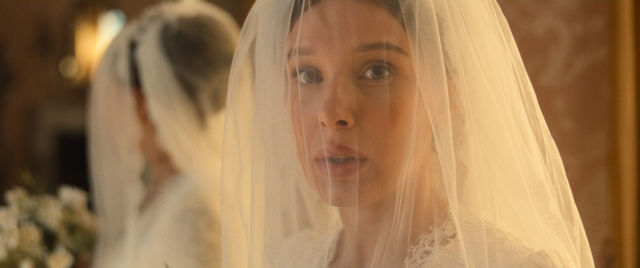
In Enola Holmes 3, Mdina is where Enola spots a suspicious soldier and chases him through the palazzos and alleyways. It's also the setting for the film's pivotal wedding scene, filmed at St. Paul's Metropolitan Cathedral, with its ornate marble floors and soaring stone columns lending exactly the kind of period-appropriate weight a Holmes wedding needs.
Mdina has history as a filming location beyond this. It stood in for King's Landing during the first season of Game of Thrones before Dubrovnik took over in season two. If you're visiting and wondering why it feels familiar, that's why.
The island's military history gave the production two more significant backdrops. Fort Ricasoli, a 17th-century fortress on the southern coast, hosted the film's explosive action sequences. It's been used in productions from Troy to Napoleon and plays host to a confrontation with an old Holmes adversary in this one. Fort Manoel, north of Valletta, was dressed to represent a sewer sequence.
On the northern coast, Mellieħa and the dramatic Marfa Ridge provided open Mediterranean vistas and the kind of arid limestone cliff scenery that makes a Victorian mystery feel genuinely perilous. The production also made use of Malta Film Studios in Kalkara, which has massive deep-water tanks directly adjacent to the open sea, used here for the film's naval sequences
A Guildford seminary in England rounded out the practical shoot, doubling as the Royal Malta Fencible Artillery building for scenes where Enola and her mother break in to pursue a hunch. It's a detail that shows how far the location team went to find authentic architectural texture
Even with Malta anchoring the film's new identity, the production's English roots are still visible. Shepperton Studios in Surrey handled all the London interiors, including the 221B Baker Street set and Enola's own detective agency office. The studio's soundstages were where the more domestic, character-driven scenes were built and shot.
Hatfield House in Hertfordshire returns as the Tewkesbury family estate, here called Basilwether Hall. Its Marble Hall, with the famous chequered floor, appears in a scene where Enola and Lady Tewkesbury work through the wedding guest list together. The house was Elizabeth I's childhood home and has appeared in everything from Batman to Paddington 2. It earns its place in period dramas
The combination of Shepperton's controlled interiors and England's historic exteriors keeps the series grounded in its Victorian identity even as the story moves south toward warmer skies.
Image Source: Netflix
Enola Holmes has always been a character who refuses to stay where she's expected, so sending her to Malta for her most complicated case feels right. If you've watched the film and found yourself looking up flights to Valletta, you're not alone. The island is genuinely worth the trip, with or without a mystery to solve.
The film was primarily filmed in Malta, with location work across Valletta, Mdina, Mellieħa, Ħ'Attard, and the Marfa Ridge. Interior sets were built at Shepperton Studios in Surrey, England.
Principal photography ran from April 10 to June 27, 2025. The shoot began at Shepperton Studios in Surrey before relocating to Malta for over a month.
Valletta served as the central setting for Enola's Maltese investigation. The production staged a full carnival sequence there, transforming several streets into a Victorian-era setting with sand laid over tarmac and period shopfronts added to facades.
Mdina hosted a key chase sequence through its car-free alleys and palazzos, as well as the film's pivotal wedding scene, which was shot at St. Paul's Metropolitan Cathedral.
Not on location. Queen Anne's Gate in London again doubled as Baker Street for exterior shots. London interior sets were built on soundstages at Shepperton Studios in Surrey.
Fort Ricasoli is a 17th-century Maltese fortress on the southern coast, previously used in Game of Thrones, Troy, and Napoleon. It hosted the film's major action sequences, including a confrontation with a key villain.
Yes. Hatfield House in Hertfordshire returns as the Tewkesbury family estate, with its famous Marble Hall appearing in a scene between Enola and Lady Tewkesbury.
Absolutely. Most of the key Enola Holmes 3 locations, including Valletta and Mdina, are publicly accessible, and the island has a deep filming history that runs from Gladiator through Game of Thrones and beyond.