We use cookies to enhance your browsing experience, serve personalized content, and analyze our traffic. By clicking "Accept All" you accept this and consent that we share this information with third parties and that your data may be processed in the USA. For more information, please read our .
You can adjust your preferences at any time. If you deny, we will use only the essential cookies and unfortunately, you will not receive any personalized content.

Paris and Rome are iconic for a reason, but they're also expensive, crowded, and increasingly exhausting. The good news is that Europe has dozens of cities that deliver just as much history, food, and atmosphere at a fraction of the price. These ten destinations are consistently overlooked, genuinely affordable, and absolutely worth your time.
Portugal's second city has grown in popularity but hasn't grown expensive. Compared to Lisbon, it's still noticeably cheaper, quieter, and arguably more beautiful. The tilework alone is worth the trip. Port wine cellars in Vila Nova de Gaia offer tastings for next to nothing, the Douro riverfront is free to walk, and the food scene is serious without the inflated prices.
Porto rewards slow travelers. Stay in the Bonfim or Cedofeita neighborhoods for a less touristy experience, and budget around $80 to $100 per day if you're being reasonable about wine.
Timișoara doesn't get nearly enough credit. This is the city where the 1989 revolution against Ceaușescu began, and that history sits alongside some of the most beautiful Austro-Hungarian architecture in Eastern Europe. The three main squares — Unirii, Victoriei, and Libertății — are genuinely stunning, and the city's designation as a 2023 European Capital of Culture brought a wave of galleries, festivals, and renovations that stuck.
Romania is one of the most affordable countries in the EU, and Timișoara reflects that. A good dinner with wine runs around $12 to $15, accommodation is cheap, and the city is compact enough to cover on foot. It's well connected by air from Western Europe and has almost no American tourist presence, which is either a warning or a selling point depending on your travel style. It's the latter.
Poland is routinely one of the most affordable countries in Europe, and Gdańsk is its most underrated city. The rebuilt medieval old town is strikingly beautiful, the amber market is unique to the region, and the World War II history here is genuinely moving. The European Solidarity Centre alone is worth the trip.
You'll eat well for under $10, sleep well for under $60, and have an entire city that doesn't feel overrun. It's also a short day trip from Sopot and Gdynia if you want a beach fix.
Ljubljana is small, which might be why it gets overlooked. But compact doesn't mean dull. The Slovenian capital has a carless old town, a castle you can hike to for free, a riverfront lined with outdoor cafes, and easy access to Lake Bled if you want a half-day excursion. The food market along the Ljubljanica is one of the better morning stops in Central Europe.
Costs are higher than the Balkans but still well below Western Europe. Expect to pay around $100 to $130 per day for a comfortable trip.
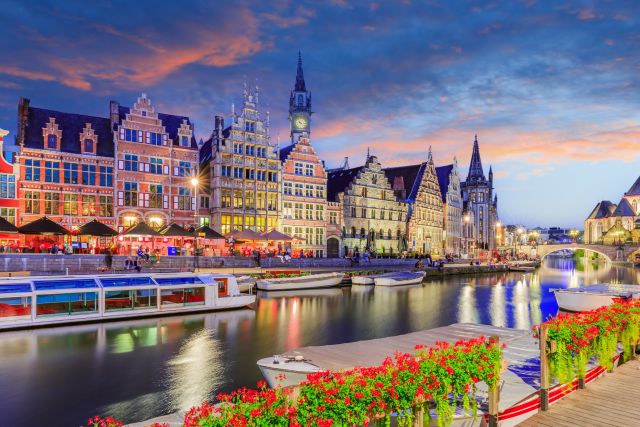
Bruges gets all the attention, but Ghent is the better city. It’s livelier, less touristy, home to a major university, and has the same medieval canal architecture without the crowds. It’s personally one of my favorite cities in Europe, and somehow it manages to be gorgeous without feeling overrun.
The Gravensteen castle sits right in the city center. The restaurant scene is strong. The beer is, of course, excellent. And stepping inside St. Bavo’s Cathedral to see the Ghent Altarpiece is worth the trip alone.
Day-trippers from Brussels and Bruges tend to stop here for a few hours. Spend a night or two and you’ll have the city largely to yourself in the evenings. For Belgium, it’s one of the more affordable options.
Montenegro doesn't yet have the tourist infrastructure of Croatia, which keeps prices lower and the crowds thinner. Kotor's walled old town is a UNESCO World Heritage Site and one of the most dramatic settings in the entire Adriatic. The drive along the Bay of Kotor is worth doing just for the views.
Accommodation and food run roughly half what you'd pay in Dubrovnik, just two hours up the coast. Summers are hot and increasingly busy, so aim for May or September if you can.
Trieste sits in the far northeastern corner of Italy, wedged between Slovenia and the Adriatic, and it feels almost nothing like the rest of the country. The architecture is Austro-Hungarian, the coffee culture is legendary (this is where Illy was founded, and locals drink espresso standing at marble bars with a seriousness that borders on ritual), and the seafood is outstanding. James Joyce lived here for over a decade. The city has that rare quality of feeling literary without trying to.
It's also significantly cheaper than Rome, Florence, or the Amalfi Coast. The waterfront promenade, the Miramare Castle just outside the city, and the karst plateau above town make it one of the most varied short-stay destinations in the article.
Italy doesn't have to mean Rome. Matera, in the southern Basilicata region, is one of the most ancient continuously inhabited cities on earth, with cave dwellings carved into a ravine that were once considered an embarrassment and are now a UNESCO site and a 2019 European Capital of Culture. The Sassi neighborhoods are genuinely unlike anything else in the world.
Southern Italy is dramatically cheaper than the north. You'll eat better for less, the sites are less crowded, and the experience is far more memorable than another lap around the Colosseum.
Valletta is the smallest EU capital by area, and it packs an extraordinary amount into a very short walk. The Knights of St. John left behind baroque architecture, fortified walls, and a harbor view that stops you mid-step. Malta sits at the crossroads of European and North African culture, which shows up in the food, the language, and the pace of life.
Budget airlines connect Valletta to most major European cities for very little. Once there, the old town is manageable on foot, and costs remain reasonable compared to Western Mediterranean alternatives.
Sarajevo is one of those cities that gets under your skin quickly. It's where East meets West in the most literal sense, with Ottoman bazaars giving way to Austro-Hungarian architecture within a single street. The food is exceptional, the coffee culture is serious, and the history is layered in ways that take time to absorb. This is also the city where WWI began, and the Latin Bridge where Archduke Franz Ferdinand was assassinated is still standing, unmarked and easy to miss, which somehow makes it more affecting.
Additionally, it's among the cheapest cities in Europe. A full day of meals, coffee, and a museum or two can be done comfortably for under $40. If you want a day trip, Mostar is two and a half hours by bus and worth every minute. Go with time to spare.
You don't have to choose between quality and affordability in Europe. The cities above deliver both, and in several cases they're more interesting than the iconic alternatives. Book a budget flight into Gdańsk or Sarajevo and see how far your money actually goes.
Sarajevo, Bosnia and Herzegovina consistently ranks as one of the most affordable cities in Europe for travelers. Daily budgets under $50 are realistic with local food, guesthouses, and public transit.
Yes. While Porto has grown in popularity, it remains significantly cheaper than Lisbon, Barcelona, and most Western European capitals. A comfortable mid-range daily budget runs around $80 to $100.
May and September offer the best combination of good weather, lower prices, and smaller crowds. July and August are peak season and noticeably busier and more expensive.
Most of them, yes. Ljubljana, Ghent, Porto, and Timișoara are particularly well set up for solo travel, with compact old towns, good public transport, and strong English coverage in cafes and restaurants.
Matera and Sarajevo are standouts. Southern Italian cuisine in Matera is exceptional and underpriced compared to Rome or Florence. Sarajevo's Bosnian food scene, especially its grilled meats, pastries, and coffee culture, is a genuine draw.
Matera is accessible by bus from Bari, about 1.5 hours away. Bari has its own airport with connections to major European cities. The journey is part of the experience.
Malta is moderate by Western European standards. It's cheaper than France, Italy, and Spain, though not as affordable as the Balkans. Budget flights from across Europe help offset accommodation costs.
Bruges is more photogenic and heavily touristed. Ghent is larger, younger in character, and more livable. If you want a quieter, more authentic Belgian experience, Ghent wins. If you want the fairy-tale canal town, Bruges delivers.