We use cookies to enhance your browsing experience, serve personalized content, and analyze our traffic. By clicking "Accept All" you accept this and consent that we share this information with third parties and that your data may be processed in the USA. For more information, please read our .
You can adjust your preferences at any time. If you deny, we will use only the essential cookies and unfortunately, you will not receive any personalized content.

They start as genuine wonders. A painting that changed art history. A checkpoint that divided a city. A rock that became a myth. But somewhere between the postcard and the pilgrimage, reality sets in. Crowds, context, and scale conspire against the legend, and you're left standing there thinking: "That's it?" This isn't a list of bad places. It's a list of places that built up an expectations gap so wide you could drive a tour bus through it. Here's what actually awaits you, and what to do instead of being disappointed.
Checkpoint Charlie should be one of the most affecting sites in Europe. It was the crossing point between East and West Berlin, the scene of the 1961 tank standoff, a symbol of Cold War tension that gripped the world for decades. The history here is real and genuinely gripping.
The experience today is not. What you'll find is a replica guardhouse in the middle of a busy intersection, surrounded by souvenir shops, fast food, and people in hired American military uniforms charging €5 for a photo. The original booth is in the Allied Museum in Berlin-Zehlendorf, not here.
Cross the street to the Mauermuseum instead, which holds real artifacts and extraordinary escape stories. Better yet, walk the East Side Gallery or visit the Berlin Wall Memorial on Bernauer Strasse, where the full border strip has been preserved with real documentation. Checkpoint Charlie as a tourist experience is a bit of an insult to its own history.
From the highway approach, there's a genuine moment. Four presidential faces carved into granite rising out of the Black Hills. It's legitimately impressive for about three minutes. Then you realize you've seen the angle. There isn't really another one.
The viewing platform is fixed, the faces look the same from every accessible direction, and the complex around them, with its grand entrance avenue of state flags, its lodge, its gift shops, feels more like a corporate campus than a national monument. The on-site museum does a good job explaining that the sculpture was never actually finished: the original design included full torsos, abandoned when funding ran out and sculptor Gutzon Borglum died in 1941 before completion. Somehow that makes the whole thing feel more interesting.
The Black Hills surrounding it, though, are genuinely beautiful. Custer State Park, the still-in-progress Crazy Horse Memorial nearby, and Needles Highway are all worth the drive. Make Rushmore a stop, not the destination.
Times Square works at a distance. From photographs and films, it looks like the electric pulse of the world. In person, it's a sensory overload of chain restaurants, costumed characters angling for tips, and a crowd so dense that forward movement starts to feel like a personal achievement.
To be fair, it delivers exactly what it promises. Bright lights, scale, relentless commercial energy. The problem is that this is more or less all it delivers. There's nothing to do there beyond being there.
New York is full of neighborhoods that actually feel like New York. The West Village, Brooklyn Heights, the High Line, the Oculus at the World Trade Center. All of them offer something Times Square doesn't: a reason to linger. If you're visiting for the first time, look at it once at night when the lights are doing their thing. Then get out and find the actual city.
The Strip is impressive the first time, under the right conditions. Arriving at night from the freeway, the scale is genuinely hard to wrap your head around. Hotel-casinos the size of small city blocks, each one trying to outdesign the next. For a few hours, it's spectacle at maximum volume.
But the Last Vegas Strip is also very deliberately engineered to disorient you and separate you from your money, your sleep schedule, and your sense of how much you've been walking. No clocks, no natural light, no easy exits. "Just cutting through" a casino somehow takes 25 minutes.
The free stuff is actually fun. The Bellagio fountains are genuinely great. The light shows are worth stopping for. Go in knowing it's a theme park built around gambling, budget for entertainment rather than the tables, eat somewhere absurdly good, see a show, and leave while you still feel like a winner.
The Walk of Fame sounds glamorous right up until you're crouching on a dirty sidewalk in Hollywood trying to photograph a star between someone's feet. The stretch of Hollywood Boulevard near Highland is one of LA's more aggressively touristy corridors, running the same costumed character/photo tip playbook as Times Square and featuring more souvenir shops than any one street deserves.
The stars themselves are also somewhat democratic in a deflating way. The criteria for inclusion is broader than most visitors expect, and you'll find yourself genuinely puzzled by half the names. They're also underfoot, which makes the whole thing feel oddly uncelebrated for something called a Walk of Fame.
LA has genuinely great things going for it: Griffith Observatory, the Getty, Grand Central Market downtown, the coastline from Malibu to Venice Beach. Give the Walk of Fame fifteen minutes if you're already in the neighborhood. Don't build a day around it.
Rome is one of the great cities on earth, and the Spanish Steps on a quiet morning in April, with wisteria blooming and a view down to the Piazza di Spagna, can be quietly lovely. In August, packed with crowds and summer heat, with the city's ban on sitting on the steps firmly in place (fines of €250 have applied since 2019), it's more or less a holding pen with better architecture.
The steps were always about the atmosphere rather than a specific sight, which means they live and die by conditions. Outside peak season, go early, grab a coffee at Antico Caffè Greco nearby, and enjoy a genuinely beautiful corner of the city. In high summer, take a look from below and spend your energy on literally any of the dozen extraordinary things within walking distance. Rome will not run out of options.
The Little Mermaid statue is small. Not disappointing-small. Genuinely, objectively small. She sits roughly at the height of a seated person on a rock at the edge of the harbor, and visitors who have traveled from across the world to see her sometimes laugh out loud when they arrive. Not always in a delighted way.
She has also been vandalized repeatedly over the decades, decapitated twice, first in 1964 and again in 1998, had an arm removed in 1984, and been doused in paint more times than anyone has bothered to count. So what you're seeing is partly a restoration. The harbor setting at Langelinie is pleasant, and the walk along the water is a nice way to spend twenty minutes.
Copenhagen itself, though, is one of the most enjoyable cities in Europe. Nyhavn, Tivoli, the Meatpacking District, Torvehallerne food market. The city has so much going for it. The Little Mermaid is a five-minute detour if you're nearby. It is not a reason to reroute your day.
The rock where the Pilgrims allegedly stepped ashore in 1620 is housed under a small Greek Revival portico on the Plymouth waterfront. It is a rock. It has "1620" carved into it. It's roughly the size of a large kitchen table, though much of the original has been chipped away over centuries of enthusiastic souvenir hunters.
There is almost no interpretive signage at the rock itself. The actual history, the complexity of the Mayflower voyage and the Wampanoag Nation who were already living there, is told elsewhere. The Plimoth Patuxent living history museum a few miles away does a remarkable job of presenting both sides of the story, and is significantly more worth the drive.
Plymouth itself is a perfectly pleasant town. The rock is worth a two-minute glance if you're already there. Just don't make it the main event.
This one stings a little, because Venice itself is extraordinary. Genuinely unlike anywhere else in the world, and worth every superlative it's ever been given. The gondola, unfortunately, has become a different kind of experience entirely.
A standard ride runs around €80 to €100 for 30 minutes (roughly $88 to $110) for the entire gondola — up to six people — and doesn't include a singing gondolier unless you pay extra. The canals are not always fragrant in summer. The gondolier is usually silent. Other gondolas full of tourists drift past taking photos of each other. It's a lot of money for a slightly awkward half hour.
The Grand Canal by vaporetto costs a few euros and gives you more of Venice's iconic waterway. The view from the Rialto Bridge at dusk is free. A glass of prosecco at a bacaro standing next to actual Venetians will do more for your Venice experience than 30 minutes in a €100 boat. If the gondola matters to you, take it once. Just go in knowing what you're buying.
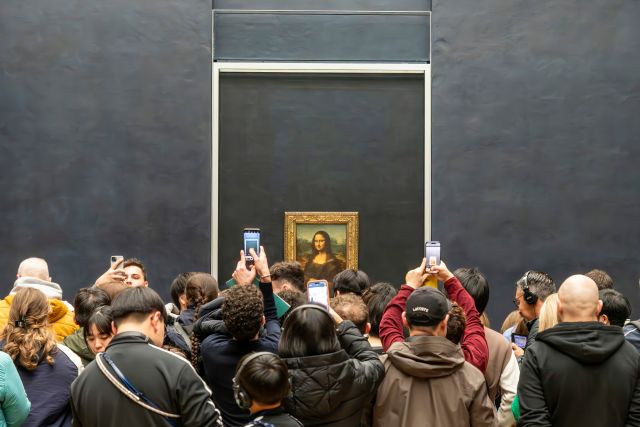
She's behind bulletproof glass. She measures roughly 30 by 21 inches — closer in size to a large laptop screen than anything you'd expect to anchor the world's most visited museum. And between you and her, there are approximately 400 people holding up phones.
The Mona Lisa is the most visited, most photographed, most hyped painting in the world, and paradoxically one of the least satisfying to experience in person. You shuffle forward in the Louvre's Salle des États, arrive at a barrier about 10 to 15 feet from the frame, squint at a small darkish canvas, and that's your moment. It lasts about 45 seconds before someone's elbow is in your ribs.
What actually makes it worth the trip is the Louvre itself. The building is extraordinary, the collection is overwhelming in the best way, and if you turn around from the Mona Lisa crowd and look directly across the room, you'll find The Wedding Feast at Cana, a massive Veronese canvas that fills the entire opposite wall and somehow gets treated like background scenery. Go for the museum. Let the painting be a footnote.
The world's most hyped attractions earned their reputations somewhere in history. The Mona Lisa really did change painting. Checkpoint Charlie really was the fault line of a divided world. The problem is that fame, crowds, and a century of postcards have stripped away the context and left behind a performance of visiting a place rather than the experience of it.
Go anyway. Arrive early where you can. Find the thing near the famous thing that nobody's photographing. And let the actual place surprise you.
If you're already going to the Louvre, absolutely. The museum is extraordinary and you'd be doing yourself a disservice to miss it. If you're making a special trip purely for the painting, temper your expectations: it's small, heavily guarded, and the viewing experience is largely a crowd management exercise.
The Strip is still worth a night or two if you go in with the right mindset. Beyond the casinos, the Nevada desert outside Vegas (Red Rock Canyon, Valley of Fire) is stunning and criminally overlooked by most visitors.
As of 2019, Rome introduced fines of €250 for sitting on the Steps, rising to €400 for causing damage. Rules and enforcement can vary by season, so it's worth checking current regulations before your visit.
For most visitors, probably not at around €80 to €100 ($88 to $110) per gondola for 30 minutes. The vaporetto along the Grand Canal and exploring the city on foot deliver a richer experience for a fraction of the cost.
Plimoth Patuxent living history museum nearby tells the full, complex story of the Pilgrims and the Wampanoag people and is a far more rewarding way to spend an afternoon.
The Mauermuseum directly across the street is genuinely worth your time. The checkpoint itself is a replica surrounded by souvenir shops. The original booth is in the Allied Museum in Berlin-Zehlendorf. For the real history, the Berlin Wall Memorial on Bernauer Strasse is a far more moving experience.
It's worth a stop if you're in the Black Hills, which are beautiful in their own right. Custer State Park and the Crazy Horse Memorial make the whole region worth the trip. Rushmore itself is about a 30-minute experience.
Yes, it's a public sidewalk and perfectly safe to walk. It's busy and touristy but straightforward. Give it fifteen minutes and then go explore the parts of LA that better capture what the city actually feels like.