We use cookies to enhance your browsing experience, serve personalized content, and analyze our traffic. By clicking "Accept All" you accept this and consent that we share this information with third parties and that your data may be processed in the USA. For more information, please read our .
You can adjust your preferences at any time. If you deny, we will use only the essential cookies and unfortunately, you will not receive any personalized content.

A century-long ban on swimming in the Seine ended two years ago, and Paris has now turned it into a full summer ritual. On July 4, 2026, the city opened three supervised, free swimming sites on the river for the second consecutive year, including one directly facing the Eiffel Tower. The sites stay open until August 30, are supervised by lifeguards every day, and require no reservation and no ticket. Water quality is tested daily by the city and public access stays open as long as currents, weather, and quality checks pass. If you're in Paris between now and the end of August, this is one of the more genuinely remarkable free things you can do in any European capital right now.
Three free swimming sites at Grenelle, Bercy, and Bras Marie opened July 4 and are scheduled to run through August 30, 2026, weather, currents, and water quality permitting. No advance booking is required.
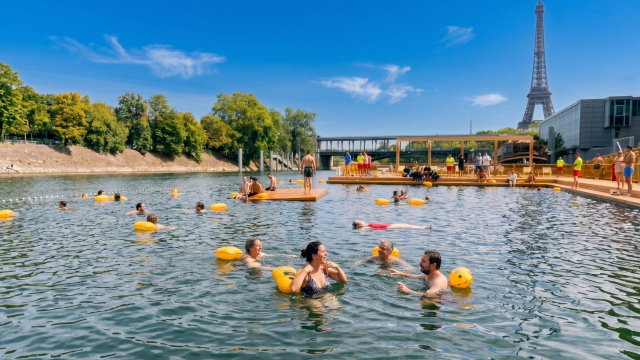
The Eiffel Tower view is at Grenelle in the 15th arrondissement, which can accommodate 200 visitors at a time, including up to 150 people in the water. Its swimming area is approximately the size of an Olympic pool.
The largest swimming site is Bercy in the 12th arrondissement, with two protected swimming areas, a sun deck, room for 600 visitors, and capacity for up to 300 swimmers. It sits opposite the Bibliothèque François-Mitterrand beneath the Simone-de-Beauvoir footbridge.
The most central location is Bras Marie in the 4th arrondissement, which sits between Pont Louis-Philippe and Pont Marie facing Île Saint-Louis. It has showers, secure lockers, restrooms, and equipment to help swimmers with limited mobility enter the water, but no private changing cabins.
Swimming rules require visitors to know how to swim, be at least 3 feet 11 inches tall, and use the flotation device provided by the site. Children under 14 must be accompanied by an adult.
Daily safety checks determine whether the sites can open, with the City of Paris testing water quality every day and closing swimming areas when pollution, currents, weather, or other conditions fail to meet safety standards. Check the live map on Paris.fr before heading out.
A €1.4 billion cleanup (about $1.6 billion) was accelerated by the Paris 2024 Olympics, which used the river for marathon swimming and triathlon events. That investment helped make permanent public swimming possible.
Paris Plages runs from July 4 through August 30 at Parc Rives de Seine and Bassin de la Villette, bringing free deckchairs, swimming, sports, children’s activities, and entertainment to the waterfront. The wider Paris en Seine program also includes free swimming at the Canal Saint-Martin.
Swimming in the Seine was officially banned in Paris in 1923 because of pollution and the dangers created by increasingly busy river traffic. Reversing that required years of infrastructure work and approximately €1.4 billion (about $1.6 billion) in investment from the City of Paris, the French government, regional authorities, and water agencies.
The cleanup included upgrades to wastewater treatment systems, work to correct buildings with improper sewage connections, and new requirements connecting boats and floating establishments to the city’s sewer network. Paris also built several stormwater storage facilities to reduce the amount of untreated wastewater entering the river after heavy rain.
The largest of those projects is the Austerlitz stormwater basin, which can temporarily hold around 50,000 cubic meters of excess rainwater and sewage. The stored water can then be treated instead of flowing directly into the Seine when the sewer system becomes overwhelmed.
The Paris 2024 Olympic and Paralympic Games gave the cleanup a firm deadline. Athletes competed in the Seine during the Games, and the infrastructure created for those events helped make regular public swimming possible. The three permanent sites first opened to the public in summer 2025 and returned for their second season in July 2026.
The three authorized swimming areas are Grenelle in the 15th arrondissement, Bras Marie in the 4th arrondissement, and Bercy in the 12th arrondissement.
These are not random stretches of river where swimmers have collectively decided the old rules no longer apply. Each site has controlled entry, lifeguards, showers, marked swimming boundaries, flotation devices, first-aid facilities, and capacity limits. Swimming outside the authorized areas remains illegal and dangerous.
Each location offers a slightly different version of the experience:
Grenelle has the Eiffel Tower view.
Bras Marie has the most atmospheric central Paris setting.
Bercy has the most space and the longest opening hours.
The Grenelle site sits in the 15th arrondissement, directly across from Île aux Cygnes, with the Eiffel Tower rising above the water. The swimming area was enlarged for 2026 and now covers roughly the same surface area as an Olympic-sized swimming pool.
Grenelle can accommodate 200 visitors at a time, including up to 150 people in the water. The smaller children’s paddling area used during the first season was removed when the main swimming zone was enlarged, so children now need to meet the same minimum height and swimming requirements as everyone else.
Grenelle opening hours
Monday through Friday from 10 a.m. to 5:30 p.m.
Saturday from 10 a.m. to 4:45 p.m.
Sunday from 10 a.m. to noon, 12:30 p.m. to 2:15 p.m., and 2:45 p.m. to 5:30 p.m.
The Sunday schedule is divided into three sessions, so it is worth checking the time before crossing Paris in wet sandals. Swimmers must leave the water 30 minutes before the end of each session.
There is also one important interruption to the summer schedule. Grenelle will close from August 1 through August 9 while a European swimming competition takes place in the Seine. From July 27 through July 31, access to the site will temporarily move to the Bir-Hakeim Bridge.
To reach Grenelle, take Metro Line 6 to Bir-Hakeim or RER C to Champ de Mars–Tour Eiffel.
Bercy is the largest of the three locations, with capacity for 600 visitors and up to 300 people in the water. It sits at 183 Quai de Bercy in the 12th arrondissement, across the river from the Bibliothèque François-Mitterrand and beneath the Simone-de-Beauvoir footbridge.
The site has two protected swimming areas, one measuring approximately 115 by 41 feet and the other measuring around 220 by 36 feet. Lateral barriers separate swimmers from passing boats, allowing river traffic to continue while the pools are open.
Bercy also has:
A large sun deck
Changing rooms
Secure lockers
Showers
Restrooms
A first-aid station
Seating beside the river
Bercy opening hours
Open every day from 11 a.m. to 9 p.m., making it the best option for an afternoon or early-evening swim. It is also the most reliable backup if Grenelle or Bras Marie reaches capacity.
Visitors with limited mobility should note that Bercy’s sun deck is accessible, but its swimming area is not. At Grenelle and Bras Marie, transfer chairs and hoists are available to help visitors enter the water.
Take Metro Line 14 or RER C to Bibliothèque François-Mitterrand.
Bras Marie is the smallest and arguably the most atmospheric of the three locations. It sits on the Right Bank between Pont Louis-Philippe and Pont Marie, directly across from Île Saint-Louis and beside the Rives de Seine section of Paris Plages.
The site can accommodate up to 150 visitors and opens earlier than the other two locations.
Bras Marie opening hours
Daily from 8 a.m. to 6 p.m.
Its central location makes it easy to combine a swim with the Marais, Hôtel de Ville, Île Saint-Louis, or a walk along the pedestrianized riverbank.
Bras Marie has secure lockers, outdoor showers, restrooms, a first-aid station, and places to sit beside the river. It does not have private changing cabins, so the city recommends arriving with your swimsuit beneath your regular clothes. Visitors who want to use a locker should bring a €1 coin or token.
Grenelle is the obvious choice for anyone who wants photographic evidence that they swam in the Seine rather than merely telling people they did. Getting into the water, however, involves more than arriving with a swimsuit and sufficient confidence.
All three sites have the same basic entry requirements:
You must know how to swim.
You must be at least 1.20 meters, or approximately 3 feet 11 inches, tall.
Anyone under 14 must be accompanied by an adult.
Staff may measure swimmers to confirm they meet the minimum height requirement.
Lifeguards supervise entry and confirm that visitors can swim.
You must use the flotation device provided by the site.
You must shower before entering the river.
Swimwear is required, but swim caps are optional.
There are no identification checks, but reception staff control access. The flotation device must be returned in good condition at the end of the session.
The supervised assessment is Paris’ very polite way of confirming that confidence and actual swimming ability are not always the same thing.
The City of Paris monitors water quality every day and can close one or more sites because of pollution, heavy rain, storms, strong currents, or other safety concerns. The city uses laboratory testing, real-time bacterial monitoring, weather data, rainfall totals, river-flow measurements, and reports from staff working along the river.
Flags displayed at each site show the current conditions:
A green flag means swimming is open and supervised, with no apparent danger.
A yellow flag means swimming remains open, but extra caution is advised because of water quality, changing weather, or stronger currents.
A red flag means swimming is prohibited because of a confirmed danger.
A lowered flag means the site is closed and there is no lifeguard supervision.
A clear sky does not necessarily mean the river is ready for swimmers. Rainfall or pollution upstream can affect conditions even when central Paris looks perfectly sunny. Heavy rain can also trigger preventive closures lasting 24 to 36 hours while the city waits for updated water-quality results.
Check the live City of Paris swimming map before leaving your hotel. Visitors should not swim if they have open cuts, wounds, scrapes, or irritated skin. Showers are mandatory before entering the river, and the city recommends washing with soap both before and after swimming.
Each site has a first-aid station. Anyone who experiences symptoms such as fever, muscle pain, nausea, or headaches after swimming should contact a medical professional.
The Seine swimming sites form part of the wider Paris en Seine summer program, which brings free swimming, performances, sports, and outdoor activities to locations throughout the city.
Paris Plages returns from July 4 through August 30, 2026, at two main locations:
Parc Rives de Seine covers the central riverbanks between the Tuileries Tunnel and Pont de Sully. It has deckchairs, pétanque courts, relaxation areas, and free activities. The Bras Marie swimming site sits directly beside it.
Bassin de la Villette offers swimming, paddleboarding, canoeing, a zipline, children’s activities, and access to the Paris Plages water-sports center.
The Canal Saint-Martin also offers designated free swimming through the broader Paris en Seine program, rather than Paris Plages itself. Several temporary pools and municipal sports centers provide additional places to cool off around the city.
Swimming in the Seine still sounds like the setup to a joke, but Paris has turned it into one of the city’s most memorable free summer experiences. The sites are supervised, the water is tested, and the rules are considerably more structured than a spontaneous jump from a bridge, which remains both illegal and a terrible idea.
Grenelle delivers the Eiffel Tower view, Bras Marie puts you in the center of historic Paris, and Bercy gives you the best chance of getting into the water without a long wait. Check the flag before you go, bring a €1 coin for the locker, and enjoy a Paris experience that would have sounded completely unhinged only a few summers ago.
Swimming is permitted only when the City of Paris determines that water quality, currents, and weather meet the required safety conditions. Water is tested daily, and all three authorized sites are continuously supervised by lifeguards during opening hours. The sites close whenever conditions become unsafe.
Yes. The official Grenelle, Bras Marie, and Bercy sites are open to both residents and visitors. There is no identification requirement, although staff may measure swimmers to confirm that they meet the minimum height requirement.
Yes. Entry to all three official river swimming sites is free, and no general reservation is required.
Grenelle in the 15th arrondissement. The site sits opposite Île aux Cygnes, with the Eiffel Tower visible from the swimming area.
Swimmers must use the flotation device provided by the site, regardless of age or swimming experience. It must be returned in good condition after the session.
Children can swim if they know how to swim and are at least 1.20 meters, or approximately 3 feet 11 inches, tall. Anyone under 14 must be accompanied by an adult.
Bras Marie is open daily from 8 a.m. to 6 p.m.
Bercy is open daily from 11 a.m. to 9 p.m.
Grenelle is open Monday through Friday from 10 a.m. to 5:30 p.m., Saturday from 10 a.m. to 4:45 p.m., and Sunday from 10 a.m. to noon, 12:30 p.m. to 2:15 p.m., and 2:45 p.m. to 5:30 p.m.
Swimmers must leave the water 30 minutes before closing.
No. Grenelle is scheduled to close from August 1 through August 9 for a European swimming competition. From July 27 through July 31, access will temporarily move to the Bir-Hakeim Bridge.
Grenelle and Bercy have changing areas. Bras Marie does not have private changing cabins, so visitors are encouraged to arrive wearing their swimsuits beneath their clothes. Secure lockers are available at all three locations and require a token or €1 coin.
No. Swimwear is required, but swim caps are optional.
Check the live swimming map on the City of Paris website or look at the flags displayed at each site. A red or lowered flag means swimming is not permitted.
The scheduled final day is August 30, 2026. Daily access remains dependent on water quality, currents, weather, and other safety conditions.