We use cookies to enhance your browsing experience, serve personalized content, and analyze our traffic. By clicking "Accept All" you accept this and consent that we share this information with third parties and that your data may be processed in the USA. For more information, please read our .
You can adjust your preferences at any time. If you deny, we will use only the essential cookies and unfortunately, you will not receive any personalized content.

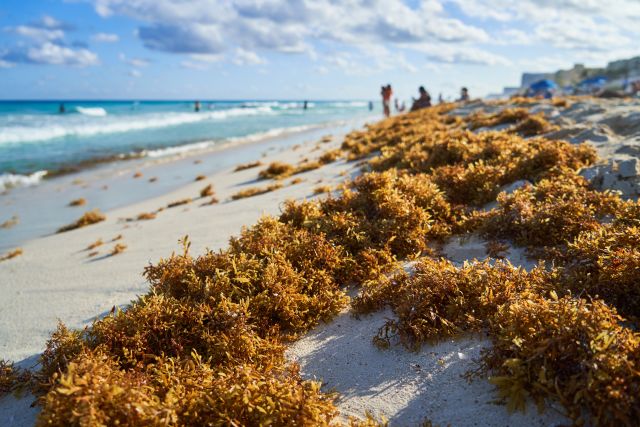
Sargassum seaweed is washing ashore across the Caribbean in unusually high quantities this summer. Data released by the University of South Florida shows nearly every region of the Caribbean and Gulf hit record-high levels in May, and volumes are likely to increase further in June, potentially making 2026 a record year by summer. Hotel occupancy in Mexico's Quintana Roo region has dropped sharply year-on-year, and properties in the hardest-hit zones are cutting rates by up to 40%. If you know which beaches to avoid and which to book, this is actually a buyer's market.
2026 is on track to be a major sargassum year and could become a record year by summer, according to the University of South Florida.
The May 31 bulletin from USF found record-high May sargassum levels in every monitored region except the West Atlantic.
Early arrivals hit Quintana Roo in January and March, months ahead of the typical May-October season.
Hotel occupancy in Quintana Roo has dropped sharply, with early May 2026 figures significantly below 2025 levels.
Tulum and Akumal are the hardest-hit beaches, due to their open Atlantic-facing coastlines.
North Cancun and Playa Mujeres are the safest mainland options, with active daily resort cleanup crews.
Isla Mujeres' Playa Norte is consistently the cleanest beach near Cancun, largely protected by geography.
Sargassum is a type of brown seaweed that floats in large mats across the Atlantic and Caribbean. In normal amounts, it plays an important role in the ocean, creating habitat for fish, turtles, and other marine life. The problem starts when massive blooms wash ashore, pile up on beaches, and begin to rot in the heat. That’s when it becomes a travel issue, with brown water, strong odors, beach closures, and cleanup crews working before most guests have even had their first coffee.
Image Courtesy of NOAA
The May 31 bulletin from the University of South Florida’s Optical Oceanography Lab shows why 2026 is getting so much attention. It found record-high May sargassum levels in most monitored regions, with blooms expected to increase in June and beaching events likely to continue around the Caribbean and southeast Florida.
The authors also make an important point: this is a regional outlook, not a beach-by-beach forecast. That’s exactly why geography matters so much when choosing where to stay.
Historically, peak sargassum season runs May through October. But 2026 is tracking differently. Early beaching events in January and March have already shifted what "low season" means this year. The usual advice to visit in spring to avoid sargassum no longer holds the way it once did.
In 2025, over 76,000 tons of sargassum were collected across Quintana Roo by October, with Cancun alone removing more than 13,000 tons, nearly four times the previous year. The total Atlantic sargassum reached 40% above the previous June 2022 peak, and the 2025 seed population remained historically strong through winter, setting up a larger 2026 bloom.
Sargassum has gone from a nuisance to a structural threat for Caribbean tourism. Rising sargassum levels are linked to climate change and nutrient pollution, prompting local authorities to deploy containment measures, but long-term risks to tourism remain. The state of Quintana Roo has significantly upgraded its response for 2026, deploying Mexican Navy vessels for collection and increasing spending on barriers, but the scale of the bloom is outpacing cleanup capacity.
Geography matters enormously here, and this is the detail most general coverage misses. Tulum is consistently the worst-hit, with an open-facing coastline that catches the full brunt of Atlantic currents. Akumal is frequently impacted due to its southerly location. Playa del Carmen faces moderate risk, with busy cleanup operations keeping beaches manageable most days. Cozumel's eastern side faces heavy arrivals, while its western leeward side is much cleaner.
Playa Norte on Isla Mujeres and Cozumel's west coast are the most consistently protected beaches near Cancun, as both face away from Atlantic currents. North Cancun and Playa Mujeres are the safest mainland options. If you've already booked a resort in a higher-risk zone, don't panic. Cancun's Hotel Zone runs one of the most aggressive daily cleanup operations in the region, with crews clearing beaches before dawn. What you see in photos at 8am often looks very different from the conditions at noon.
Still, beach conditions can change quickly. Regional sargassum bulletins show broad bloom patterns across the Caribbean and Gulf, but wind, currents, resort cleanup, shoreline shape, and local geography all matter. This is not the year to book on vibes alone. Check recent traveler photos, live beach webcams, and resort updates before you lock anything in.
A bad sargassum day doesn’t have to ruin a trip. The Caribbean has some genuinely sargassum-proof alternatives within easy reach, especially in the Mexican Caribbean.
Cenotes, the freshwater sinkholes that dot the Yucatan Peninsula, are completely unaffected and often more memorable than a beach day anyway. Day trips to Isla Mujeres typically include a catamaran ride, lunch, and time near Playa Norte, where the water is usually much clearer. Resort pool day passes can run around $45 to $85 at many all-inclusive properties in Cancun, giving you access to swim-up bars, loungers, restaurants, and pools without setting foot on the beach.
Good backup ideas include:
Cenote swimming near Tulum, Valladolid, or Playa del Carmen
A catamaran trip to Isla Mujeres
A day trip to Chichén Itzá or Coba
Snorkeling on Cozumel’s west coast
A resort pool day pass
Food, shopping, and nightlife in Playa del Carmen
If you have flexibility, January through April and November through December have historically offered the best odds for clearer beaches. But 2026 has already shown that even winter and early spring are no longer guaranteed. The safer bet is to choose your resort based on geography, not just reviews, and keep a backup cenote day in your back pocket.
Here’s the upside: if you’re not fixated on lying on the beach in Tulum specifically, this may be one of the better value windows the Mexican Caribbean has seen in years.
Hotels are cutting rates to fill rooms, and some travelers are avoiding the region entirely based on dramatic sargassum photos that don’t reflect conditions at every beach. That means real deals exist, especially in Cancun’s northern Hotel Zone, Playa Mujeres, and Isla Mujeres, where conditions tend to be better.
The trick is to stop thinking of the Riviera Maya as one uniform beach destination. It isn’t. A resort in Tulum, a resort in North Cancun, and a hotel near Playa Norte can have completely different beach conditions on the same week.
For travelers who do their homework, the savings may more than compensate for the inconvenience of occasionally pivoting to a cenote or pool day. The Riviera Maya is still one of the best-value beach destinations in the Americas, and many of its biggest draws have nothing to do with the beach. The ruins, the cenotes, the underground rivers, Cozumel’s west coast, and the food scene in Playa del Carmen are all still very much in play.
Come informed, stay flexible, and don’t book the cheapest room in the worst-hit beach zone just because the discount looks tempting. Choose protected beaches, check real-time conditions, build in a non-beach backup plan, and don’t assume one ugly shoreline photo tells the whole story. For travelers who are flexible, this could be the rare travel problem that also creates a real deal opportunity.
The University of South Florida projects 2026 as a major sargassum year and possibly a record year by summer. Early arrivals were confirmed in January and March, months ahead of the typical May season. North Cancun and Playa Mujeres are among the least affected mainland areas near Cancun.
Near Cancun, Playa Norte on Isla Mujeres and Cozumel’s west coast are among the most consistently protected beach areas. North Cancun and Playa Mujeres are also safer mainland options because of their geography and active cleanup operations.
Yes, if you choose your beach carefully and book a flexible trip. Hotel prices have dropped in some areas, and sargassum conditions vary widely from beach to beach. Protected and north-facing areas can be much clearer than open-coast beaches like Tulum.
Historically, November through April offers the best chance of clear water. However, 2026 has already seen early arrivals in January and March, so no month is guaranteed. Checking live beach conditions before travel is strongly recommended.
Cenote swimming, catamaran day trips to Isla Mujeres, Chichén Itzá excursions, and resort pool day passes are all solid alternatives. Most larger resorts also run daily cleanup, often before guests wake up.
Large sargassum blooms are linked to warming waters, shifting currents, and nutrient runoff from agriculture and deforestation that can feed algae growth in the Atlantic. Volumes have increased dramatically over the last decade, and major blooms now affect tourism across much of the Caribbean.
Yes, some hotels in harder-hit areas are cutting rates to attract travelers as occupancy drops. The best value is likely in areas where beach conditions are less severe but prices are still being affected by broader regional concern.