
We use cookies to enhance your browsing experience, serve personalized content, and analyze our traffic. By clicking "Accept All" you accept this and consent that we share this information with third parties and that your data may be processed in the USA. For more information, please read our .
You can adjust your preferences at any time. If you deny, we will use only the essential cookies and unfortunately, you will not receive any personalized content.
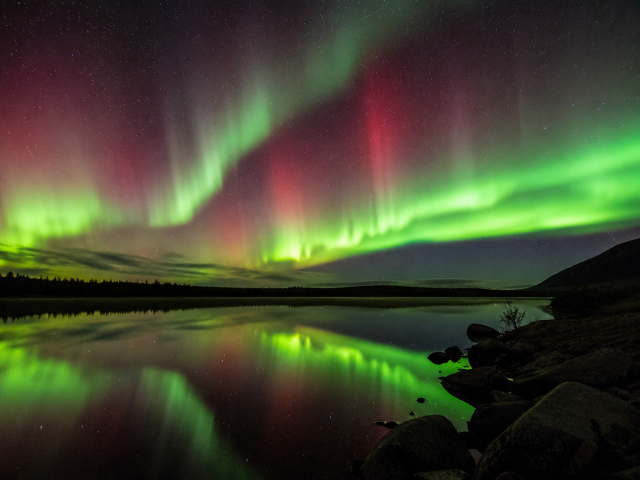
A coronal mass ejection that left the sun on Saturday, June 6, is reaching Earth today, and NOAA is forecasting G1 to G3 geomagnetic storm conditions through Monday night and into Tuesday morning. Under G3 conditions, the aurora could be visible across parts of 20 states, possibly reaching as far south as Illinois and Oregon. So if you missed last week’s show, you may get another chance tonight. Check your northern horizon, get away from city lights if you can, and don’t forget that your phone camera may pick up color your eyes can’t see.
Storm level: G1 to G3, with isolated strong G3 periods possible
Peak window: Tonight, June 8, through early Tuesday, June 9
Viewing states: Up to 20, including Illinois, Oregon, and parts of the Northeast
Best viewing time: Around 10 p.m. to 2 a.m. local time
Moon phase: Waning crescent, rising close to dawn, so moonlight should not be much of an issue tonight
Under G2 conditions, the northern lights may be visible from the northern parts of Washington, Idaho, Montana, North Dakota, South Dakota, Minnesota, Wisconsin, Michigan, and Maine. States a little farther south, including Oregon, Wyoming, Nebraska, Iowa, Illinois, Indiana, Ohio, Pennsylvania, New York, Vermont, and New Hampshire, are also in play.
If the storm strengthens to G3, the viewing line could drop even farther. That means dark-sky observers in Kansas, Missouri, Kentucky, West Virginia, Virginia, and Maryland may have a chance to catch a faint glow on the northern horizon. Altogether, that puts roughly 20 states in the “worth checking” zone tonight, with even more possible if conditions overperform.
As always with the aurora, forecasts can change quickly. NOAA’s 30-minute aurora forecast and apps like SpaceWeatherLive are your best bet for real-time updates once the storm gets going.
Image Credit: NOAA Space Weather Prediction Center
NOAA rates geomagnetic storms on a scale from G1, or minor, to G5, or extreme. G3 is where things start to get genuinely interesting. It is strong enough to push the aurora well south of its usual far-northern range, which is why tonight is worth paying attention to if you live anywhere near the viewing line.
The thing to watch tonight is the Bz component of the solar wind. When Bz turns south and stays there, solar energy can enter Earth’s magnetosphere more easily, and aurora activity can ramp up fast.
Most aurora apps and SpaceWeatherLive show the Bz reading in real time. If you see it dip to around −5 nT or stronger, that is your cue to head outside, look north, and give your phone camera a chance to pick up what your eyes might miss.
NOAA recommends the 10 p.m. to 2 a.m. window as the prime viewing time, when geomagnetic activity tends to peak. The good news about tonight: the moon is a waning crescent that rises close to dawn, so it won't wash out fainter displays earlier in the evening. That's a meaningful improvement over last week's waning gibbous situation.
Get as far from city lights as you reasonably can. A state park, a dark hillside, or even a rural road with a clear northern horizon will all give you a much better view than anywhere near a downtown. Give your eyes 10 to 15 minutes to adjust before you decide nothing's happening.
If you’re newer to aurora chasing, green is the color you’re most likely to see. It comes from oxygen roughly 60 to 150 miles above Earth and shows up in most moderate geomagnetic storms.
Red auroras happen higher in the atmosphere, usually above 150 miles, and are more likely during stronger G3 or G4 events. Blue and purple come from nitrogen, which is why they can show up as extra color along the edges or lower parts of a stronger display.
One trick worth knowing: your phone camera will almost always capture more color than your eyes can. Switch to night mode or a long-exposure setting, point it north, and take a few shots. Even from suburban areas, you may be surprised by what appears on the screen.
Late spring aurora chasing comes with one built-in challenge: nights are short. With the summer solstice two weeks away, darkness arrives late and doesn't last long, which compresses your viewing window. That said, a strong enough storm doesn't care about the calendar. The waning crescent moon tonight actually helps, and if conditions reach G3 or above, earlier evening hours could still produce something worth seeing.
Solar activity is expected to stay elevated through the rest of 2026, but the current solar maximum won't last forever. The sun will eventually wind down toward its quieter phase, and nights like this will get harder to catch. Tonight is a reasonable excuse to step outside and look north.
NOAA forecasts aurora visibility across up to 20 states, including Minnesota, Wisconsin, Michigan, New York, Illinois, Oregon, and surrounding areas, with potential sightings farther south under G3 conditions.
The prime window is 10 p.m. to 2 a.m. local time on Monday, June 8, through Tuesday, June 9, when geomagnetic activity is typically strongest.
A coronal mass ejection launched from the sun on June 6 is arriving at Earth today, triggering G1 to G3 geomagnetic storm conditions.
NOAA forecasts periods of Kp 7 on Monday, which is the threshold for aurora displays visible across roughly 20 U.S. states.
No — the waning crescent moon rises near dawn, leaving most of the night dark and favorable for viewing.
No. Your eyes are enough during a moderate or strong storm. A smartphone in night or long-exposure mode will often pick up more color than you can see directly.
Under G3 conditions, the aurora has been seen as far south as Illinois in the Midwest and Oregon on the West Coast, with isolated G4 activity potentially pushing it even farther.