We use cookies to enhance your browsing experience, serve personalized content, and analyze our traffic. By clicking "Accept All" you accept this and consent that we share this information with third parties and that your data may be processed in the USA. For more information, please read our .
You can adjust your preferences at any time. If you deny, we will use only the essential cookies and unfortunately, you will not receive any personalized content.

A rare convergence of three coronal mass ejections is arriving at Earth today, and NOAA is forecasting a G3 strong geomagnetic storm with potential G4 severe conditions tonight through Friday. This is the kind of event that can push the northern lights well below their usual far-northern viewing zones, and right now, tens of millions of Americans are in the viewing zone. If you’ve been hoping to see the aurora, this may be your chance.
NOAA’s Space Weather Prediction Center has issued a G3 strong geomagnetic storm watch, with isolated periods that could reach G4 severe levels. Translation: the northern lights may be visible much farther south than usual, with parts of 23 states across the Northeast, Midwest, and West currently in the possible viewing zone.
The forecast shows auroras could stretch across many northern states, from the Northeast through the Midwest and out toward Oregon. And if conditions do hit G4 levels, the display could push even farther south. During past severe geomagnetic storms, the northern lights have been reported as far south as Alabama and Northern California.
The reason? A pileup of solar activity. Multiple coronal mass ejections, or CMEs, left the sun on June 2. These are massive bursts of plasma and magnetic energy from the sun’s surface, and in this case, three of them may arrive at Earth around the same time because the fastest one is expected to catch up with the first two.
In short: the sun is piling on, and that is very good news for aurora hunters.
Image Credit: NOAA Space Weather Prediction Center
NOAA rates geomagnetic storms on a scale from G1 to G5. G1 is minor, usually producing subtle aurora activity mostly at far northern latitudes. G5 is the extreme end, the kind of event that can turn skies red much farther south and keep space weather scientists talking for years. A G3 sits firmly in “maybe plan your evening around this” territory.
At G3 levels, there can be some minor effects on technology, including voltage corrections on power systems, satellite navigation issues, and low-frequency radio problems. For most travelers and skywatchers, though, the main effect is much more fun: a real chance at a more spectacular night sky than usual.
The sun entered solar maximum in 2024, the most active peak of its 11-year solar cycle, and that has helped push northern lights sightings much farther south than usual. We’re still riding that wave, and tonight’s triple-CME event is one of the more notable aurora chances of the year so far.
Timing matters almost as much as location. NOAA says the best aurora viewing is usually within an hour or two of midnight, roughly between 10 p.m. and 2 a.m. local time, when activity tends to be strongest.
Location matters too. The farther you can get from city lights, the better. A dark hillside, a state park, or even a rural road with a clear view to the north will give you a much better shot than standing under a streetlight and hoping for magic.
One caveat: a bright waning gibbous moon rising after midnight could make fainter auroras harder to see. Try watching earlier in the evening if possible, and give your eyes at least 10 to 15 minutes to adjust before you give up.
Most people picture the northern lights as green, and most of the time, they are. But aurora colors depend on which atmospheric gases the charged solar particles collide with, and how high up those collisions happen.
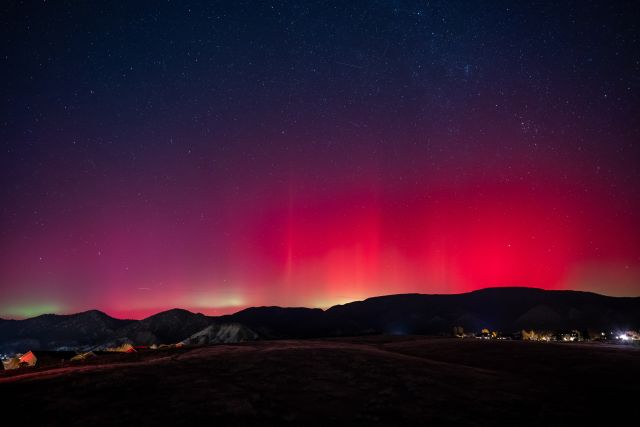
Green comes from oxygen roughly 60 to 150 miles above Earth, which is the most common aurora-producing interaction. Red auroras happen higher up, usually above 150 miles, and tend to show up during stronger storms. Blue and purple hues come from nitrogen.
So yes, green is the classic. But if this storm reaches G4 intensity, red skies are very much on the table.
One more tip: your phone camera may pick up colors your eyes miss. Point it north, use a long-exposure or night mode setting, and you may be surprised by what shows up, even from suburban areas.
Late spring is not usually ideal for northern lights viewing, mostly because sunsets are later and the window of true darkness is shorter. But when a geomagnetic storm becomes strong enough, the aurora can still put on a serious show, sometimes even reaching as far south as Florida. Tonight’s storm is the kind worth watching.
And this may not be the last surprise of the year. Solar activity is expected to stay elevated through 2026, which means more colorful geomagnetic storms could still be ahead. But the current solar maximum will not last forever. Eventually, the sun will start winding down toward its next quieter phase, and nights like this will become harder to catch.
For now, though, step outside tonight. Look north. Give your eyes a minute. The sky might have something amazing for you.
NOAA forecasts the aurora could be visible across 23 states in the Northeast, Midwest, and West, with isolated periods of G4 storm activity possible.
NOAA recommends between 10 p.m. and 2 a.m. local time as the prime window, when aurora activity is at its peak.
Three separate coronal mass ejections left the sun on June 2 and are expected to arrive at Earth simultaneously, triggering a G3 or G4 geomagnetic storm.
No. The naked eye is enough during a strong storm. A smartphone camera on night mode or long exposure will often capture more color than you can see directly.
Under G4 geomagnetic storm conditions, the northern lights have previously been seen as far south as Alabama and Northern California.
A bright waning gibbous moon rising after midnight could interfere with fainter displays, so earlier in the evening is preferable.
Possibly during a strong storm, though you'll see far more from a dark location. Move away from downtown, head to a park or elevated spot, and look north.