We use cookies to enhance your browsing experience, serve personalized content, and analyze our traffic. By clicking "Accept All" you accept this and consent that we share this information with third parties and that your data may be processed in the USA. For more information, please read our .
You can adjust your preferences at any time. If you deny, we will use only the essential cookies and unfortunately, you will not receive any personalized content.

Morocco has been building toward this moment for the past few years, and Kayak’s 2026 search data suggests it has finally broken through. The country ranks among the top trending international destinations for US travelers this summer, with Casablanca accounting for 58% of Morocco-related flight searches and Marrakech drawing 34%. Nonstop flights are available from New York, Boston, Miami, Washington, DC, and Los Angeles, making the country easier to reach than many travelers realize. With summer fares still coming in below many comparable routes to Western Europe, Morocco is becoming an increasingly appealing option for travelers who want a major international trip without paying Paris or Rome prices.
Morocco is confirmed as one of the top trending international summer destinations for US travelers per Kayak search data published June 2026
Casablanca gets 58% of Morocco-related flight searches from the US, with Marrakech at 34% and Rabat at 4%
Direct flights to Morocco exist from New York, Boston, Miami, and Washington DC, operated primarily by Royal Air Maroc and American Airlines; LAX also has nonstop options via American and Royal Air Maroc
Round-trip fares from New York to Casablanca have been found as low as $579 this summer, below the cost of most comparable Europe summer fares
No visa is required for US citizens to enter Morocco for trips under 90 days
Average summer temperatures in Marrakech run around 100°F in July, making early morning and evening the most comfortable times for outdoor exploration
Morocco has direct rail connections between its major cities: Casablanca to Marrakech takes about 3 hours on the ONCF national rail network
Morocco is trending this summer for a pretty simple reason: it offers much of what travelers love about Europe, including history, food, architecture, markets, coastline, and culture, often at a lower overall cost. It is also closer than many Americans realize, especially from the East Coast, and feels genuinely different from the usual Western European itinerary. Kayak’s 2026 travel data points to experience-led trips as a major driver of interest, with culturally rich destinations gaining ground across the platform. Marrakech made that list alongside Okinawa and the Swiss Alps, which says a lot about how travelers are viewing it. Morocco is not a fallback for people priced out of Europe. It is becoming a first-choice destination in its own right.
Royal Air Maroc’s expanding US network has also made the country much easier to reach. With more nonstop options from major American cities, Morocco no longer feels like a complicated long-haul trip that requires multiple connections. It now has the kind of access that supports real mainstream demand.
Most American travelers arrive in Morocco through Casablanca’s Mohammed V International Airport, which handles much of the country’s transatlantic traffic. Casablanca is a large, modern coastal city and worth giving at least a day or two. The Hassan II Mosque is one of the largest in the world, set dramatically on the Atlantic, while the city’s old medina is smaller and less overwhelming than Marrakech’s, making it a gentler introduction before heading south.
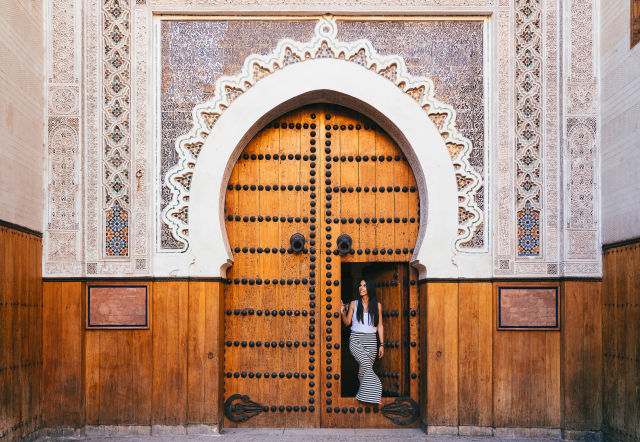
Marrakech, though, is the place most travelers are coming to see. At its heart is Jemaa el-Fna, the city’s famous main square, which transforms throughout the day from a bustling marketplace into an open-air stage filled with storytellers, musicians, food stalls, and street performers. The souks behind it are organized by trade and can easily absorb hours of wandering, while the Bahia Palace, Saadian Tombs, and Majorelle Garden are all genuinely worth the time. Trains between Casablanca and Marrakech run frequently, and the journey takes around three hours.
July is the hottest month in Marrakech, with average highs hovering around 100°F and very little cloud cover. The heat is intense, so it helps to plan your day around it. Head out early and do most of your sightseeing before 11am, take a long break over lunch in a shaded riad or hammam, then return to the medina after 5pm when the temperature starts to ease. The evenings are often the best part of the day, so don’t waste them indoors.
Riads, traditional Moroccan courtyard homes that have been converted into guesthouses, are one of the best places to stay in Marrakech. Their thick walls and central courtyards are naturally suited to the heat, and many also have rooftop terraces where you can unwind after sunset. Prices vary, but a comfortable mid-range riad often costs far less than a comparable boutique hotel in Paris or Barcelona.
US passport holders can visit Morocco for up to 90 days without a visa. Travelers may be asked to show a return or onward ticket, and normal precautions apply in busy markets and crowded public spaces. Tap water is generally not recommended for visitors in Marrakech, but bottled water is inexpensive and easy to find.
Morocco’s appeal goes far beyond Casablanca and Marrakech. The Atlas Mountains begin about an hour south of Marrakech, with everything from easy day hikes through scenic valleys to multi-day treks past Amazigh villages. The Ourika Valley is one of the simplest day trips from the city, while the route toward Mount Toubkal offers a more adventurous option for travelers who want to spend longer in the mountains.
The dunes at Merzouga, near the Algerian border, take more effort to reach, but they are also one of the most memorable experiences in Morocco. The journey from Marrakech usually takes around two days, and most travelers pair it with a night in a desert camp under a sky almost completely free of light pollution. It is the kind of place that does not need much selling.
On the Atlantic coast, Essaouira is a relaxed walled city about three hours from Marrakech by road, known for its fishing port, walkable medina, and steady coastal winds. Those winds make it especially popular with kitesurfers, but they also offer welcome relief from the inland heat. Farther south, Agadir is Morocco’s main beach resort city, with plenty of hotels and an easy tourism setup, though it feels more polished and less distinctive than some of the country’s other coastal stops.
Morocco has spent years improving its tourism infrastructure, expanding its flight connections, and making itself easier for international travelers to navigate. Summer 2026 feels like the moment when all of that work is finally paying off. Fares can still compare favorably with many European destinations, the trip feels genuinely different from the usual American travel circuit, and the country offers enough variety to fill far more than a long weekend, from the medinas of Marrakech and the streets of Casablanca to the Atlas Mountains, Atlantic coast, and Sahara.
What the search data really shows is that travelers are not just looking for somewhere cheaper. They are looking for somewhere that feels exciting, memorable, and worth the effort, and Morocco delivers on all three. Marrakech in particular is the kind of place that stays with you, not because every moment is easy or polished, but because the experience feels vivid and completely its own. It is the sort of trip people come home from with stories they are still telling years later.
No. US passport holders can enter Morocco for up to 90 days without a visa. You'll need a valid passport, a return or onward ticket, and evidence of planned departure.
Direct flights to Casablanca are available from New York (JFK), Boston (BOS), Miami (MIA), Washington DC (IAD), and Los Angeles (LAX). Royal Air Maroc and American Airlines are the primary carriers.
Based on Kayak data, October is historically the cheapest month for US to Morocco flights. July fares are higher but round-trip prices from New York have been found as low as $579 this summer, below comparable Europe routes.
Most first-time visitors to Morocco anchor in Marrakech, which offers the most concentrated access to the medina, souks, palaces, gardens, and the Djemaa el-Fna square. Casablanca makes sense as a landing point given the airport, but it's a different — and less immediately striking — city.
Marrakech averages around 100°F in July with strong sun and minimal cloud cover. Morning and evening exploration is significantly more comfortable. Riads and traditional courtyard guesthouses are designed for this heat and are the right accommodation choice.
The ONCF national rail network runs regular trains between the two cities, with the journey taking approximately three hours. Tickets are affordable and the train is the most comfortable option.
The Atlas Mountains are accessible as a day trip from Marrakech. The Saharan dunes at Merzouga are worth the two-day journey for a desert camp experience. Essaouira on the Atlantic coast is about three hours by road and offers a different, coastal medina atmosphere.