We use cookies to enhance your browsing experience, serve personalized content, and analyze our traffic. By clicking "Accept All" you accept this and consent that we share this information with third parties and that your data may be processed in the USA. For more information, please read our .
You can adjust your preferences at any time. If you deny, we will use only the essential cookies and unfortunately, you will not receive any personalized content.

Europe's new biometric border system was supposed to modernize travel. Instead, it's producing four-hour lines at Paris CDG, missed flights, and stranded passengers across the Schengen Area. Now a senior EU official has admitted it could take up to two years to stabilize. Here's what that means if you're flying to Europe this summer.
Up to four-hour waits have been reported at Paris CDG and Geneva, with three-hour delays at Vienna, Brussels, Madrid, Barcelona, and Palma
All non-EU travelers, including Americans, Brits, Canadians, and Australians, must provide fingerprints and a facial scan at every Schengen border crossing
29 Schengen countries are covered since the full rollout on April 10, 2026
One to two years is how long a senior Frontex official says the system could take to fully stabilize
Missed connections are the biggest risk, since airlines aren't liable for delays caused by border processing
First-time visitors take longest, because biometric enrollment only happens once, but that initial queue is the worst of it
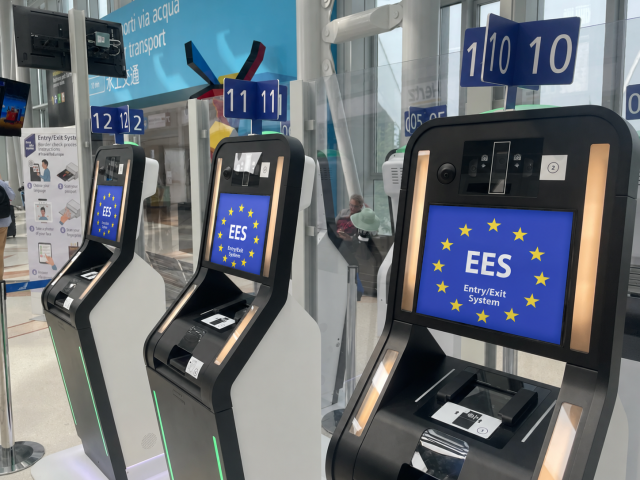
The EES is a new digital border control system that replaces traditional passport stamping with a secure process that records biometric data, entry dates, exit dates, and refusals of entry. In plain terms, that means fingerprints and a facial image, collected at the border when you enter or exit the Schengen Area as a non-EU national.
For Americans, the important part is simple: if you’re entering or leaving the Schengen Area for a short stay, you should expect biometric registration at the border, especially if it’s your first crossing since the system became fully operational. Every time you enter or leave the Schengen Area, the system digitally records that movement instead of relying on an old-fashioned passport stamp.
On your first crossing, expect to have your fingerprints taken, usually four fingers, and your photo captured. After that initial registration, future entries should move faster since your data is already in the system.
Here’s what the system covers at a glance:
Your passport details, name, date of birth, nationality, and gender
Fingerprints and a facial image
Children under 12 are exempt from fingerprinting but still need to register and provide a photo
Entry and exit dates, tracked digitally rather than stamped
Records of any refusals of entry
Short-stay visits of up to 90 days within a 180-day period
29 European countries, including France, Spain, Italy, Germany, Portugal, Greece, the Netherlands, Austria, Belgium, and Switzerland
Notably, Ireland and Cyprus are not currently part of the EES. Travelers’ passports are still being manually stamped in those two countries, so if you’re routing through Dublin or Nicosia, that part of your trip works differently. That said, if you're continuing on into the Schengen Area afterward, you'll hit EES enrollment at your first participating border crossing.
Here’s the part travelers really need to pay attention to: Uku Särekanno, a deputy executive director at Frontex, the agency that helps manage the EU’s external borders, warned that the new system could take one to two years to fully stabilize. He also called first-time biometric enrollment “probably the most challenging part” of the rollout, which tracks with what travelers are already seeing on the ground.
The other problem is that not every country is handling this the same way. Some have added enough staff and resources to keep things moving. Others are still clearly struggling. That patchwork approach means your experience can look very different depending on where you land, connect, or leave Europe.
And there doesn’t seem to be a big pressure valve coming for the summer rush. Countries had some ability to ease EES checks during especially busy periods, but there are no plans to extend that flexibility. In plain English: the summer crowds are coming, the lines are real, and travelers shouldn’t count on the system magically smoothing itself out before their trip.
ABTA chief executive Mark Tanzer called the two-year warning “very painful.” Honestly, that about covers it.
According to live line data, the most impacted airports have been Paris CDG and Geneva, with both seeing waits of up to four hours. Three-hour delays have also been reported at Vienna, Brussels, Madrid, Barcelona, and Palma.
That’s not exactly a niche list. It includes some of the biggest transatlantic gateways and some of the most popular summer destinations for US travelers. If your Europe trip touches any of these airports, whether you’re arriving, connecting, or flying home, you need to build extra time into the plan.
Airlines, airports, and major industry groups, including ACI Europe, Airlines for Europe, and IATA, have released a joint letter citing “critical issues” with the ongoing delays. That tells you the aviation industry is taking this seriously. Unfortunately, it doesn’t make the airport line move any faster this summer.
The missed-connection issue is what’s catching people most off guard. A lot of transatlantic routes funnel through major European hubs, where travelers have to clear passport control before catching their next flight. Under EES, that process can take a lot longer, which means the connection time you thought was fine may suddenly look way too tight.
Here’s the frustrating part: if your flight from New York lands on time and you spend 90 minutes in a biometric line before missing your connection to Rome, that delay is usually not treated like an airline problem. EU compensation rules cover airline-caused delays, not border processing delays. If everything is on one ticket, your airline should rebook you on the next available flight, but you may still lose hours, a hotel night, or part of your trip. If you booked separate tickets, it gets much worse, because you could be stuck buying a new fare at last-minute prices.
That’s why travel insurance with missed connection coverage is one of the smartest protections right now. It’s not glamorous, but neither is watching your onward flight leave while you’re still waiting for a fingerprint scanner.
Part of what makes this so annoying is that Europe isn’t handling the rollout in one clean, consistent way. In May, French police temporarily suspended the extra checks at the port of Dover, while Greece initially suggested it would pause biometric checks for British travelers until September. Then the Greek foreign ministry later said it had no information that specific nationalities were exempt.
That kind of back-and-forth is exactly what Frontex has been warning about. The agency has called for a more coherent approach to border procedures, because the current patchwork makes an already slow process even harder to predict.
Frontex has also flagged another problem: some travelers are being asked to submit fingerprints again after their first visit, even though that’s not required under EES policy. That adds extra time to a process that doesn’t exactly need help becoming slower.
For US travelers, the takeaway is simple. Don’t assume your arrival airport has this running smoothly just because another airport does. Check current conditions before you travel, build in extra time, and please do not plan your summer Europe itinerary around the best-case scenario.
Allow at least two to three hours for connections at major hubs, and more during peak summer travel periods
Check your existing itinerary now, especially if you have a layover under 90 minutes at CDG, Schiphol, Geneva, or any other high-volume airport
Book on a single ticket wherever possible so rebooking protection applies if you miss a connection
Have your passport ready before you reach the checkpoint and follow biometric instructions carefully, because having to repeat the process costs time you don't have
Add travel insurance with trip interruption and missed connection coverage before departure
Arrive earlier than usual on departure days, since EES exit processing adds time at your last Schengen airport too
The situation will improve. Frontex is hoping for meaningful progress by September, and repeat visitors won't face the same first-enrollment delays once their biometrics are in the system. But this summer, with the rollout still fresh and queues at their most unpredictable, Europe rewards travelers who plan for extra time, not ones who assume things will move the way they used to.
Europe is absolutely still worth it. Just give yourself the runway to actually get there.
The EES is a biometric border tracking system requiring all non-EU travelers, including Americans, to provide fingerprints and a facial scan when crossing Schengen borders. It became fully operational on April 10, 2026, covering 29 countries.
A senior Frontex official has warned it could take one to two years for the system to fully stabilize. Modest improvement is expected by September 2026 as countries adjust, but significant delays are likely throughout this summer.
Paris CDG and Geneva have seen waits of up to four hours. Vienna, Brussels, Madrid, Barcelona, and Palma have reported delays of around three hours. Any airport with high volumes of non-EU arrivals may be affected.
Your first visit requires full biometric enrollment, including fingerprints and a facial scan. After that, the process is faster since your data is already in the system.
If you booked a single-ticket itinerary and your first flight arrived on time, your airline should rebook you at no extra cost. If you booked separate tickets, you're responsible for any new fares. EU delay compensation rules don't cover border processing delays.
Implementation has been inconsistent across the EU. Some countries have temporarily suspended or eased checks; others are running the full process. Check your specific destination and airport before you travel, as policies continue to shift.
Yes. EES exit processing applies at your last Schengen airport before flying home. Build extra time into your departure schedule accordingly.
Book long connection times at major hubs, use single-ticket itineraries where possible, and add travel insurance with missed connection coverage before you depart.