We use cookies to enhance your browsing experience, serve personalized content, and analyze our traffic. By clicking "Accept All" you accept this and consent that we share this information with third parties and that your data may be processed in the USA. For more information, please read our .
You can adjust your preferences at any time. If you deny, we will use only the essential cookies and unfortunately, you will not receive any personalized content.

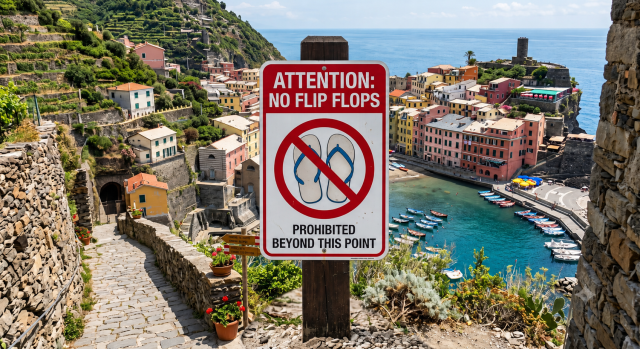
Cinque Terre is one of Italy’s most visited stretches of coastline, but its hiking trails come with stricter rules than many travelers expect. Flip-flops, smooth-soled sandals, and other shoes without proper grip are banned, with fines reaching €2,500 (about $2,900). The rule dates to 2019, after rescue crews repeatedly had to help visitors who attempted steep, rocky paths in beach shoes. In 2026, travelers also need to plan around timed entry for Via dell’Amore, changing trail prices, closures, and one-way routes on the busiest days. If you're visiting this summer, here's what the trails actually look like right now and what you need to know before you lace up.
Closed shoes with nonslip soles are required under the park’s official hiking guidance.
The trail network covers more than 75 miles, with several routes designed for experienced hikers rather than casual walkers.
The Manarola-to-Corniglia coastal route remains closed, so travelers need to use the train or a higher inland trail.
A one-day Trekking Card costs €10 (about $11), rising to €15 (about $17) on peak dates.
A one-day Train Card costs €22 to €35 (about $25 to $40), depending on expected visitor levels.
Via dell’Amore visits are limited to 30 minutes and require a reserved entry time.
La Spezia is the main gateway, with regular trains reaching the first Cinque Terre village in around 10 minutes.
The first thing to understand is that flip-flops haven’t been banned across Cinque Terre. You can still wear them through the villages, along the waterfront, and to the beach without causing an international footwear incident. The restriction begins when you leave the paved streets and enter the national park’s marked hiking network.
The park’s Hiker’s Handbook says open shoes and smooth soles are forbidden and warns that violations can be punished under Italian national park law. Reports published since the rule was introduced have placed possible fines between €50 and €2,500, or roughly $57 to $2,900. The largest amount is associated with serious situations and costly rescues, not a ranger hiding behind a lemon tree and issuing maximum fines for every visible toe.
Officials may check footwear at trail entrances and along the busiest routes. Travelers wearing unsuitable shoes can be stopped before they begin, which is considerably better than discovering halfway up several hundred stone steps that your sandals aren’t as adventurous as you thought.
The rule grew out of a very predictable problem. Visitors saw five pastel villages beside the sea, packed beach clothes, and assumed the paths between them would be gentle coastal promenades. Rescue teams then had to help people who slipped, fell, became stranded, or simply couldn’t continue in shoes designed for walking between a hotel room and the pool.
Cinque Terre looks deceptively easy in photographs. The villages are colorful, the water is bright blue, and someone is usually holding an Aperol spritz. What those photos tend to leave out are the steep mule tracks, exposed ledges, uneven rocks, and staircases that appear to have been designed by someone with a personal grudge against knees.
The national park has more than 75 miles of trails, and many are closer to mountain routes than city walks. The famous path between Vernazza and Monterosso is only around 2.3 miles long, but it includes roughly 712 feet of elevation change and takes about two hours. Expect steep stairs, rocky ground, narrow sections, and repeated climbs and descents.
The popular Blue Trail also isn’t currently one continuous coastal walk. The lower route between Manarola and Corniglia remains closed, which means anyone hoping to hike straight through all five villages will need to change the plan.
Your main alternatives are:
Take the train between Manarola and Corniglia before continuing on foot.
Use a higher inland route, which is longer, steeper, and better suited to experienced hikers.
Choose one open trail section and spend the rest of the day exploring the villages.
Trail conditions can change quickly because of heavy rain, landslides, erosion, and maintenance work. Check the park’s live trail map on the morning of your hike rather than relying on an old blog, a saved screenshot, or the extremely confident advice of someone’s cousin who visited in 2018.
The park’s official wording is stricter than simply saying “no flip-flops.” Hikers are told to wear closed, waterproof shoes that cover the ankle and have a nonslip sole. Lightweight hiking boots or supportive hiking shoes are therefore the safest choice, especially for the steeper routes around Vernazza, Monterosso, and Corniglia.
A sturdy trail sneaker may feel comfortable on easier sections, but smooth-soled fashion sneakers, backless sandals, wedges, and flimsy canvas shoes aren’t good options. Even expensive hiking sandals are still open footwear, which means they may not satisfy the park’s stated requirement. This is one of those rare moments when the sensible shoes should win the argument with the pair you packed specifically for Italian vacation photos.
Along with proper shoes, bring:
More water than you think you’ll need, particularly during the hottest part of the day.
Sunscreen and a hat, since long stretches of trail have very little shade.
A charged phone, although reception may be inconsistent in some areas.
A light layer, because exposed coastal paths can become windy.
A small snack, especially if lunch depends on reaching the next village.
There aren’t water fountains waiting conveniently around every bend. Fill your bottle before leaving the village, and don’t assume a two-mile hike will feel short when most of it appears to be heading directly upward.
The Cinque Terre Trekking Card covers the paid portions of the Blue Trail, local park buses, station restrooms, selected guided activities, and several smaller services. In 2026, a one-day adult card costs €10 (about $11) on standard dates or €15 (about $17) during high season.
The Cinque Terre Train Card adds unlimited second-class regional train travel between La Spezia, the five villages, and Levanto. Prices vary according to expected attendance rather than staying fixed throughout the season.
For a one-day adult Train Card, the 2026 rates are:
Low-attendance dates: €22 (about $25)
Medium-attendance dates: €29.50 (about $34)
High-attendance dates: €35 (about $40)
For most travelers visiting several villages in one day, the Train Card is usually the easier option. The trains aren’t merely an emergency backup for tired legs. They’re part of how people realistically travel through Cinque Terre, particularly when a route closes or when “one more hill” starts to sound like a threat.
The park can also introduce one-way hiking controls on particularly busy dates. The Monterosso-to-Vernazza section has operated only in that direction between 9 a.m. and 2 p.m. on selected holidays and high-traffic weekends. The measure prevents hikers from squeezing past each other on narrow sections where there’s barely enough room for one person and a very committed backpack.
Buying your card online can save time, but it doesn’t remove the need to check trail conditions. A valid pass won’t reopen a path closed by a landslide or weather warning. Italian bureaucracy is powerful, but it hasn’t yet learned how to negotiate with a cliff.
The reopened Via dell’Amore between Riomaggiore and Manarola is Cinque Terre’s easiest and most famous coastal walk. It’s also carefully controlled after remaining closed for more than a decade while crews completed extensive stabilization and restoration work.
Visitors must reserve a specific 30-minute entry slot. The route generally operates one-way from Riomaggiore toward Manarola, and entry numbers are limited to prevent the narrow walkway from becoming a slow-moving wall of selfie sticks.
Access requires either a Cinque Terre Card that includes Via dell’Amore or an additional ticket added to an existing card. Prices vary according to the combination selected, so check the current options before buying a standard pass and assuming everything is included.
The 30-minute slot doesn’t mean someone will chase you down the path with a stopwatch. It does mean this is now a managed attraction rather than a place to spread out a picnic, write several chapters of a travel memoir, and stay indefinitely for sunset.
Via dell’Amore is still a good option for travelers who want dramatic sea views without committing to one of the tougher mountain routes. It’s paved, relatively level, and much gentler than the trail between Vernazza and Monterosso. Reserve it before arriving if it’s a priority, since popular time slots can fill up. The Path of Love has become surprisingly serious about scheduling.
The train is the easiest way to reach and move around Cinque Terre. Regional services connect La Spezia, Riomaggiore, Manarola, Corniglia, Vernazza, Monterosso, and Levanto throughout the day. Driving between the villages is difficult, parking is limited, and the roads are winding enough to make the train feel like a personal favor from the Italian government.
La Spezia is also the usual starting point for cruise passengers visiting Cinque Terre during a port stop. Major cruise lines regularly call there, and the train ride to Riomaggiore takes around 10 minutes once you reach La Spezia Centrale. Anyone working with a limited number of hours should be realistic about how much can fit into one day.
A practical itinerary might look like this:
Start early in Monterosso and hike toward Vernazza before the trail becomes crowded.
Stop for lunch and explore Vernazza rather than immediately rushing onward.
Take the train to Manarola or Riomaggiore later in the afternoon.
Reserve Via dell’Amore separately if you plan to walk it.
Leave enough time to return to La Spezia without a dramatic sprint for your train or departing ship.
Hiking one section and visiting two or three villages is usually more enjoyable than attempting all five while checking the time every six minutes. Families and less experienced hikers may be happier choosing Via dell’Amore or shorter walks near the villages.
Experienced hikers can explore the higher ridge routes, which are usually quieter and often have even better views. Those paths also demand more fitness, more water, and shoes that have encountered a hill before.
Cinque Terre has a habit of turning “we’ll just look around” into “apparently we’re hiking up a mountain now.” Bring proper shoes even if hiking is only a possibility.
The footwear rule sounds excessive until you see what these paths actually look like. Cinque Terre’s trails are beautiful because they cling to a steep, rugged coastline that was never designed for effortless tourism. Pack the flip-flops for the beach, but bring real hiking shoes for anything involving a trail marker. Check the closures, carry water, and reserve Via dell’Amore before you arrive. It’s considerably easier than returning home with a sprained ankle and a $2,900 vacation story.
Yes, you can wear flip-flops in the villages and at the beach. They’re prohibited on the national park’s hiking trails, along with other open or smooth-soled footwear.
Possible penalties have been widely reported as ranging from €50 to €2,500, or approximately $57 to $2,900. The exact amount may depend on the circumstances and the cost or difficulty of any resulting rescue.
Open sandals aren’t permitted under the park’s published guidance. Even hiking sandals may not meet the requirement because the official rule calls for closed shoes with ankle coverage and nonslip soles.
Lightweight hiking boots or supportive hiking shoes are the safest option. Some easier routes may not require heavy boots, but your shoes should be closed and designed to grip uneven ground.
No. The coastal route between Manarola and Corniglia is currently closed. Travelers can use the train or choose a more demanding higher trail, depending on current conditions.
A one-day adult Trekking Card costs €10 (about $11) on standard dates and €15 (about $17) during high season. Two-day and three-day versions are also available.
A one-day adult Train Card costs between €22 and €35 (about $25 to $40), depending on the expected crowd level. It includes unlimited regional train travel between La Spezia and Levanto.
Yes. Visitors need a reserved entry time, and most tourists walk one-way from Riomaggiore toward Manarola. Access requires an eligible Cinque Terre Card or an additional ticket.